
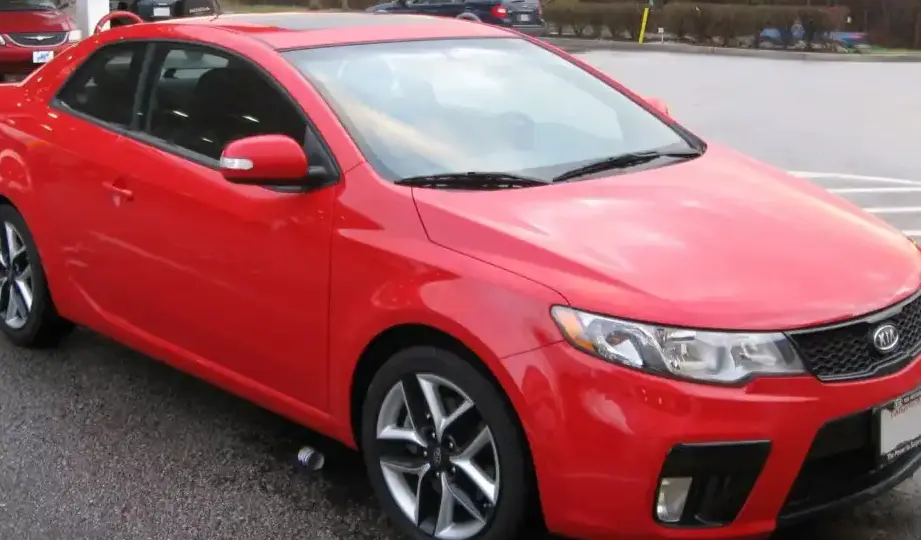
The Kia Forte Koup 2.4, produced for the 2009 and 2010 model years, represented Kia’s entry into the sporty coupe segment. Positioned as a more stylish alternative to the standard Forte sedan, the Koup offered a two-door body style aimed at a younger demographic. This particular variant, equipped with the 2.4-liter Theta II engine and a five-speed automatic transmission, served as a mid-range offering within the Koup lineup, bridging the gap between the base 2.0-liter models and potential future performance trims. It was a key model in Kia’s efforts to elevate its brand image and appeal to a broader customer base in the North American market.
Technical Specifications
| Brand | Kia |
| Model | Forte |
| Generation | Forte I Koup |
| Type (Engine) | 2.4 (165 Hp) Automatic 5-speed |
| Start of production | 2009 |
| End of production | 2010 |
| Powertrain Architecture | Internal Combustion engine |
| Body type | Coupe |
| Seats | 5 |
| Doors | 2 |
| Fuel consumption (economy) – urban (EPA) | 10.2 l/100 km (23.1 US mpg) |
| Fuel consumption (economy) – extra urban (EPA) | 7.6 l/100 km (30.9 US mpg) |
| Fuel Type | Petrol (Gasoline) |
| Emission standard | SULEV |
| Weight-to-power ratio | 7.9 kg/Hp, 126.5 Hp/tonne |
| Weight-to-torque ratio | 6 kg/Nm, 167.2 Nm/tonne |
| Power | 165 Hp @ 6000 rpm |
| Power per litre | 69.9 Hp/l |
| Torque | 218 Nm @ 4000 rpm (160.79 lb.-ft. @ 4000 rpm) |
| Engine layout | Front, Transverse |
| Engine Model/Code | Theta II / G4KE |
| Engine displacement | 2359 cm3 (143.96 cu. in.) |
| Number of cylinders | 4 |
| Engine configuration | Inline |
| Cylinder Bore | 88 mm (3.46 in.) |
| Piston Stroke | 97 mm (3.82 in.) |
| Compression ratio | 10.5:1 |
| Number of valves per cylinder | 4 |
| Fuel injection system | Multi-port manifold injection |
| Engine aspiration | Naturally aspirated engine |
| Valvetrain | DOHC, CVVT |
| Engine oil capacity | 4.3 l (4.54 US qt | 3.78 UK qt) |
| Coolant | 6 l (6.34 US qt | 5.28 UK qt) |
| Kerb Weight | 1304 kg (2874.83 lbs.) |
| Trunk (boot) space – minimum | 357 l (12.61 cu. ft.) |
| Fuel tank capacity | 52 l (13.74 US gal | 11.44 UK gal) |
| Length | 4480 mm (176.38 in.) |
| Width | 1765 mm (69.49 in.) |
| Height | 1400 mm (55.12 in.) |
| Wheelbase | 2650 mm (104.33 in.) |
| Front track | 1542 mm (60.71 in.) |
| Rear (Back) track | 1546 mm (60.87 in.) |
| Ride height (ground clearance) | 140 mm (5.51 in.) |
| Minimum turning circle (turning diameter) | 10.8 m (35.43 ft.) |
| Drivetrain Architecture | The Internal combustion engine (ICE) drives the front wheels of the vehicle. |
| Drive wheel | Front wheel drive |
| Number of gears and type of gearbox | 5 gears, automatic transmission |
| Front suspension | Independent, type McPherson with coil spring and anti-roll bar |
| Rear suspension | Transverse stabilizer, Coil spring, Torsion |
| Front brakes | Ventilated discs, 300 mm |
| Rear brakes | Disc, 262 mm |
| Assisting systems | ABS (Anti-lock braking system) |
| Steering type | Steering rack and pinion |
| Power steering | Hydraulic Steering |
| Tires size | 215/45 R17 |
| Wheel rims size | 7J x 17 |
The Kia Forte Koup, launched in 2009, was a significant step for Kia in the compact coupe market. Built on the same 1HX0 platform as the Forte sedan, the Koup distinguished itself with its two-door configuration and more aggressive styling. The 2.4-liter engine paired with a five-speed automatic transmission was a popular choice, offering a balance of performance and convenience. This combination aimed to attract buyers who desired a sporty look without sacrificing everyday usability. The Koup was primarily marketed towards North America, where the coupe segment held considerable appeal.
Powertrain & Engine Architecture
At the heart of the Forte Koup 2.4 lies the Theta II G4KE engine, a 2.4-liter inline-four cylinder powerplant. This engine utilizes multi-port fuel injection and a double overhead camshaft (DOHC) valvetrain with continuously variable valve timing (CVVT) on both intake and exhaust camshafts. The CVVT system optimizes engine breathing across the rev range, improving both power and fuel efficiency. The engine produces 165 horsepower at 6000 rpm and 160.79 lb-ft of torque at 4000 rpm. The five-speed automatic transmission, while providing smooth shifts, was a conventional torque converter automatic, lacking the efficiency of newer continuously variable transmissions (CVTs) or dual-clutch transmissions. Gear ratios were tuned for a balance of acceleration and highway cruising, prioritizing comfort over outright performance.
Driving Characteristics
The 2.4-liter engine and five-speed automatic combination in the Forte Koup delivered adequate, but not exhilarating, performance. Acceleration from 0 to 60 mph was estimated to be around 8.5-9 seconds. The automatic transmission, while smooth, could feel somewhat hesitant during quick acceleration, and lacked the responsiveness of a manual gearbox. The gear ratios were spaced to provide reasonable fuel economy during highway driving, but could sometimes leave the engine feeling strained during aggressive maneuvers. Compared to a manual transmission equipped Koup, the automatic version offered less driver engagement and slightly reduced fuel efficiency. It was, however, more accessible to a wider range of drivers, particularly those unfamiliar or uncomfortable with manual transmissions.
Equipment & Trim Levels
The Forte Koup 2.4 typically came standard with features such as air conditioning, power windows and locks, a CD player with MP3 compatibility, and ABS brakes. Higher trim levels offered upgrades like alloy wheels, a sunroof, keyless entry, and upgraded audio systems. Interior upholstery was typically cloth, with optional leather available on some trims. The dashboard layout was functional and straightforward, prioritizing ease of use over stylistic flair. Optional extras included a premium sound system and a navigation system, though these were less common on the Koup compared to higher-end vehicles.
Chassis & Braking
The Forte Koup utilized a McPherson strut front suspension and a torsion beam rear suspension. This setup provided a comfortable ride quality, but didn’t offer the same level of handling precision as more sophisticated independent rear suspension systems. Front brakes were ventilated discs, providing adequate stopping power, while rear brakes were solid discs. ABS was standard, enhancing braking performance in emergency situations. The Koup’s chassis was tuned for a balance of ride comfort and handling, leaning more towards the former. Stabilizer bars were included at both the front and rear to reduce body roll during cornering.
Market Reception & Comparison
Critics generally viewed the Forte Koup 2.4 as a competent, if unremarkable, entry in the compact coupe segment. It was praised for its value proposition, offering a good amount of features for its price. However, the automatic transmission was often criticized for its lack of responsiveness. Fuel economy was considered average for its class. Compared to other coupes like the Honda Civic Coupe or the Nissan Sentra Coupe, the Koup offered a more affordable price point, but lacked the same level of refinement and driving dynamics. The 2.0-liter engine variants of the Koup offered better fuel economy, while a hypothetical higher-performance trim would have provided more exciting acceleration.
Legacy
The Kia Forte Koup 2.4, while not a groundbreaking vehicle, played a role in establishing Kia as a more credible automotive brand. The Theta II engine proved to be relatively reliable, with few widespread mechanical issues reported. Today, used examples of the Koup 2.4 are readily available and generally affordable. Maintenance costs are typically low, making it an attractive option for budget-conscious buyers. While it may not offer the same level of performance or features as more modern coupes, the Koup 2.4 remains a decent and practical choice for those seeking an inexpensive and reliable two-door vehicle.
