
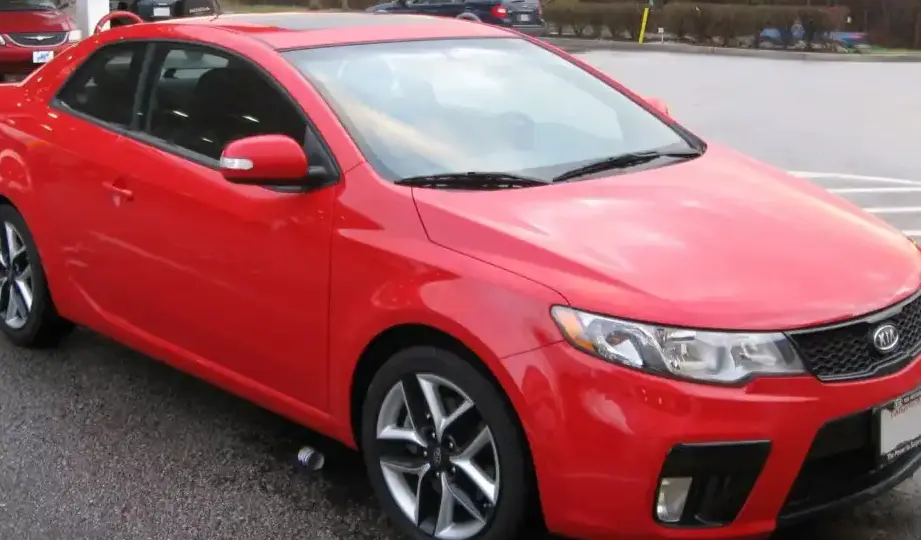
The Kia Forte Koup 2.4, produced from 2010 to 2013, represented Kia’s entry into the sporty coupe market. Positioned as a more stylish alternative to the standard Forte sedan, the Koup offered a two-door body style aimed at a younger demographic. This particular variant, equipped with the 2.4-liter Theta II engine and a six-speed automatic transmission, served as a mid-range offering within the Koup lineup, bridging the gap between the base 1.6-liter engine and potential future performance-oriented trims. It was a key model in Kia’s efforts to elevate its brand image and appeal to a broader customer base in North America and other global markets.
Technical Specifications
| Brand | Kia |
| Model | Forte |
| Generation | Forte I Koup |
| Type (Engine) | 2.4 (165 Hp) Automatic 6-speed |
| Start of production | 2010 |
| End of production | 2013 |
| Powertrain Architecture | Internal Combustion engine |
| Body type | Coupe |
| Seats | 5 |
| Doors | 2 |
| Fuel consumption (economy) – urban (EPA) | 10.2 l/100 km (23.1 US mpg) |
| Fuel consumption (economy) – extra urban (EPA) | 7.6 l/100 km (30.9 US mpg) |
| Fuel Type | Petrol (Gasoline) |
| Emission standard | SULEV |
| Weight-to-power ratio | 7.9 kg/Hp, 125.9 Hp/tonne |
| Weight-to-torque ratio | 6 kg/Nm, 166.3 Nm/tonne |
| Power | 165 Hp @ 6000 rpm |
| Power per litre | 69.9 Hp/l |
| Torque | 218 Nm @ 4000 rpm (160.79 lb.-ft. @ 4000 rpm) |
| Engine layout | Front, Transverse |
| Engine Model/Code | Theta II / G4KE |
| Engine displacement | 2359 cm3 (143.96 cu. in.) |
| Number of cylinders | 4 |
| Engine configuration | Inline |
| Cylinder Bore | 88 mm (3.46 in.) |
| Piston Stroke | 97 mm (3.82 in.) |
| Compression ratio | 10.5:1 |
| Number of valves per cylinder | 4 |
| Fuel injection system | Multi-port manifold injection |
| Engine aspiration | Naturally aspirated engine |
| Valvetrain | DOHC, CVVT |
| Engine oil capacity | 4.3 l (4.54 US qt | 3.78 UK qt) |
| Coolant | 6 l (6.34 US qt | 5.28 UK qt) |
| Kerb Weight | 1311 kg (2890.26 lbs.) |
| Trunk (boot) space – minimum | 357 l (12.61 cu. ft.) |
| Fuel tank capacity | 52 l (13.74 US gal | 11.44 UK gal) |
| Length | 4480 mm (176.38 in.) |
| Width | 1765 mm (69.49 in.) |
| Height | 1400 mm (55.12 in.) |
| Wheelbase | 2650 mm (104.33 in.) |
| Front track | 1542 mm (60.71 in.) |
| Rear (Back) track | 1546 mm (60.87 in.) |
| Ride height (ground clearance) | 140 mm (5.51 in.) |
| Minimum turning circle (turning diameter) | 10.8 m (35.43 ft.) |
| Drivetrain Architecture | The Internal combustion engine (ICE) drives the front wheels of the vehicle. |
| Drive wheel | Front wheel drive |
| Number of gears and type of gearbox | 6 gears, automatic transmission |
| Front suspension | Independent, type McPherson with coil spring and anti-roll bar |
| Rear suspension | Transverse stabilizer, Coil spring, Torsion |
| Front brakes | Ventilated discs, 300 mm |
| Rear brakes | Disc, 262 mm |
| Assisting systems | ABS (Anti-lock braking system) |
| Steering type | Steering rack and pinion |
| Power steering | Hydraulic Steering |
| Tires size | 215/45 R17 |
| Wheel rims size | 7J x 17 |
INTRODUCTION
The Kia Forte Koup, launched in 2010, was a significant step for Kia in terms of design and market positioning. Building upon the success of the Forte sedan, the Koup aimed to attract buyers seeking a more dynamic and youthful vehicle. The 2.4-liter engine paired with the six-speed automatic transmission was a popular configuration, offering a balance of performance and convenience. This model year fell within the first generation of the Forte (BD platform), and represented a noticeable improvement in build quality and features compared to previous Kia offerings. The Koup was primarily marketed towards North America, Europe, and select Asian markets.
Powertrain & Engine Architecture
At the heart of the Forte Koup 2.4 lies the Theta II G4KE engine, a 2.4-liter inline-four cylinder powerplant. This engine utilizes multi-port fuel injection and a double overhead camshaft (DOHC) valvetrain with continuously variable valve timing (CVVT) on both intake and exhaust camshafts. The CVVT system optimizes engine breathing for improved fuel efficiency and power delivery across the rev range. The engine produces 165 horsepower at 6000 rpm and 218 Nm (160.79 lb-ft) of torque at 4000 rpm. The six-speed automatic transmission, a Hyundai-developed unit, provides smooth and relatively quick shifts. While not a sport-tuned transmission, it was well-suited to the engine’s characteristics and offered a comfortable driving experience. The transmission featured a conventional torque converter and offered a manual shift mode for greater driver control.
Driving Characteristics
The 2.4-liter engine and six-speed automatic combination in the Forte Koup delivered adequate performance for everyday driving. Acceleration was respectable, though not particularly brisk, with a 0-60 mph time estimated around 8.5-9 seconds. The automatic transmission was programmed for fuel efficiency, meaning it would upshift quickly to conserve fuel. However, the manual shift mode allowed drivers to hold gears longer for more spirited driving. Compared to the base 1.6-liter engine, the 2.4-liter offered a noticeable improvement in power and responsiveness, making it more suitable for highway merging and passing maneuvers. It didn’t possess the raw power of a V6, but it provided a good balance of performance and economy. The steering was light and precise, and the suspension provided a comfortable ride, though it wasn’t particularly sporty.
Equipment & Trim Levels
The Forte Koup 2.4 typically came standard with features such as air conditioning, power windows and locks, a six-speaker audio system with USB and auxiliary inputs, and a tilt/telescoping steering wheel. Higher trim levels added features like alloy wheels, a sunroof, keyless entry, and upgraded interior materials. Interior upholstery was typically cloth, with optional leather available on higher trims. The dashboard layout was functional and straightforward, with easy-to-read gauges and controls. Optional extras included a navigation system and a premium audio system.
Chassis & Braking
The Forte Koup utilized a front-wheel-drive layout with an independent McPherson strut suspension in the front and a torsion beam rear suspension. The front suspension incorporated a stabilizer bar to reduce body roll during cornering. Braking duties were handled by ventilated discs in the front and solid discs in the rear. The braking system was equipped with ABS (Anti-lock Braking System) as standard. The Koup’s chassis was tuned for comfort rather than outright handling prowess, providing a stable and predictable ride. The relatively lightweight construction of the vehicle helped to offset the limitations of the suspension.
Market Reception & Comparison
The Kia Forte Koup 2.4 was generally well-received by automotive critics. It was praised for its stylish design, comfortable interior, and generous standard features. However, some reviewers noted that the engine could feel strained at higher speeds and that the automatic transmission wasn’t as responsive as some competitors. Compared to other coupes in its class, such as the Honda Civic Coupe and the Nissan Sentra Coupe, the Forte Koup offered a compelling value proposition, with a lower price point and a longer warranty. Fuel economy was competitive, averaging around 25 mpg in combined driving. Reliability was generally good, though some owners reported minor issues with the electrical system.
Legacy
The Kia Forte Koup 2.4, while not a groundbreaking vehicle, played an important role in Kia’s brand transformation. It demonstrated Kia’s ability to produce stylish, well-equipped, and reliable vehicles that could compete with established brands. The Theta II engine proved to be a durable and dependable powerplant, and the six-speed automatic transmission generally held up well over time. On the used car market today, the Forte Koup 2.4 remains an affordable and practical option for buyers seeking a sporty-looking coupe. Maintenance costs are relatively low, and parts availability is good. While it may not offer the performance or refinement of more expensive coupes, it provides a solid and reliable transportation solution.
