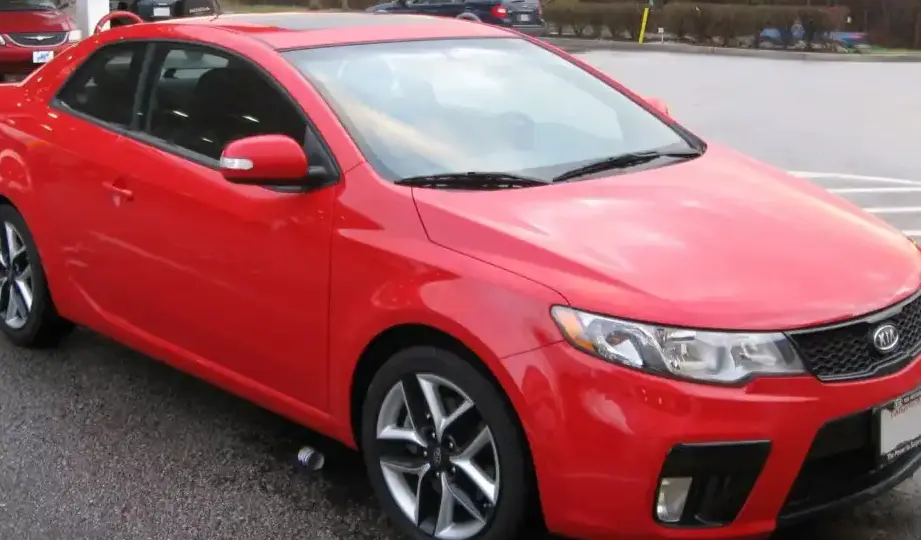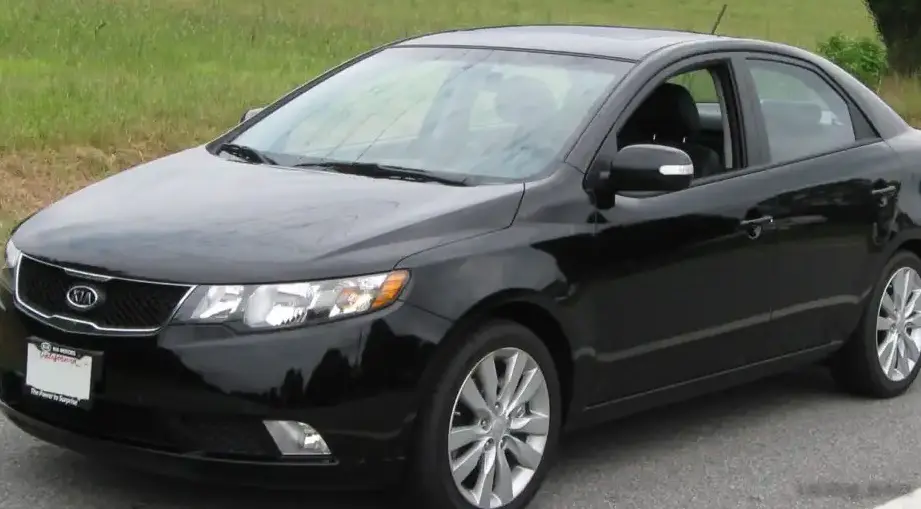
The Kia Forte, launched in 2009 as a replacement for the Spectra, represented a significant step forward for the Korean automaker in the competitive compact sedan segment. The first generation, designated TD, aimed to offer a compelling blend of style, features, and value. Within the TD range, the 2.0-liter engine paired with a four-speed automatic transmission occupied a middle ground, providing a balance between performance and fuel efficiency. Produced from 2009 through 2010, this variant was positioned as a comfortable and practical choice for buyers seeking a no-nonsense daily driver. It was a key model for Kia as they sought to establish a stronger foothold in the North American market.
Technical Specifications
| Brand | Kia |
| Model | Forte |
| Generation | Forte I (TD) |
| Type | 2.0 (156 Hp) Automatic 4-speed |
| Start of production | 2009 |
| End of production | 2010 |
| Powertrain Architecture | Internal Combustion engine |
| Body type | Sedan |
| Seats | 5 |
| Doors | 4 |
| Fuel consumption (urban) | 9.4 l/100 km (25 US mpg) |
| Fuel consumption (extra urban) | 6.9 l/100 km (34.1 US mpg) |
| Fuel Type | Petrol (Gasoline) |
| Emission standard | ULEV |
| Weight-to-power ratio | 8 kg/Hp |
| Weight-to-torque ratio | 6.4 kg/Nm |
| Power | 156 Hp @ 6200 rpm |
| Torque | 195 Nm @ 4300 rpm (143.82 lb.-ft. @ 4300 rpm) |
| Engine layout | Front, Transverse |
| Engine Model/Code | Theta II / G4KD |
| Engine displacement | 1998 cm3 (121.93 cu. in.) |
| Number of cylinders | 4 |
| Engine configuration | Inline |
| Cylinder Bore | 86 mm (3.39 in.) |
| Piston Stroke | 86 mm (3.39 in.) |
| Compression ratio | 10.5:1 |
| Number of valves per cylinder | 4 |
| Fuel injection system | Multi-port manifold injection |
| Engine aspiration | Naturally aspirated |
| Valvetrain | DOHC, CVVT |
| Engine oil capacity | 3.9 l (4.12 US qt | 3.43 UK qt) |
| Coolant capacity | 6 l (6.34 US qt | 5.28 UK qt) |
| Kerb Weight | 1243 kg (2740.35 lbs.) |
| Trunk space | 416 l (14.69 cu. ft.) |
| Fuel tank capacity | 52 l (13.74 US gal | 11.44 UK gal) |
| Length | 4530 mm (178.35 in.) |
| Width | 1775 mm (69.88 in.) |
| Height | 1460 mm (57.48 in.) |
| Wheelbase | 2650 mm (104.33 in.) |
| Front track | 1543-1557 mm (60.75 – 61.3 in.) |
| Rear track | 1550-1564 mm (61.02 – 61.57 in.) |
| Ride height | 150 mm (5.91 in.) |
| Turning circle | 10.3 m (33.79 ft.) |
| Drivetrain | Front wheel drive |
| Number of gears | 4 |
| Gearbox type | Automatic transmission |
| Front suspension | Independent, McPherson with coil spring and anti-roll bar |
| Rear suspension | Transverse stabilizer, Coil spring, Torsion |
| Front brakes | Ventilated discs, 280 mm |
| Rear brakes | Disc, 262 mm |
| Assisting systems | ABS |
| Steering type | Steering rack and pinion |
| Power steering | Hydraulic |
| Tires size | 195/65 R15; 205/55 R16 |
| Wheel rims size | 5.5J x 15; 6J x 16 |
INTRODUCTION
The 2009-2010 Kia Forte 2.0L with the four-speed automatic transmission was a crucial variant within the TD generation. It aimed to provide a comfortable and accessible entry point into the compact sedan market. Built on the 1HX0/A3 platform (shared with the Hyundai Elantra), the Forte sought to challenge established competitors like the Honda Civic and Toyota Corolla. This particular configuration was designed to appeal to buyers prioritizing ease of use and affordability over outright performance. It represented a step up from the base 1.6L engine, offering more power for highway merging and passing maneuvers.
Powertrain & Engine Architecture
At the heart of this Forte variant lies the Theta II 2.0-liter inline-four cylinder engine, internally designated G4KD. This engine featured a cast iron block and an aluminum cylinder head, a common configuration for balancing durability and weight. The engine utilized multi-port fuel injection (MPI) to deliver fuel to the cylinders, and incorporated Kia’s Continuously Variable Valve Timing (CVVT) technology on both the intake and exhaust valves. CVVT optimized engine breathing across the rev range, improving both power and fuel efficiency. The four-speed automatic transmission was a conventional torque converter type, chosen for its smoothness and relative simplicity. While not as technologically advanced as newer transmissions with more gears, it provided adequate performance for the engine’s output. The transmission’s gear ratios were tuned for comfortable cruising and acceptable acceleration, prioritizing fuel economy over sporty responsiveness.
Driving Characteristics
The 2.0-liter engine and four-speed automatic combination delivered a respectable, if not exhilarating, driving experience. With 156 horsepower and 195 lb-ft of torque, the Forte offered sufficient power for everyday driving situations. Acceleration from 0 to 60 mph was estimated to be around 9-10 seconds. The automatic transmission shifted smoothly, but lacked the responsiveness of a manual gearbox or a more modern automatic with more gears. The gear ratios were spaced to favor fuel economy, meaning the engine could feel somewhat strained during aggressive acceleration. Compared to the base 1.6L engine, the 2.0L provided noticeably more power, making highway driving and overtaking maneuvers significantly easier. However, it didn’t offer the same level of engagement as the available manual transmission or the more powerful engines found in higher trim levels.
Equipment & Trim Levels
The 2.0L automatic Forte typically came standard with features such as air conditioning, power windows and locks, a basic audio system with an auxiliary input, and anti-lock brakes (ABS). Higher trim levels, such as the EX, added features like alloy wheels, a more sophisticated audio system, cruise control, and keyless entry. Interior upholstery was typically cloth, with a straightforward and functional dashboard layout. Optional extras included a sunroof, upgraded audio systems, and various accessory packages. The overall interior design was aimed at practicality and durability rather than luxury.
Chassis & Braking
The Forte’s chassis featured an independent McPherson strut front suspension and a torsion beam rear suspension. This setup provided a comfortable ride quality, although it wasn’t particularly sporty. The front suspension included a stabilizer bar to reduce body roll during cornering. Braking duties were handled by ventilated discs at the front and solid discs at the rear. ABS was standard, providing enhanced braking control in emergency situations. The suspension tuning was geared towards providing a comfortable and compliant ride, prioritizing passenger comfort over sharp handling.
Market Reception & Comparison
Critics generally praised the 2009-2010 Kia Forte for its value proposition and improved quality compared to previous Kia models. The 2.0L automatic variant was seen as a sensible choice for buyers seeking a reliable and affordable compact sedan. Fuel economy was considered competitive for its class, with EPA estimates of 25 mpg city and 34 mpg highway. Compared to other trims, the 2.0L automatic offered a good balance between performance and fuel efficiency, but the manual transmission provided slightly better fuel economy and a more engaging driving experience. The 1.6L engine was more affordable but lacked the power of the 2.0L, while higher trim levels with more features came at a higher price point.
Legacy
The Kia Forte TD, particularly the 2.0L automatic variant, proved to be a reliable and durable vehicle. The Theta II engine, while not without its issues (some early versions experienced oil consumption problems), generally proved to be a robust powerplant. The four-speed automatic transmission is also known for its durability. Today, these Fortes can be found on the used car market at very affordable prices. They represent a good value for buyers seeking a basic and dependable transportation option. While not a performance icon, the 2.0L automatic Forte played a significant role in Kia’s rise as a mainstream automotive brand, demonstrating their commitment to quality and value.