Technical Specifications
| Brand | Kia |
| Model | Forte |
| Generation | Forte I (TD) |
| Type (Engine) | 2.0 (156 Hp) Manual 5-speed |
| Start of production | 2009 |
| End of production | 2010 |
| Powertrain Architecture | Internal Combustion engine |
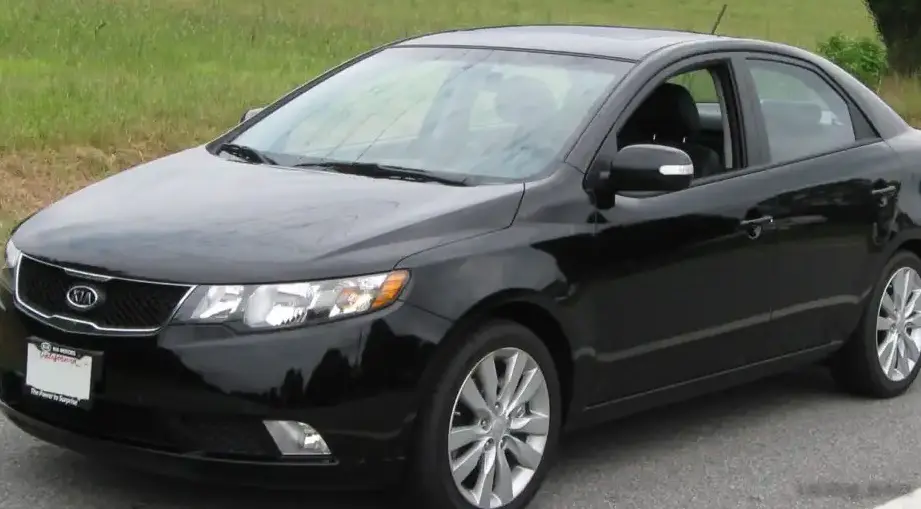
| Body type | Sedan |
| Seats | 5 |
| Doors | 4 |
| Fuel consumption (economy) – urban (EPA) | 9.4 l/100 km (25 US mpg) |
| Fuel consumption (economy) – extra urban (EPA) | 6.9 l/100 km (34.1 US mpg) |
| Fuel Type | Petrol (Gasoline) |
| Emission standard | ULEV |
| Weight-to-power ratio | 7.9 kg/Hp |
| Weight-to-torque ratio | 6.3 kg/Nm |
| Power | 156 Hp @ 6200 rpm |
| Power per litre | 78.1 Hp/l |
| Torque | 195 Nm @ 4300 rpm (143.82 lb.-ft. @ 4300 rpm) |
| Engine layout | Front, Transverse |
| Engine Model/Code | Theta II / G4KD |
| Engine displacement | 1998 cm3 (121.93 cu. in.) |
| Number of cylinders | 4 |
| Engine configuration | Inline |
| Cylinder Bore | 86 mm (3.39 in.) |
| Piston Stroke | 86 mm (3.39 in.) |
| Compression ratio | 10.5:1 |
| Number of valves per cylinder | 4 |
| Fuel injection system | Multi-port manifold injection |
| Engine aspiration | Naturally aspirated engine |
| Valvetrain | DOHC, CVVT |
| Engine oil capacity | 3.9 l (4.12 US qt | 3.43 UK qt) |
| Coolant | 6 l (6.34 US qt | 5.28 UK qt) |
| Kerb Weight | 1228 kg (2707.28 lbs.) |
| Trunk (boot) space – minimum | 416 l (14.69 cu. ft.) |
| Fuel tank capacity | 52 l (13.74 US gal | 11.44 UK gal) |
| Length | 4530 mm (178.35 in.) |
| Width | 1775 mm (69.88 in.) |
| Height | 1460 mm (57.48 in.) |
| Wheelbase | 2650 mm (104.33 in.) |
| Front track | 1543-1557 mm (60.75 – 61.3 in.) |
| Rear (Back) track | 1550-1564 mm (61.02 – 61.57 in.) |
| Ride height (ground clearance) | 150 mm (5.91 in.) |
| Minimum turning circle (turning diameter) | 10.3 m (33.79 ft.) |
| Drivetrain Architecture | The Internal combustion engine (ICE) drives the front wheels of the vehicle. |
| Drive wheel | Front wheel drive |
| Number of gears and type of gearbox | 5 gears, manual transmission |
| Front suspension | Independent, type McPherson with coil spring and anti-roll bar |
| Rear suspension | Transverse stabilizer, Coil spring, Torsion |
| Front brakes | Ventilated discs, 280 mm |
| Rear brakes | Disc, 262 mm |
| Assisting systems | ABS (Anti-lock braking system) |
| Steering type | Steering rack and pinion |
| Power steering | Hydraulic Steering |
| Tires size | 195/65 R15; 205/55 R16 |
| Wheel rims size | 5.5J x 15; 6J x 16 |
The 2009-2010 Kia Forte TD 2.0 equipped with a 5-speed manual transmission marked a pivotal moment for Kia as they aimed to reshape their brand perception. Based on the 1HX0 platform, shared with the Hyundai Elantra, the Forte sought to provide a more sophisticated and contemporary experience than its predecessor, the Spectra. This specific configuration held a desirable position within the lineup, offering a noticeable performance increase over the base 1.6-liter engine while remaining more accessible than the higher-end trims. It was designed to appeal to buyers seeking a practical, fuel-efficient sedan with a touch of driving enjoyment.
Powertrain & Engine Architecture
The core of this Forte variant is the Theta II 2.0-liter inline-four engine, identified as G4KD. This engine represented a substantial improvement over previous Kia engines, incorporating dual overhead camshafts (DOHC) and continuously variable valve timing (CVVT) on both the intake and exhaust valves. The multi-port fuel injection system precisely delivered fuel to the intake ports, maximizing combustion efficiency. The engine generated 156 horsepower at 6200 rpm and 195 Nm (143.82 lb-ft) of torque at 4300 rpm. The 5-speed manual transmission provided a direct link between the engine and the front wheels, granting the driver enhanced control. The transmission’s gear ratios were carefully calibrated for a balance of acceleration and fuel economy, featuring a relatively high fifth gear optimized for highway driving.
Driving Characteristics
The combination of the 2.0-liter engine and 5-speed manual transmission delivered a more engaging driving experience compared to the base 1.6-liter option. Acceleration was sufficient for everyday driving, with the engine exhibiting responsiveness across the rev range. The manual transmission empowered drivers to fully exploit the engine’s capabilities, offering precise gear changes and a more connected feel. While not designed as a sports sedan, the Forte 2.0 provided a level of driver involvement absent in the automatic transmission models. In comparison to the later introduction of the more potent 2.4L engine, the 2.0L offered a more balanced approach, prioritizing fuel efficiency without significantly compromising performance. The 5-speed manual also provided superior control in diverse driving conditions compared to the available 4-speed automatic.
Equipment & Trim Levels
The 2.0-liter manual Forte typically included standard features such as air conditioning, power windows and locks, a basic audio system with an auxiliary input, and ABS brakes. Higher trim levels, like the EX, added enhancements such as alloy wheels, a more sophisticated audio system, cruise control, and keyless entry. The interior upholstery was generally cloth, with a straightforward and functional dashboard layout. Optional extras encompassed a sunroof, upgraded audio systems, and various accessory packages.
Chassis & Braking
The Forte TD employed a front-wheel-drive layout with an independent McPherson strut suspension at the front and a torsion beam rear suspension. This configuration provided a comfortable ride quality, well-suited for daily commuting. The front brakes consisted of ventilated discs, offering adequate stopping power, while the rear brakes were solid discs. ABS was standard, enhancing safety by preventing wheel lockup during emergency braking. The suspension tuning prioritized comfort over sporty handling, focusing on absorbing road imperfections and maintaining a stable ride.
Market Reception & Comparison
The Kia Forte 2.0 manual received largely favorable reviews from automotive critics. It was commended for its value, spacious interior, and improved build quality compared to earlier Kia models. The 2.0-liter engine was regarded as a good compromise between performance and fuel economy. Compared to competitors like the Honda Civic and Toyota Corolla, the Forte offered a more comprehensive feature set for the price. However, some reviewers pointed out that the interior materials weren’t quite as refined as those found in Japanese competitors. Fuel economy was competitive, averaging around 25 mpg in the city and 34 mpg on the highway. The manual transmission variant was generally considered more reliable than the initial 4-speed automatic, which experienced some durability concerns.
Legacy
The Kia Forte TD 2.0 manual played a vital role in establishing Kia as a serious contender in the compact sedan market. The Theta II engine proved to be a dependable and long-lasting powerplant, with numerous examples still in operation today. While the 4-speed automatic transmission had a reputation for issues, the 5-speed manual version has demonstrated considerable robustness. In the used car market, these Fortes are often sought after for their affordability, practicality, and relatively low maintenance expenses. They represent a solid value proposition for buyers seeking a reliable and fuel-efficient compact sedan.