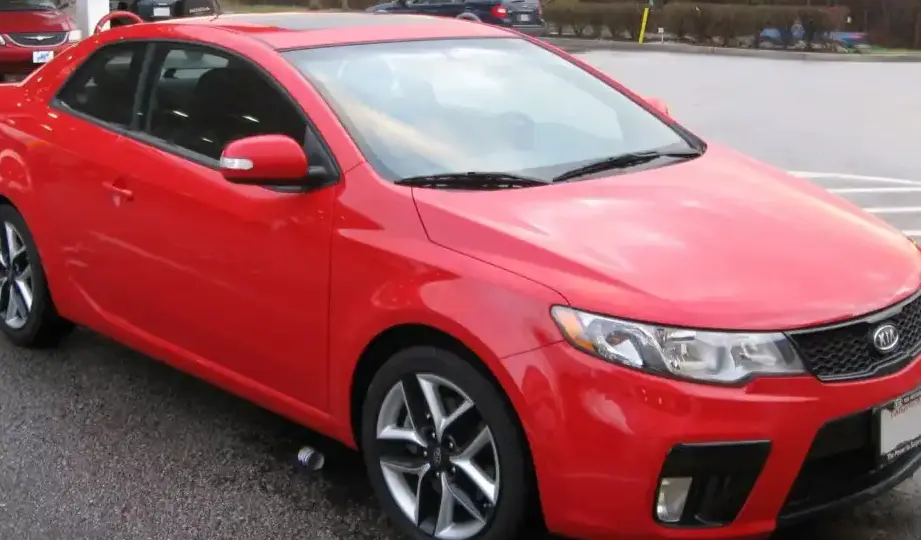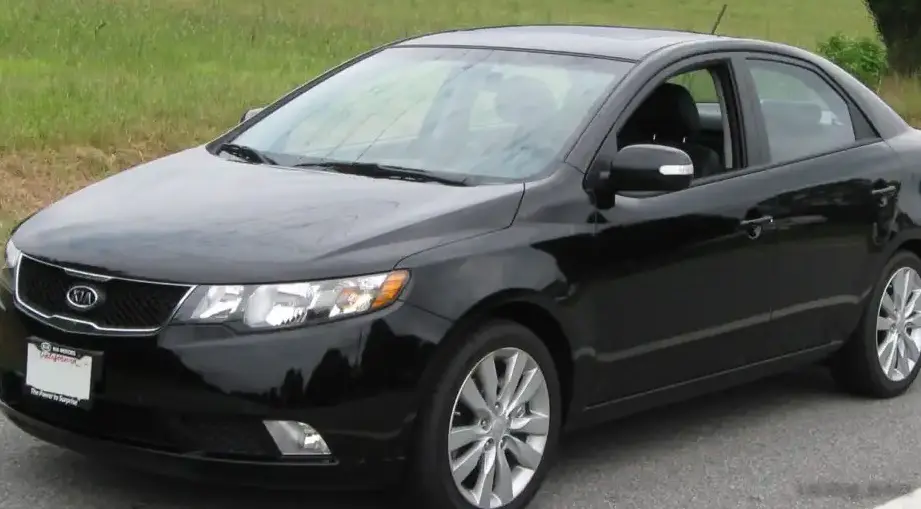
The Kia Forte, introduced in 2009, marked a significant evolution for Kia in the competitive compact sedan segment, replacing the Spectra. The first generation, known as the TD (2009-2010), aimed to deliver a compelling combination of value, fuel efficiency, and contemporary styling. Within the TD range, the 2.4-liter engine paired with a 5-speed automatic transmission occupied a mid-tier position, offering a performance upgrade over the base 2.0-liter models while remaining more accessible than any potential future performance-oriented trims. This configuration was primarily targeted at buyers seeking a comfortable, reasonably powerful, and practical daily driver.
Technical Specifications
| Brand | Kia |
| Model | Forte |
| Generation | Forte I (TD) |
| Type | 2.4 (165 Hp) Automatic 5-speed |
| Start of production | 2009 |
| End of production | 2010 |
| Powertrain Architecture | Internal Combustion engine |
| Body type | Sedan |
| Seats | 5 |
| Doors | 4 |
| Fuel consumption (urban) | 10.2 l/100 km (23.1 US mpg) |
| Fuel consumption (extra urban) | 7.6 l/100 km (30.9 US mpg) |
| Fuel Type | Petrol (Gasoline) |
| Emission standard | SULEV |
| Weight-to-power ratio | 7.9 kg/Hp |
| Weight-to-torque ratio | 6 kg/Nm |
| Power | 165 Hp @ 6000 rpm |
| Power per litre | 69.9 Hp/l |
| Torque | 218 Nm @ 4000 rpm (160.79 lb.-ft. @ 4000 rpm) |
| Engine layout | Front, Transverse |
| Engine Model/Code | Theta II / G4KE |
| Engine displacement | 2359 cm3 (143.96 cu. in.) |
| Number of cylinders | 4 |
| Engine configuration | Inline |
| Cylinder Bore | 88 mm (3.46 in.) |
| Piston Stroke | 97 mm (3.82 in.) |
| Compression ratio | 10.5:1 |
| Number of valves per cylinder | 4 |
| Fuel injection system | Multi-port manifold injection |
| Engine aspiration | Naturally aspirated engine |
| Valvetrain | DOHC, CVVT |
| Engine oil capacity | 4.3 l (4.54 US qt | 3.78 UK qt) |
| Coolant capacity | 6 l (6.34 US qt | 5.28 UK qt) |
| Kerb Weight | 1301 kg (2868.21 lbs.) |
| Trunk (boot) space | 416 l (14.69 cu. ft.) |
| Fuel tank capacity | 52 l (13.74 US gal | 11.44 UK gal) |
| Length | 4530 mm (178.35 in.) |
| Width | 1775 mm (69.88 in.) |
| Height | 1460 mm (57.48 in.) |
| Wheelbase | 2650 mm (104.33 in.) |
| Front track | 1539 mm (60.59 in.) |
| Rear track | 1546 mm (60.87 in.) |
| Ride height (ground clearance) | 150 mm (5.91 in.) |
| Minimum turning circle | 10.8 m (35.43 ft.) |
| Drivetrain | Front wheel drive |
| Number of gears | 5 |
| Gearbox type | Automatic transmission |
| Front suspension | Independent, McPherson with coil spring and anti-roll bar |
| Rear suspension | Transverse stabilizer, Coil spring, Torsion |
| Front brakes | Ventilated discs, 300 mm |
| Rear brakes | Disc, 262 mm |
| Assisting systems | ABS (Anti-lock braking system) |
| Steering type | Steering rack and pinion |
| Power steering | Hydraulic Steering |
| Tires size | 215/45 R17 |
| Wheel rims size | 7J x 17 |
Powertrain & Engine Architecture
The core of this Forte variant is Kia’s Theta II 2.4-liter inline-four cylinder engine, identified by the internal code G4KE. This engine features a cast iron block paired with an aluminum cylinder head – a common design choice balancing durability and weight reduction. The Theta II series represented a substantial improvement over previous Kia engines, incorporating dual overhead camshafts (DOHC) and continuously variable valve timing (CVVT) on both the intake and exhaust valves. This CVVT system optimizes engine breathing across the entire RPM range, enhancing both power output and fuel efficiency. Fuel delivery is managed through a multi-port fuel injection system. The 5-speed automatic transmission, while not the most technologically advanced of its time, offered smooth and predictable gear changes, prioritizing fuel economy and driving comfort over outright performance. The transmission’s gear ratios were carefully tuned to complement the engine’s torque curve, providing sufficient acceleration for typical daily driving scenarios.
Driving Characteristics
The combination of 165 horsepower and 160 lb-ft of torque delivered adequate, though not particularly sporty, performance. Acceleration from 0 to 60 mph was estimated to be in the range of 9-10 seconds. The automatic transmission, while generally smooth, exhibited characteristics common to older torque-converter automatics, including a slight delay in response and a tendency to “hunt” for the correct gear when ascending inclines. Compared to the available manual transmission option, the automatic resulted in a modest decrease in fuel economy and a less engaging driving experience. However, it offered a significant convenience advantage for drivers prioritizing ease of use. The engine’s power delivery was relatively linear, making it predictable and easy to modulate in everyday traffic conditions.
Equipment & Trim Levels
The 2.4-liter automatic Forte typically came standard with features such as air conditioning, power windows and door locks, a basic audio system with a CD player and auxiliary input jack, and anti-lock brakes (ABS). Higher trim levels, often designated as “LX” or “EX,” added features like alloy wheels, an upgraded audio system, keyless entry, and cruise control. Interior upholstery was generally cloth, with options for upgraded materials available on the higher trim levels. The dashboard layout was functional and straightforward, emphasizing usability over elaborate styling.
Chassis & Braking
The Forte TD employed a front-wheel-drive layout with an independent McPherson strut suspension in the front and a torsion beam rear suspension. This suspension configuration prioritized ride comfort, although it wasn’t designed for particularly sporty handling. The front brakes consisted of ventilated discs, providing adequate stopping power, while the rear brakes utilized solid discs. Hydraulic power steering offered a reasonable level of assistance, making maneuvering in tight spaces relatively easy. The standard tire size was 215/45 R17, providing a good balance between grip and ride comfort.
Market Reception & Comparison
The 2.4-liter automatic Forte was generally well-received by automotive critics as a practical and affordable compact sedan. It was praised for its spacious interior, comfortable ride quality, and Kia’s generous warranty coverage. However, some reviewers noted that the engine lacked the refinement and power found in some of its competitors, such as the Honda Civic or Toyota Corolla. Fuel economy was considered average for the class. Compared to the base 2.0-liter Forte, the 2.4-liter engine offered a noticeable improvement in performance, making it a worthwhile upgrade for drivers who frequently carried passengers or drove on highways.
Legacy
The Kia Forte TD, and specifically the 2.4-liter automatic variant, has proven to be a relatively reliable vehicle in the used car market. The Theta II engine, while occasionally exhibiting issues like oil consumption in some instances, is generally considered durable with proper maintenance. The 5-speed automatic transmission is also known for its reliability. Today, these Fortes are available at very affordable prices, making them an attractive option for budget-conscious buyers seeking a dependable and practical compact sedan. Their inherent simplicity and relatively low maintenance costs continue to contribute to their enduring appeal.