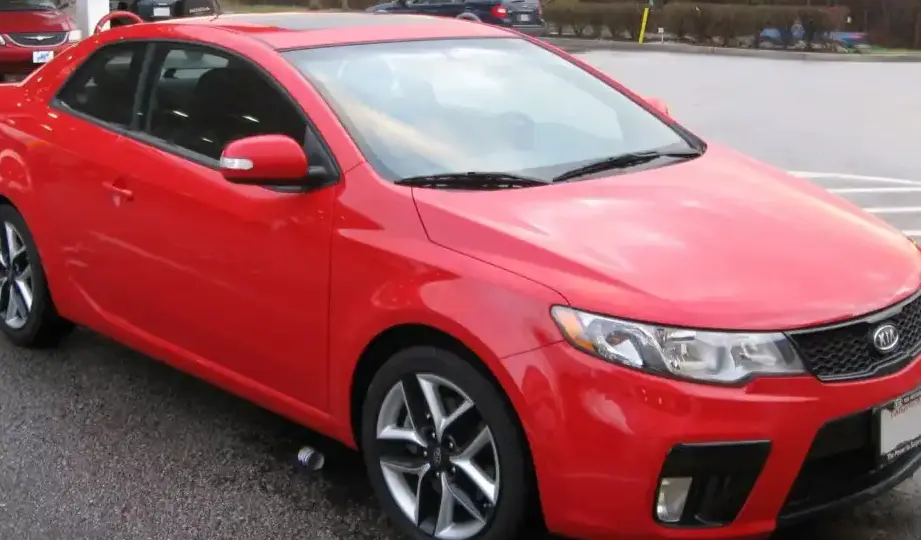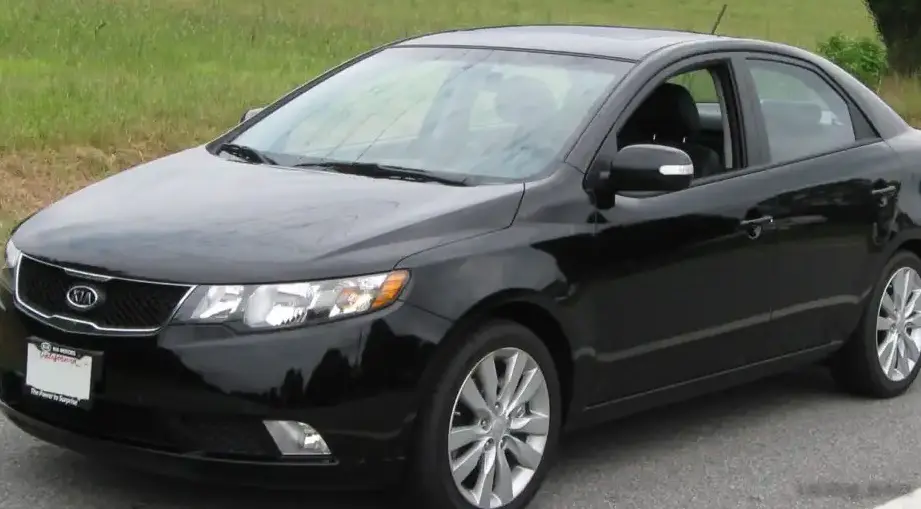
The Kia Forte, launched in 2010 as a replacement for the Spectra, represented a significant step forward for the Korean automaker in the competitive compact sedan segment. The first generation, designated TD, was offered with a range of engines and transmissions, with the 2.4-liter, 165 horsepower variant paired with a six-speed automatic transmission being a popular choice for North American buyers. Produced from 2010 through 2012, this configuration aimed to balance performance with the convenience of an automatic gearbox, positioning itself as a mid-range offering within the Forte lineup.
Technical Specifications
| Brand | Kia |
| Model | Forte |
| Generation | Forte I (TD) |
| Type (Engine) | 2.4 (165 Hp) Automatic 6-speed |
| Start of production | 2010 |
| End of production | 2012 |
| Powertrain Architecture | Internal Combustion engine |
| Body type | Sedan |
| Seats | 5 |
| Doors | 4 |
| Fuel consumption (economy) – urban (EPA) | 10.2 l/100 km (23.1 US mpg) |
| Fuel consumption (economy) – extra urban (EPA) | 7.4 l/100 km (31.8 US mpg) |
| Fuel Type | Petrol (Gasoline) |
| Emission standard | SULEV |
| Weight-to-power ratio | 8 kg/Hp, 125.5 Hp/tonne |
| Weight-to-torque ratio | 6 kg/Nm, 165.8 Nm/tonne |
| Power | 165 Hp @ 6000 rpm |
| Power per litre | 69.9 Hp/l |
| Torque | 218 Nm @ 4000 rpm (160.79 lb.-ft. @ 4000 rpm) |
| Engine layout | Front, Transverse |
| Engine Model/Code | Theta II / G4KE |
| Engine displacement | 2359 cm3 (143.96 cu. in.) |
| Number of cylinders | 4 |
| Engine configuration | Inline |
| Cylinder Bore | 88 mm (3.46 in.) |
| Piston Stroke | 97 mm (3.82 in.) |
| Compression ratio | 10.5:1 |
| Number of valves per cylinder | 4 |
| Fuel injection system | Multi-port manifold injection |
| Engine aspiration | Naturally aspirated engine |
| Valvetrain | DOHC, CVVT |
| Engine oil capacity | 4.3 l (4.54 US qt | 3.78 UK qt) |
| Coolant | 6 l (6.34 US qt | 5.28 UK qt) |
| Kerb Weight | 1315 kg (2899.08 lbs.) |
| Trunk (boot) space – minimum | 416 l (14.69 cu. ft.) |
| Fuel tank capacity | 52 l (13.74 US gal | 11.44 UK gal) |
| Length | 4530 mm (178.35 in.) |
| Width | 1775 mm (69.88 in.) |
| Height | 1460 mm (57.48 in.) |
| Wheelbase | 2650 mm (104.33 in.) |
| Front track | 1539 mm (60.59 in.) |
| Rear (Back) track | 1546 mm (60.87 in.) |
| Ride height (ground clearance) | 150 mm (5.91 in.) |
| Minimum turning circle (turning diameter) | 10.8 m (35.43 ft.) |
| Drivetrain Architecture | The Internal combustion engine (ICE) drives the front wheels of the vehicle. |
| Drive wheel | Front wheel drive |
| Number of gears and type of gearbox | 6 gears, automatic transmission |
| Front suspension | Independent, type McPherson with coil spring and anti-roll bar |
| Rear suspension | Transverse stabilizer, Coil spring, Torsion |
| Front brakes | Ventilated discs, 300 mm |
| Rear brakes | Disc, 262 mm |
| Assisting systems | ABS (Anti-lock braking system) |
| Steering type | Steering rack and pinion |
| Power steering | Hydraulic Steering |
| Tires size | 215/45 R17 |
| Wheel rims size | 7J x 17 |
INTRODUCTION
The 2010-2012 Kia Forte 2.4L with the six-speed automatic transmission was a key offering in Kia’s efforts to establish itself as a mainstream automotive brand. Built on the 1HX0/A3 platform (shared with the Hyundai Elantra), the Forte aimed to provide a compelling alternative to established Japanese and American compact sedans. This particular variant was positioned as a step up from the base 1.6-liter engine, offering more power and a smoother driving experience thanks to the automatic transmission. It targeted buyers who desired a comfortable and reasonably efficient daily driver without sacrificing performance.
Powertrain & Engine Architecture
At the heart of this Forte variant lies the Theta II 2.4-liter inline-four cylinder engine, designated G4KE. This engine featured a cast iron block with an aluminum cylinder head, incorporating Kia’s Continuously Variable Valve Timing (CVVT) technology on both intake and exhaust camshafts. This system optimized valve timing for improved fuel efficiency and power delivery across the rev range. Fuel delivery was handled by a multi-port fuel injection system. The engine produced 165 horsepower at 6000 rpm and 160.79 lb-ft of torque at 4000 rpm. The six-speed automatic transmission, a crucial component of this configuration, was designed to provide smooth and responsive shifts. It featured a torque converter and electronically controlled shifting, aiming to balance fuel economy with drivability. The transmission’s gear ratios were tuned to maximize acceleration and highway cruising efficiency.
Driving Characteristics
The 2.4-liter engine and six-speed automatic combination delivered a noticeable improvement in performance compared to the base 1.6-liter engine. While not a sports car, the Forte 2.4 offered adequate acceleration for merging onto highways and passing other vehicles. The automatic transmission generally shifted smoothly, although some reviewers noted a slight hesitation during quick downshifts. The gear ratios were well-suited for everyday driving, providing a comfortable cruising experience at highway speeds. Compared to the manual transmission versions, the automatic offered greater convenience, particularly in stop-and-go traffic, but at the expense of some driver engagement and fuel economy. The automatic transmission did slightly diminish the overall fuel efficiency compared to the manual, but the convenience factor was often considered a worthwhile trade-off by many buyers.
Equipment & Trim Levels
The 2.4-liter automatic Forte typically came standard with features such as air conditioning, power windows and locks, a CD player with MP3 compatibility, and an anti-lock braking system (ABS). Higher trim levels, such as the EX, added features like alloy wheels, a sunroof, keyless entry, and upgraded audio systems. Interior upholstery was typically cloth, with optional leather available on higher trims. The dashboard layout was functional and straightforward, with easy-to-read gauges and intuitive controls. Optional extras included a navigation system and a premium sound system.
Chassis & Braking
The Forte’s chassis featured an independent McPherson strut front suspension and a torsion beam rear suspension. This setup provided a comfortable ride quality, although it wasn’t particularly sporty. The front suspension incorporated a stabilizer bar to reduce body roll during cornering. Braking duties were handled by ventilated discs up front and solid discs in the rear. ABS was standard, providing enhanced braking control in emergency situations. The suspension tuning was geared towards providing a comfortable and compliant ride, prioritizing passenger comfort over sharp handling.
Market Reception & Comparison
The Kia Forte 2.4L automatic received generally positive reviews from automotive critics. It was praised for its spacious interior, comfortable ride, and value for money. However, some reviewers criticized its somewhat bland styling and lack of a truly engaging driving experience. Compared to competitors like the Honda Civic and Toyota Corolla, the Forte offered a more affordable price point with a comparable level of features. Against other trims within the Forte lineup, the 2.4-liter automatic offered a significant performance upgrade over the 1.6-liter engine, but it was less fuel-efficient and slightly more expensive. The 2.0-liter engine offered a middle ground, balancing performance and economy.
Legacy
The Kia Forte 2.4L automatic proved to be a reliable and durable powertrain. The Theta II engine, in particular, has a reputation for longevity when properly maintained. In the used car market, these Fortes are often sought after for their affordability and practicality. While not known for being collector’s items, they represent a solid and dependable choice for budget-conscious buyers. Common maintenance items include regular oil changes, timing belt replacement (depending on mileage), and inspection of the cooling system. Overall, the 2010-2012 Kia Forte 2.4L automatic remains a viable option for those seeking a reliable and affordable compact sedan.