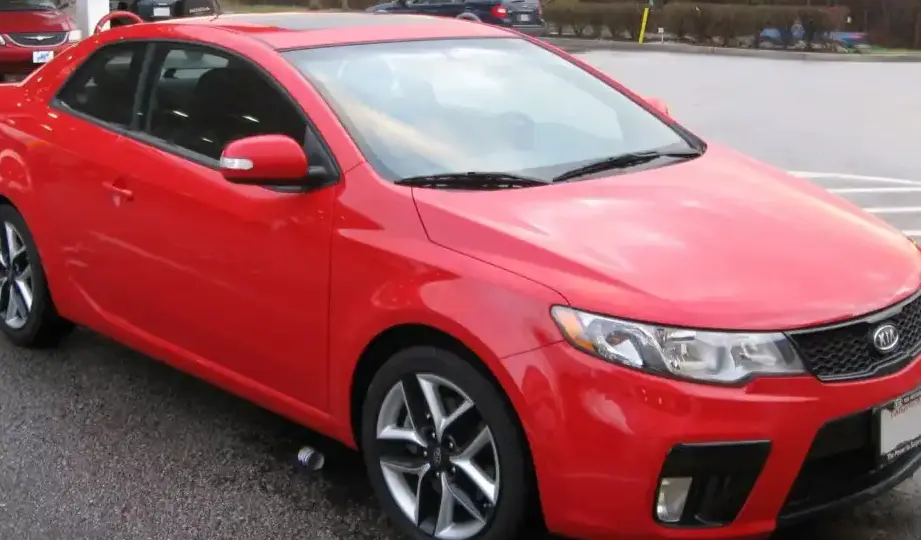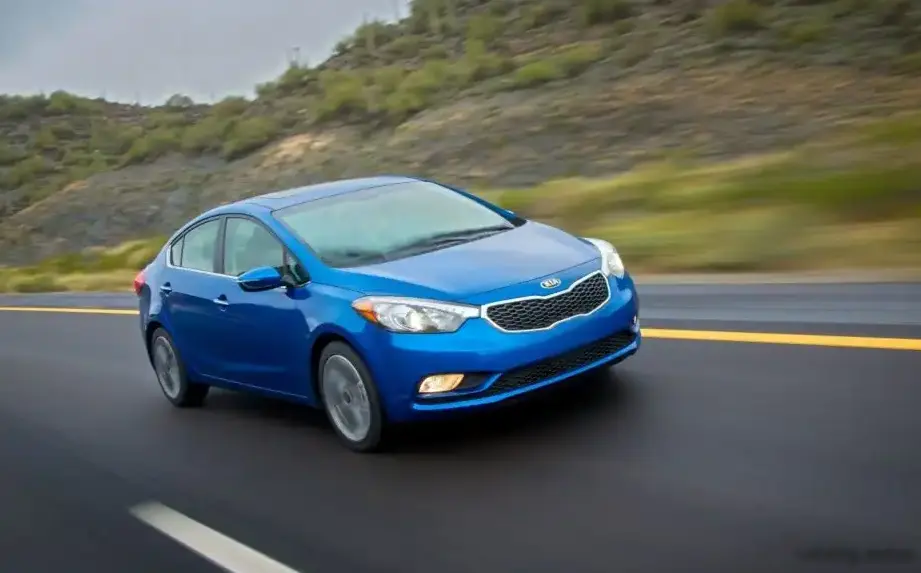
The Kia Forte II (YD), produced from 2013 to 2016, represented a significant step forward for the South Korean automaker in the highly competitive compact sedan segment. Positioned as a mainstream offering, the Forte II aimed to deliver a blend of style, fuel efficiency, and value. Within the YD generation, the 1.8 MPI (145 Hp) Automatic variant served as a core model, offering a balance between affordability and acceptable performance for everyday driving. It was designed to appeal to a broad customer base seeking a practical and reliable vehicle. This model was primarily marketed in North America, South America, and select markets in Europe and Asia.
Technical Specifications
| Brand | Kia |
| Model | Forte |
| Generation | Forte II (YD) |
| Type (Engine) | 1.8 MPI (145 Hp) Automatic |
| Start of production | 2013 |
| End of production | 2016 |
| Powertrain Architecture | Internal Combustion engine |
| Body type | Sedan |
| Seats | 5 |
| Doors | 4 |
| Fuel consumption (economy) – urban (EPA) | 9 l/100 km (26.1 US mpg, 31.4 UK mpg, 11.1 km/l) |
| Fuel consumption (economy) – extra urban (EPA) | 6 l/100 km (39.2 US mpg, 47.1 UK mpg, 16.7 km/l) |
| Fuel consumption (economy) – combined (EPA) | 7.6 l/100 km (30.9 US mpg, 37.2 UK mpg, 13.2 km/l) |
| Fuel Type | Petrol (Gasoline) |
| Emission standard | SULEV |
| Weight-to-power ratio | 8.9 kg/Hp, 112.4 Hp/tonne |
| Weight-to-torque ratio | 7.3 kg/Nm, 136.4 Nm/tonne |
| Power | 145 Hp @ 6500 rpm |
| Power per litre | 80.7 Hp/l |
| Torque | 176 Nm @ 4700 rpm (129.81 lb.-ft. @ 4700 rpm) |
| Engine layout | Front, Transverse |
| Engine Model/Code | Nu / G4NB |
| Engine displacement | 1797 cm3 (109.66 cu. in.) |
| Number of cylinders | 4 |
| Engine configuration | Inline |
| Cylinder Bore | 81 mm (3.19 in.) |
| Piston Stroke | 87.2 mm (3.43 in.) |
| Compression ratio | 10.3:1 |
| Number of valves per cylinder | 4 |
| Fuel injection system | Multi-port manifold injection |
| Engine aspiration | Naturally aspirated engine |
| Valvetrain | DOHC, D-CVVT |
| Engine oil capacity | 4 l (4.23 US qt | 3.52 UK qt) |
| Coolant | 6 l (6.34 US qt | 5.28 UK qt) |
| Kerb Weight | 1290-1353 kg (2843.96 – 2982.85 lbs.) |
| Max. weight | 1760 kg (3880.14 lbs.) |
| Max load | 407-470 kg (897.28 – 1036.17 lbs.) |
| Trunk (boot) space – minimum | 421 l (14.87 cu. ft.) |
| Fuel tank capacity | 50 l (13.21 US gal | 11 UK gal) |
| Length | 4560 mm (179.53 in.) |
| Width | 1780 mm (70.08 in.) |
| Height | 1430 mm (56.3 in.) |
| Wheelbase | 2700 mm (106.3 in.) |
| Front track | 1553-1563 mm (61.14 – 61.54 in.) |
| Rear (Back) track | 1566-1576 mm (61.65 – 62.05 in.) |
| Front overhang | 880 mm (34.65 in.) |
| Rear overhang | 980 mm (38.58 in.) |
| Ride height (ground clearance) | 135 mm (5.31 in.) |
| Minimum turning circle (turning diameter) | 10.6 m (34.78 ft.) |
| Approach angle | 15.2° |
| Departure angle | 20.4° |
| Drivetrain Architecture | The Internal combustion engine (ICE) drives the front wheels of the vehicle. |
| Drive wheel | Front wheel drive |
| Number of gears and type of gearbox | 6 gears, automatic transmission |
| Front suspension | Independent, type McPherson with coil spring and anti-roll bar |
| Rear suspension | Coil spring, Torsion |
| Front brakes | Ventilated discs, 280 mm |
| Rear brakes | Disc, 262 mm |
| Assisting systems | ABS (Anti-lock braking system) |
| Steering type | Steering rack and pinion |
| Power steering | Electric Steering |
| Tires size | 195/65 R15; 205/55 R16 |
| Wheel rims size | 6J x 15; 6.5J x 16 |
Powertrain & Engine Architecture
The heart of the Forte 1.8 MPI Automatic is Kia’s Nu engine family, specifically the G4NB code. This 1.8-liter inline-four cylinder engine utilizes a naturally aspirated configuration and multi-point fuel injection. The engine features a double overhead camshaft (DOHC) design with Kia’s Dual Continuously Variable Valve Timing (D-CVVT) system. D-CVVT optimizes valve timing based on engine load and speed, improving both fuel efficiency and power output. The engine produces 145 horsepower at 6,500 rpm and 176 Nm (129.81 lb-ft) of torque at 4,700 rpm. The engine’s relatively simple design contributes to its reliability and ease of maintenance. Paired with the engine is a six-speed automatic transmission. This transmission was chosen for its smooth operation and accessibility, catering to drivers prioritizing comfort over sporty performance. The transmission’s gear ratios are tuned for fuel economy and everyday drivability, rather than aggressive acceleration.
Driving Characteristics
The 1.8L Automatic Forte delivers adequate, but not exhilarating, performance. Acceleration is sufficient for merging onto highways and navigating city streets, but it won’t provide a particularly sporty driving experience. The automatic transmission contributes to a smooth and predictable driving experience, but it can sometimes feel hesitant during quick overtaking maneuvers. Compared to the manual transmission version of the same engine, the automatic sacrifices some responsiveness. The six-speed automatic’s gear ratios are optimized for fuel efficiency, meaning the engine often operates at lower RPMs during cruising. This contributes to a quieter cabin experience but can also result in a slight delay when requesting more power. Compared to higher-trim Forte models equipped with the more powerful 2.0-liter engine, the 1.8L Automatic feels noticeably less potent.
Equipment & Trim Levels
The 1.8 MPI Automatic trim typically included standard features such as air conditioning, power windows and locks, a basic audio system with USB connectivity, and standard safety equipment like ABS, airbags, and stability control. Higher trim levels, such as the EX, added features like alloy wheels, a more advanced audio system, a rearview camera, and keyless entry. Interior upholstery was typically cloth, with options for upgraded materials on higher trims. The dashboard layout was functional and straightforward, prioritizing ease of use over stylistic flair. Optional extras included a sunroof, navigation system, and leather upholstery.
Chassis & Braking
The Forte II utilized a front-wheel-drive platform with an independent McPherson strut suspension in the front and a torsion beam rear suspension. This suspension setup provided a comfortable ride quality, suitable for everyday commuting. The front brakes were ventilated discs, while the rear brakes were solid discs. ABS (Anti-lock Braking System) was standard, enhancing braking performance and safety. The steering system was an electric power steering (EPS) system, providing light and easy steering feel. Stabilizer bars were included in both the front and rear suspension to reduce body roll during cornering.
Market Reception & Comparison
The Kia Forte II 1.8 MPI Automatic was generally well-received by critics as a practical and affordable compact sedan. It was praised for its fuel efficiency, comfortable ride, and generous warranty. However, some reviewers noted its lack of sporty handling and somewhat bland interior design. Compared to competitors like the Honda Civic, Toyota Corolla, and Hyundai Elantra, the Forte offered a similar level of features and fuel economy at a slightly lower price point. The 1.8L engine offered better fuel economy than the available 2.0L engine, but at the cost of performance. Reliability reports generally indicated good long-term reliability for the 1.8L engine and automatic transmission.
Legacy
The Kia Forte II 1.8 MPI Automatic remains a relatively common sight on used car lots today. The G4NB engine and six-speed automatic transmission have proven to be durable and reliable, with many examples exceeding 150,000 miles with proper maintenance. Parts availability is generally good, and maintenance costs are reasonable. While it may not offer the same level of refinement or performance as some of its competitors, the Forte II 1.8 MPI Automatic represents a solid value proposition for budget-conscious buyers seeking a dependable and fuel-efficient compact sedan.