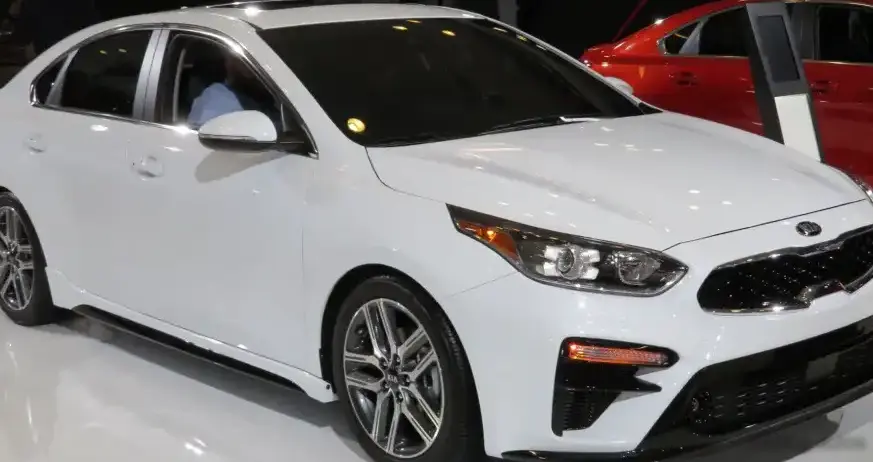
The Kia Forte III 2.0 MPI (147 Hp) i-CVT is a front-wheel-drive compact sedan produced by the South Korean manufacturer Kia between 2019 and October 2021. This variant occupied a central position within the third generation Forte (BD) lineup, offering a balance between fuel efficiency, affordability, and everyday usability. It was primarily marketed towards buyers seeking a comfortable and practical sedan with modern features, without the higher price tag of the GT or premium trims. The Forte III represented a significant step forward for Kia in terms of design, technology, and overall refinement, aiming to compete directly with established players like the Honda Civic and Toyota Corolla in the North American market.
Technical Specifications
| Brand | Kia |
| Model | Forte |
| Generation | Forte III |
| Type (Engine) | 2.0 MPI (147 Hp) i-CVT |
| Start of production | 2019 |
| End of production | October, 2021 |
| Powertrain Architecture | Internal Combustion engine |
| Body type | Sedan |
| Seats | 5 |
| Doors | 4 |
| Fuel consumption (urban) | 7.6-7.8 l/100 km (30.9 – 30.2 US mpg) |
| Fuel consumption (extra urban) | 5.7-5.9 l/100 km (41.3 – 39.9 US mpg) |
| Fuel consumption (combined) | 6.7-6.9 l/100 km (35.1 – 34.1 US mpg) |
| Fuel Type | Petrol (Gasoline) |
| Weight-to-power ratio | 8.5 kg/Hp |
| Weight-to-torque ratio | 7 kg/Nm |
| Power | 147 Hp @ 6200 rpm |
| Power per litre | 73.5 Hp/l |
| Torque | 179 Nm @ 4500 rpm (132.02 lb.-ft. @ 4500 rpm) |
| Engine layout | Front, Transverse |
| Engine Model/Code | Nu / G4NH |
| Engine displacement | 1999 cm3 (121.99 cu. in.) |
| Number of cylinders | 4 |
| Engine configuration | Inline |
| Cylinder Bore | 81 mm (3.19 in.) |
| Piston Stroke | 97 mm (3.82 in.) |
| Compression ratio | 12.5:1 |
| Number of valves per cylinder | 4 |
| Fuel injection system | Multi-port manifold injection |
| Engine aspiration | Naturally aspirated engine |
| Valvetrain | DOHC, D-CVVT |
| Engine oil capacity | 4 l (4.23 US qt | 3.52 UK qt) |
| Coolant capacity | 6.6 l (6.97 US qt | 5.81 UK qt) |
| Kerb Weight | 1253-1317 kg (2762.39 – 2903.49 lbs.) |
| Max. weight | 1720 kg (3791.95 lbs.) |
| Max load | 403-467 kg (888.46 – 1029.56 lbs.) |
| Trunk (boot) space | 433 l (15.29 cu. ft.) |
| Fuel tank capacity | 53 l (14 US gal | 11.66 UK gal) |
| Length | 4641 mm (182.72 in.) |
| Width | 1801 mm (70.91 in.) |
| Height | 1435 mm (56.5 in.) |
| Wheelbase | 2700 mm (106.3 in.) |
| Front track | 1549-1554 mm (60.98 – 61.18 in.) |
| Rear track | 1557-1565 mm (61.3 – 61.61 in.) |
| Ride height (ground clearance) | 135 mm (5.31 in.) |
| Minimum turning circle | 10.6 m (34.78 ft.) |
| Front suspension | Independent type McPherson |
| Rear suspension | Torsion |
| Front brakes | Ventilated discs |
| Rear brakes | Disc |
| Steering type | Steering rack and pinion |
| Power steering | Electric Steering |
| Tires size | 205/55 R16; 225/45 R17 |
| Wheel rims size | 6.5J x 16; 7.0J x 17 |
| Gearbox | automatic transmission i-CVT |
INTRODUCTION
The Kia Forte III 2.0 MPI i-CVT, launched in 2019, represented a key offering in Kia’s compact sedan range. Built on the K3 platform (internally designated BD), it aimed to provide a more refined and feature-rich experience than its predecessors. The 2.0-liter engine paired with the Intelligent Variable Continuously Variable Transmission (i-CVT) was positioned as the sweet spot in the lineup, appealing to a broad customer base prioritizing fuel economy and smooth driving dynamics over outright performance. This configuration was available across several trim levels, including LX, S, and EX, each offering a progressively increasing level of standard equipment.
Powertrain & Engine Architecture
At the heart of the Forte III 2.0 MPI i-CVT lies the Kia Nu engine family, specifically the G4NH 2.0-liter inline-four cylinder. This engine utilizes a multi-point fuel injection system and a double overhead camshaft (DOHC) valvetrain with Kia’s Dual Continuously Variable Valve Timing (D-CVVT) technology. D-CVVT optimizes valve timing based on engine load and speed, improving both fuel efficiency and power output. The engine produces 147 horsepower at 6,200 rpm and 179 Nm (132 lb-ft) of torque at 4,500 rpm. The i-CVT transmission is a key component, designed to simulate traditional gear shifts while offering the smoothness and efficiency of a continuously variable transmission. It utilizes a belt-and-pulley system to provide a seamless power delivery, optimizing engine speed for the given driving conditions. Unlike some CVTs, Kia’s i-CVT incorporates simulated shift points to provide a more familiar driving experience for drivers accustomed to traditional automatic transmissions.
Driving Characteristics
The 2.0-liter engine and i-CVT combination delivers a comfortable and predictable driving experience. Acceleration is adequate for everyday driving situations, though it doesn’t offer the sporty feel of the optional turbocharged engine found in the Forte GT. The i-CVT prioritizes fuel efficiency, keeping engine speeds low during cruising and providing smooth, linear acceleration. The transmission’s simulated shift points are generally well-executed, minimizing the “rubber band” effect often associated with CVTs. Compared to the six-speed manual transmission available on lower trims, the i-CVT offers greater convenience and ease of use, particularly in stop-and-go traffic. However, the manual transmission provides a more engaging driving experience and slightly better fuel economy in certain conditions. The gear ratios are tuned for efficiency, resulting in a relaxed highway cruising experience but potentially requiring more aggressive throttle input for quick overtaking maneuvers.
Equipment & Trim Levels
The standard equipment level for the 2.0 MPI i-CVT varied depending on the trim level. The base LX trim typically included features such as a touchscreen infotainment system, rearview camera, Bluetooth connectivity, and basic safety features like ABS and stability control. The S trim added features like alloy wheels, a sport-tuned suspension, and upgraded interior trim. The EX trim, the most well-equipped variant, included features such as leather upholstery, a sunroof, heated front seats, and advanced safety technologies like forward collision warning and lane departure warning. Optional extras included a premium audio system, navigation system, and automatic climate control.
Chassis & Braking
The Forte III utilizes a McPherson strut front suspension and a torsion beam rear suspension. This setup provides a good balance between ride comfort and handling. The front suspension is designed to absorb bumps and provide stable cornering, while the torsion beam rear suspension offers a compact and lightweight solution. Braking duties are handled by ventilated discs at the front and solid discs at the rear. ABS (Anti-lock Braking System) is standard, providing enhanced braking performance in emergency situations. The steering is electrically assisted, providing light and precise steering feel.
Market Reception & Comparison
The Kia Forte III 2.0 MPI i-CVT was generally well-received by automotive critics. It was praised for its comfortable ride, spacious interior, and long list of standard features. The i-CVT transmission was noted for its smoothness and efficiency, although some reviewers found it lacking in responsiveness compared to traditional automatic transmissions. Compared to other trims in the Forte lineup, the 2.0 MPI i-CVT offered a compelling value proposition, providing a good balance of features and fuel economy at a competitive price point. The turbocharged engine in the Forte GT offered more performance, but at a higher cost. The base 2.0 MPI with a manual transmission was more affordable but lacked the convenience of the i-CVT.
Legacy
The Kia Forte III 2.0 MPI i-CVT has proven to be a reliable and durable powertrain. The Nu engine is known for its longevity, and the i-CVT transmission has generally held up well over time. In the used car market, these models represent a good value for buyers seeking a practical and affordable compact sedan. Maintenance costs are relatively low, and parts availability is good. While not a performance standout, the 2.0 MPI i-CVT remains a popular choice for those prioritizing fuel efficiency, comfort, and reliability.