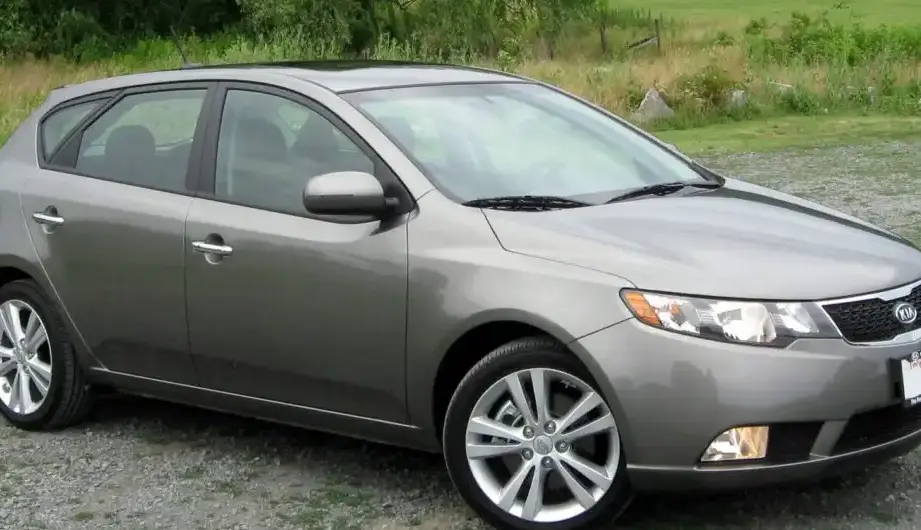
The Kia Forte5 first generation (TD), produced from 2010 to 2013, represented Kia’s entry into the increasingly popular compact hatchback segment in North America. Positioned as a more practical and sporty alternative to the Forte sedan, the Forte5 aimed to attract buyers seeking versatility and a youthful image. The 2.4-liter engine variant, producing 173 horsepower, occupied the top trim level within the Forte5 lineup, offering a balance of performance and fuel efficiency. It was a key model in Kia’s efforts to establish itself as a mainstream automotive brand known for value and reliability.
Technical Specifications
| Brand | Kia |
| Model | Forte |
| Generation | Forte5 I (TD) |
| Type (Engine) | 2.4 (173 Hp) |
| Start of production | 2010 |
| End of production | 2013 |
| Powertrain Architecture | Internal Combustion engine |
| Body type | Hatchback |
| Seats | 5 |
| Doors | 5 |
| Fuel consumption (economy) – urban (EPA) | 10.7 l/100 km (22 US mpg) |
| Fuel consumption (economy) – extra urban (EPA) | 7.4 l/100 km (31.8 US mpg) |
| Fuel Type | Petrol (Gasoline) |
| Emission standard | ULEV |
| Weight-to-power ratio | 7.6 kg/Hp |
| Weight-to-torque ratio | 5.8 kg/Nm |
| Power | 173 Hp @ 6000 rpm |
| Power per litre | 73.3 Hp/l |
| Torque | 228 Nm @ 4000 rpm (168.16 lb.-ft. @ 4000 rpm) |
| Engine layout | Front, Transverse |
| Engine Model/Code | Theta II / G4KE |
| Engine displacement | 2359 cm3 (143.96 cu. in.) |
| Number of cylinders | 4 |
| Engine configuration | Inline |
| Cylinder Bore | 88 mm (3.46 in.) |
| Piston Stroke | 97 mm (3.82 in.) |
| Compression ratio | 10.5:1 |
| Number of valves per cylinder | 4 |
| Fuel injection system | Multi-port manifold injection |
| Engine aspiration | Naturally aspirated engine |
| Valvetrain | DOHC, CVVT |
| Engine oil capacity | 4.3 l (4.54 US qt | 3.78 UK qt) |
| Coolant | 6 l (6.34 US qt | 5.28 UK qt) |
| Kerb Weight | 1314 kg (2896.87 lbs.) |
| Trunk (boot) space – minimum | 550 l (19.42 cu. ft.) |
| Fuel tank capacity | 52 l (13.74 US gal | 11.44 UK gal) |
| Length | 4340 mm (170.87 in.) |
| Width | 1775 mm (69.88 in.) |
| Height | 1460 mm (57.48 in.) |
| Wheelbase | 2650 mm (104.33 in.) |
| Front track | 1539 mm (60.59 in.) |
| Rear (Back) track | 1546 mm (60.87 in.) |
| Ride height (ground clearance) | 150 mm (5.91 in.) |
| Minimum turning circle (turning diameter) | 10.8 m (35.43 ft.) |
| Drivetrain Architecture | The Internal combustion engine (ICE) drives the front wheels of the vehicle. |
| Drive wheel | Front wheel drive |
| Number of gears and type of gearbox | 6 gears, manual transmission |
| Front suspension | Independent, type McPherson with coil spring and anti-roll bar |
| Rear suspension | Transverse stabilizer, Coil spring, Torsion |
| Front brakes | Ventilated discs, 300 mm |
| Rear brakes | Disc, 262 mm |
| Assisting systems | ABS (Anti-lock braking system) |
| Steering type | Steering rack and pinion |
| Power steering | Hydraulic Steering |
| Tires size | 215/45 R17 |
| Wheel rims size | 7J x 17 |
INTRODUCTION
The 2010-2013 Kia Forte5 2.4 represents a significant step forward for Kia in terms of design, build quality, and overall refinement. Built on the TD platform, it shared its underpinnings with the Hyundai Elantra Touring, but offered a distinct styling package and a focus on a more youthful demographic. The 2.4-liter engine was the range-topping option for the Forte5, providing a noticeable performance boost over the base 2.0-liter engine. This variant aimed to appeal to drivers who wanted a practical hatchback with a bit more pep and responsiveness.
Powertrain & Engine Architecture
At the heart of the Forte5 2.4 lies the Theta II 2.4-liter inline-four cylinder engine, designated G4KE. This engine is a naturally aspirated powerplant featuring multi-port fuel injection and a double overhead camshaft (DOHC) valvetrain with continuously variable valve timing (CVVT) on both intake and exhaust camshafts. The CVVT system optimizes engine breathing across the rev range, improving both power and fuel efficiency. The engine produces 173 horsepower at 6000 rpm and 168 lb-ft of torque at 4000 rpm. The engine’s architecture is relatively simple and robust, contributing to its generally good reliability. The 6-speed manual transmission was standard, offering precise shifts and a more engaging driving experience.
Driving Characteristics
The Forte5 2.4 with the 6-speed manual transmission delivers a noticeably more spirited driving experience compared to the base 2.0-liter model. Acceleration is brisk, and the engine feels responsive throughout the rev range. The manual gearbox is well-matched to the engine’s powerband, allowing drivers to easily maintain control and extract maximum performance. While not a sports car, the Forte5 2.4 offers a level of agility and responsiveness that is uncommon in its class. The suspension is tuned for comfort, but still provides adequate body control in corners. The steering is light and precise, making it easy to maneuver in city traffic.
Equipment & Trim Levels
The 2.4-liter Forte5 typically came well-equipped, even in its base trim. Standard features generally included air conditioning, power windows and locks, a six-speaker audio system with USB and auxiliary inputs, and a tilt/telescoping steering wheel. Higher trim levels added features such as alloy wheels, a sunroof, keyless entry, and a premium audio system. Interior upholstery was typically cloth, with optional leather available on some trims. The dashboard layout is functional and straightforward, with easy-to-read gauges and intuitive controls.
Chassis & Braking
The Forte5 utilizes a McPherson strut front suspension and a torsion beam rear suspension. This setup provides a good balance of ride comfort and handling. The front suspension incorporates a stabilizer bar to reduce body roll during cornering. Braking duties are handled by ventilated discs up front and solid discs in the rear. The braking system is equipped with ABS (Anti-lock Braking System) to enhance safety and control during emergency stops. The chassis is relatively lightweight, contributing to the car’s nimble handling characteristics.
Market Reception & Comparison
The Kia Forte5 2.4 was generally well-received by automotive critics. Reviewers praised its stylish design, spacious interior, and generous standard features. The 2.4-liter engine was lauded for its strong performance and smooth operation. Compared to competitors like the Honda Civic, Toyota Corolla, and Mazda3, the Forte5 offered a compelling value proposition, with more features for the price. However, some critics noted that the interior materials were not as premium as those found in some of its rivals. Fuel economy was competitive for its class, averaging around 22 mpg city and 31 mpg highway.
Legacy
The Kia Forte5 2.4 has proven to be a reliable and durable vehicle. The Theta II engine is known for its longevity, and with proper maintenance, it can easily exceed 150,000 miles. The Forte5’s simple mechanical design makes it relatively easy and affordable to repair. On the used car market, the 2.4-liter variant commands a slightly higher price than the base 2.0-liter model, reflecting its superior performance and desirability. The Forte5 played a crucial role in Kia’s brand transformation, helping to establish the company as a serious contender in the compact car segment. It remains a popular choice for budget-conscious buyers seeking a practical and reliable hatchback.