Technical Specifications
| Brand | Kia |
| Model | Carnival |
| Generation | Grand Carnival II |
| Type (Engine) | 2.9 CRDi (170 Hp) |
| Start of production | 2006 |
| End of production | 2010 |
| Powertrain Architecture | Internal Combustion engine |
| Body type | Minivan |
| Seats | 7 |
| Doors | 5 |
| Fuel Type | Diesel |
| Weight-to-power ratio | 13 kg/Hp, 76.9 Hp/tonne |
| Weight-to-torque ratio | 6.3 kg/Nm, 159.7 Nm/tonne |
| Power | 170 Hp @ 3700 rpm |
| Power per litre | 58.6 Hp/l |
| Torque | 353 Nm @ 2000-3000 rpm (260.36 lb.-ft. @ 2000-3000 rpm) |
| Engine layout | Front, Transverse |
| Engine displacement | 2902 cm3 (177.09 cu. in.) |
| Number of cylinders | 4 |
| Engine configuration | Inline |
| Cylinder Bore | 97.1 mm (3.82 in.) |
| Piston Stroke | 98 mm (3.86 in.) |
| Number of valves per cylinder | 4 |
| Fuel injection system | Diesel Commonrail |
| Engine aspiration | Turbocharger, Intercooler |
| Valvetrain | DOHC |
| Engine oil capacity | 6.6 l (6.97 US qt | 5.81 UK qt) |
| Coolant | 10 l (10.57 US qt | 8.8 UK qt) |
| Kerb Weight | 2211 kg (4874.42 lbs.) |
| Trunk (boot) space – minimum | 912 l (32.21 cu. ft.) |
| Trunk (boot) space – maximum | 4007 l (141.51 cu. ft.) |
| Fuel tank capacity | 80 l (21.13 US gal | 17.6 UK gal) |
| Length | 5130 mm (201.97 in.) |
| Width | 1985 mm (78.15 in.) |
| Height | 1780 mm (70.08 in.) |
| Wheelbase | 3020 mm (118.9 in.) |
| Front track | 1685 mm (66.34 in.) |
| Rear (Back) track | 1685 mm (66.34 in.) |
| Drag coefficient (Cd) | 0.34 |
| Minimum turning circle | 12.1 m (39.7 ft.) |
| Drivetrain Architecture | The Internal combustion engine (ICE) drives the front wheels of the vehicle. |
| Drive wheel | Front wheel drive |
| Number of gears and type of gearbox | 5 gears, manual transmission |
| Front suspension | Independent type McPherson |
| Rear suspension | Dependent spring suspension with transverse stabilizer |
| Front brakes | Ventilated discs |
| Rear brakes | Drum |
| Assisting systems | ABS (Anti-lock braking system) |
| Steering type | Steering rack and pinion |
| Tires size | 235/60 R17 |
| Wheel rims size | 17 |
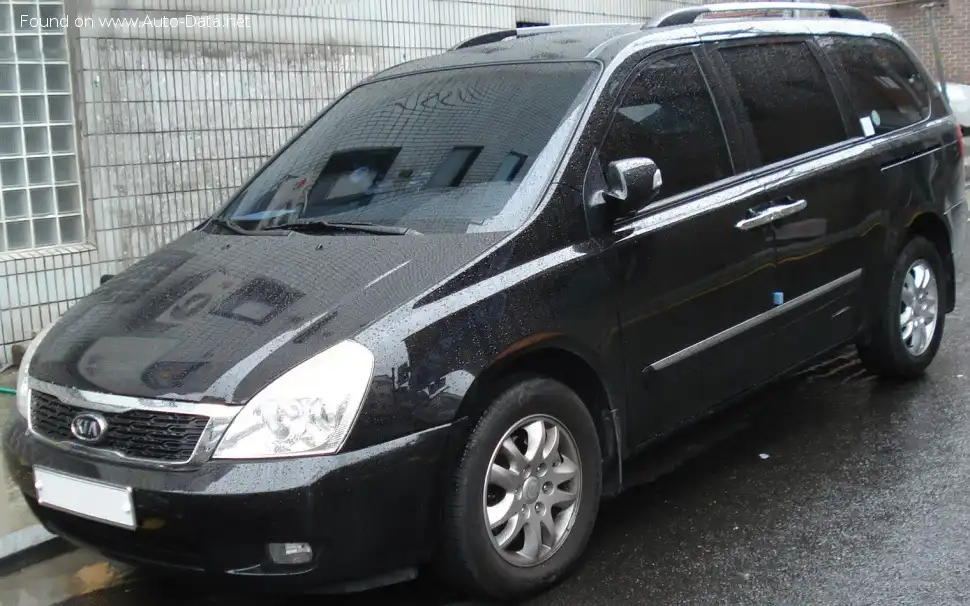
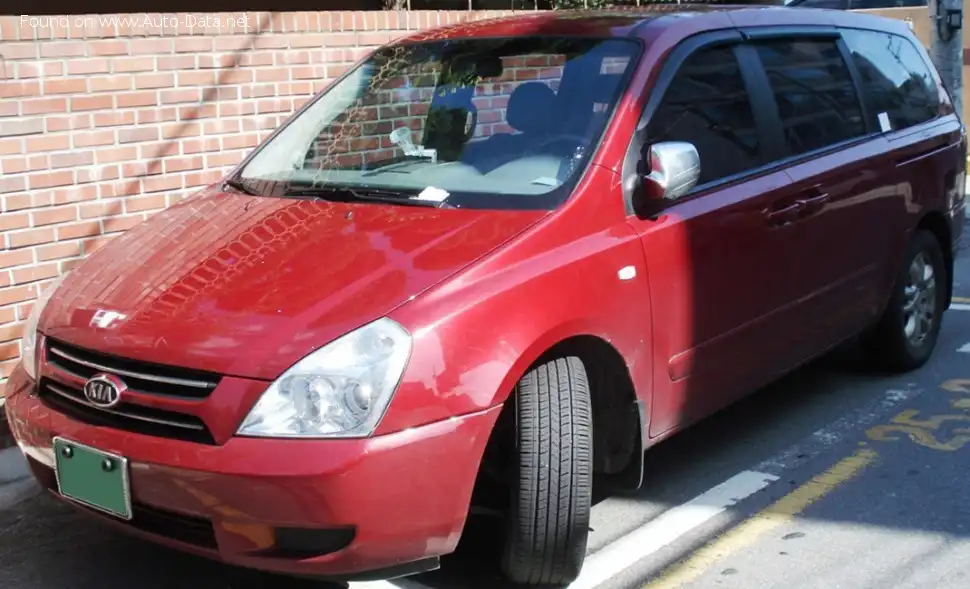
The Kia Grand Carnival II, specifically the 2.9 CRDi variant producing 170 horsepower, was a significant offering in the minivan segment from 2006 to 2010. Positioned as a mid-range option within the second generation (codenamed KQ5), this model aimed to balance fuel efficiency, practicality, and a reasonable level of performance for family transportation. The Grand Carnival, known as the Sedona in North American markets, represented Kia’s ambition to compete with established players like the Honda Odyssey and Toyota Sienna, offering a compelling value proposition with a longer warranty and a more generous feature set for the price. This particular engine and transmission combination was popular in markets outside of North America, where diesel engines held a stronger presence in the minivan category.
Powertrain & Engine Architecture
The heart of this Grand Carnival variant is the 2.9-liter inline-four cylinder diesel engine. This engine, often referred to by its internal code, utilizes a common rail direct injection system, a technology that significantly improved fuel efficiency and reduced noise compared to older diesel injection methods. The common rail system maintains a high fuel pressure, allowing for precise fuel metering and optimized combustion. A turbocharger with an intercooler is employed to boost power output, forcing more air into the cylinders. The engine features a double overhead camshaft (DOHC) valvetrain, operating four valves per cylinder for improved breathing and volumetric efficiency. The 5-speed manual transmission was the standard offering, providing a balance between fuel economy and driver control. The transmission’s gear ratios were tuned to maximize the engine’s torque output, providing adequate acceleration for a vehicle of this size and weight.
Driving Characteristics
The 170 hp 2.9 CRDi Grand Carnival offered a respectable driving experience, particularly when considering its size and intended purpose. While not a performance vehicle, the engine delivered sufficient torque to handle a fully loaded cabin and maintain comfortable cruising speeds on the highway. The manual transmission allowed for greater driver engagement and control compared to an automatic, and the gear ratios were well-matched to the engine’s powerband. Acceleration was adequate, but not brisk, with a 0-60 mph time estimated around 11-12 seconds. Compared to the gasoline engine options available in some markets, the diesel offered significantly better fuel economy and a more relaxed driving experience at highway speeds due to the engine’s higher torque output. However, it lacked the immediate responsiveness of the gasoline engines.
Equipment & Trim Levels
The 2.9 CRDi trim typically included features such as air conditioning, power windows and locks, a basic audio system, and standard safety equipment like ABS and dual front airbags. Higher trim levels added features like alloy wheels, a sunroof, upgraded audio systems, and leather upholstery. The interior was designed with practicality in mind, offering a spacious cabin with flexible seating configurations. The second and third-row seats could be folded flat or removed entirely to maximize cargo space. The dashboard layout was functional and straightforward, with easy-to-use controls.
Chassis & Braking
The Grand Carnival II utilized a front-wheel-drive layout with an independent McPherson strut suspension in the front and a dependent spring suspension with a transverse stabilizer bar in the rear. This suspension setup provided a comfortable ride quality, although it wasn’t particularly sporty. The front brakes were ventilated discs, offering good stopping power, while the rear brakes were drums, a cost-saving measure common in this class of vehicle. The steering was a rack and pinion system, providing reasonably precise steering feel.
Market Reception & Comparison
The 2.9 CRDi Grand Carnival was generally well-received by automotive critics, particularly for its spacious interior, comfortable ride, and competitive price. The diesel engine was praised for its fuel efficiency and torque output, making it a popular choice for long-distance family travel. However, some critics noted that the engine could be somewhat noisy and that the handling wasn’t as refined as some of its competitors. Compared to the gasoline-powered versions of the Grand Carnival, the 2.9 CRDi offered superior fuel economy and torque, but at the expense of some refinement. Against rivals like the Honda Odyssey and Toyota Sienna, the Grand Carnival offered a more affordable alternative with a longer warranty, but it lacked the brand recognition and established reputation of the Japanese minivans.
Legacy
The Kia Grand Carnival II 2.9 CRDi has proven to be a relatively reliable vehicle, with the diesel engine generally holding up well over time. However, like any diesel engine, it requires regular maintenance, including oil changes and fuel filter replacements. Common issues reported by owners include problems with the turbocharger and the fuel injection system. In the used car market, this variant remains a popular choice for those seeking a spacious and fuel-efficient minivan. Its affordability and practicality continue to make it a compelling option for families on a budget. The 2.9 CRDi engine, while not the most technologically advanced, provided a solid foundation for Kia’s expansion into the minivan segment and helped establish the brand as a viable competitor in the global automotive market.