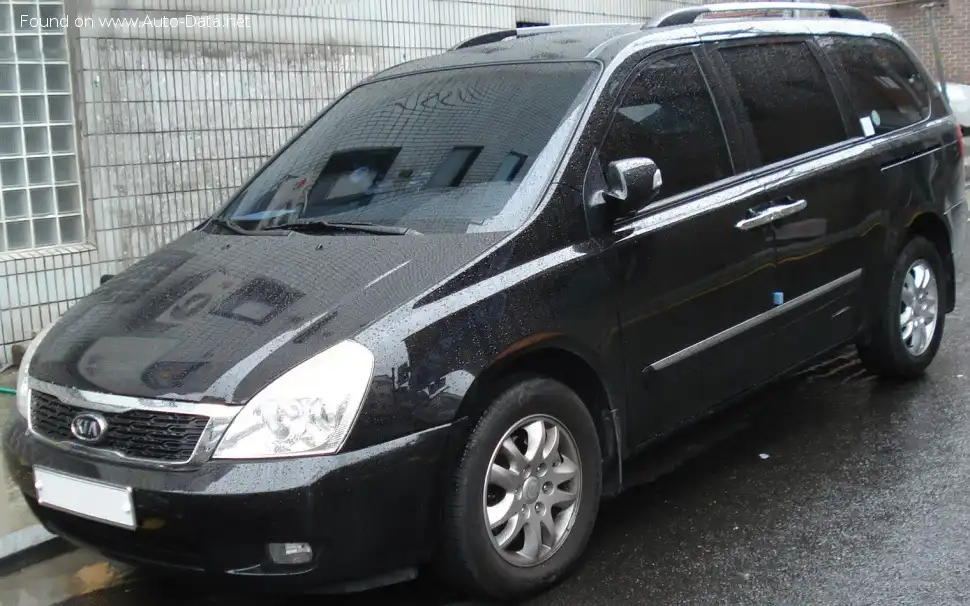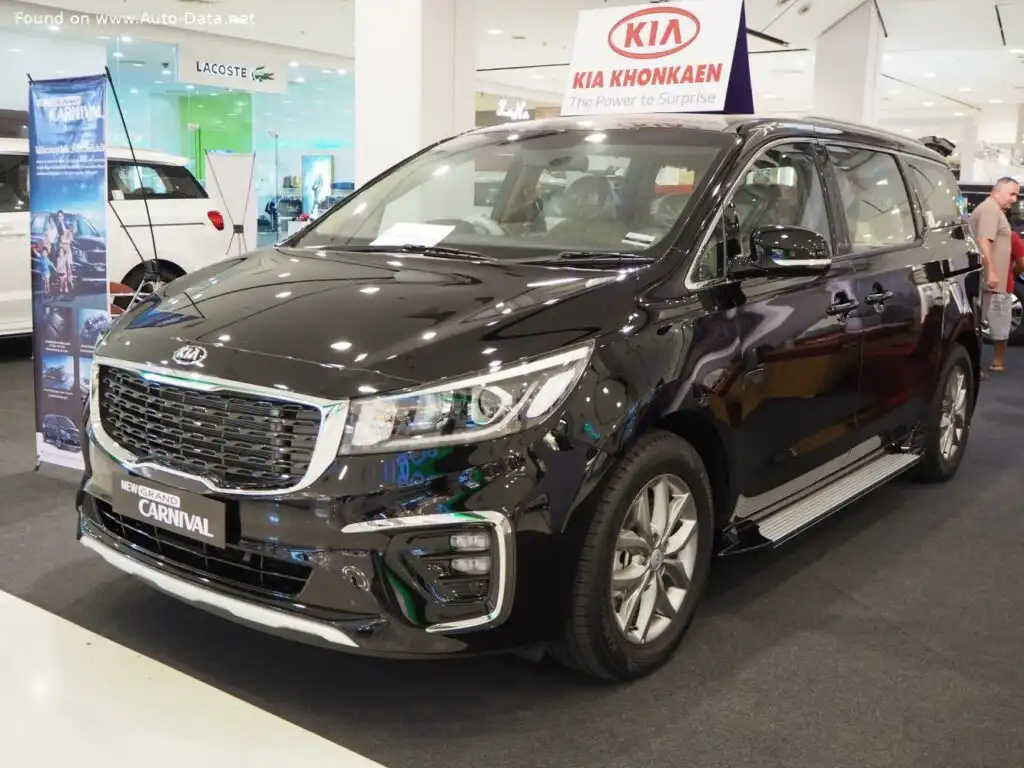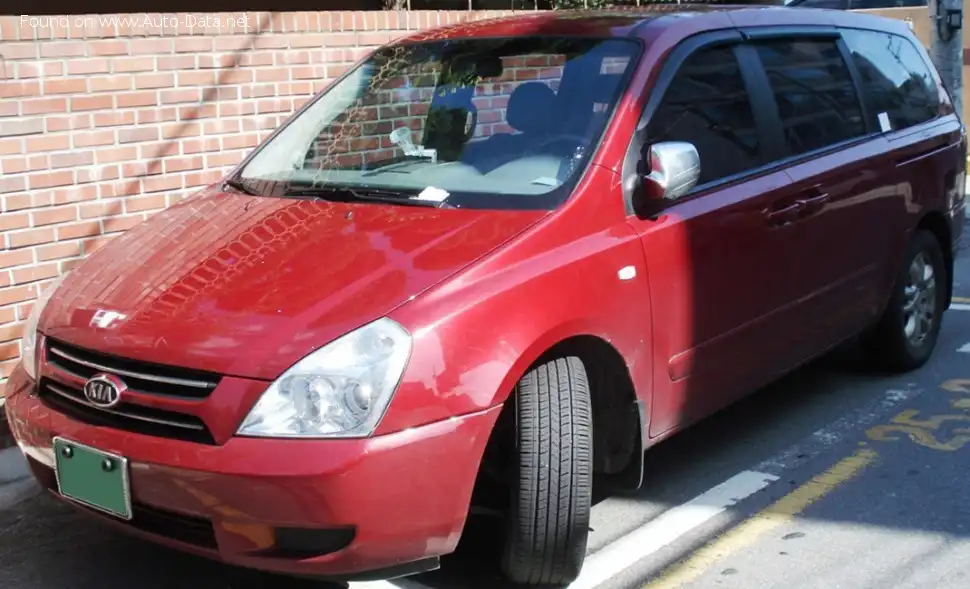
The Kia Grand Carnival II, specifically the 2.9 CRDi variant with the five-speed automatic transmission, was produced from 2006 to 2010. This model represented a significant step forward for Kia in the minivan segment, offering a compelling blend of space, features, and diesel efficiency. Positioned as a mid-range offering within the Grand Carnival II lineup, it slotted between the base gasoline engine options and the higher-output diesel variants. The Grand Carnival, known as the Sedona in North American markets, aimed to provide a practical and comfortable family vehicle, competing with established players like the Honda Odyssey and Toyota Sienna, though with a distinctly Korean approach to value and features.
Technical Specifications
| Brand | Kia |
| Model | Carnival |
| Generation | Grand Carnival II |
| Type (Engine) | 2.9 CRDi (170 Hp) Automatic |
| Start of production | 2006 |
| End of production | 2010 |
| Powertrain Architecture | Internal Combustion engine |
| Body type | Minivan |
| Seats | 7 |
| Doors | 5 |
| Fuel Type | Diesel |
| Weight-to-power ratio | 13 kg/Hp, 76.9 Hp/tonne |
| Weight-to-torque ratio | 6.3 kg/Nm, 159.7 Nm/tonne |
| Power | 170 Hp @ 3700 rpm |
| Power per litre | 58.6 Hp/l |
| Torque | 353 Nm @ 2000-3000 rpm (260.36 lb.-ft. @ 2000-3000 rpm) |
| Engine layout | Front, Transverse |
| Engine displacement | 2902 cm3 (177.09 cu. in.) |
| Number of cylinders | 4 |
| Engine configuration | Inline |
| Cylinder Bore | 97.1 mm (3.82 in.) |
| Piston Stroke | 98 mm (3.86 in.) |
| Number of valves per cylinder | 4 |
| Fuel injection system | Diesel Commonrail |
| Engine aspiration | Turbocharger, Intercooler |
| Valvetrain | DOHC |
| Engine oil capacity | 6.6 l (6.97 US qt | 5.81 UK qt) |
| Coolant | 10 l (10.57 US qt | 8.8 UK qt) |
| Kerb Weight | 2211 kg (4874.42 lbs.) |
| Trunk (boot) space – minimum | 912 l (32.21 cu. ft.) |
| Trunk (boot) space – maximum | 4007 l (141.51 cu. ft.) |
| Fuel tank capacity | 80 l (21.13 US gal | 17.6 UK gal) |
| Length | 5130 mm (201.97 in.) |
| Width | 1985 mm (78.15 in.) |
| Height | 1780 mm (70.08 in.) |
| Wheelbase | 3020 mm (118.9 in.) |
| Front track | 1685 mm (66.34 in.) |
| Rear (Back) track | 1685 mm (66.34 in.) |
| Drag coefficient (Cd) | 0.34 |
| Minimum turning circle | 12.1 m (39.7 ft.) |
| Drivetrain Architecture | The Internal combustion engine (ICE) drives the front wheels of the vehicle. |
| Drive wheel | Front wheel drive |
| Number of gears and type of gearbox | 5 gears, automatic transmission |
| Front suspension | Independent type McPherson |
| Rear suspension | Dependent spring suspension with transverse stabilizer |
| Front brakes | Ventilated discs |
| Rear brakes | Drum |
| Assisting systems | ABS (Anti-lock braking system) |
| Steering type | Steering rack and pinion |
| Tires size | 235/60 R17 |
| Wheel rims size | 17 |
Powertrain & Engine Architecture
The heart of the Grand Carnival II 2.9 CRDi Automatic is the 2.9-liter inline-four cylinder diesel engine. This engine, often referred to by its internal code, utilizes a common rail direct injection system, a technology that significantly improved fuel efficiency and reduced emissions compared to older diesel designs. The common rail system maintains a high fuel pressure, allowing for precise fuel metering and optimized combustion. A turbocharger with an intercooler further enhances performance by forcing more air into the cylinders, boosting power output. The engine features a double overhead camshaft (DOHC) valvetrain, contributing to improved breathing and overall efficiency. The five-speed automatic transmission was chosen for its balance of smoothness and cost-effectiveness. While not as sophisticated as some of the newer automatic transmissions available at the time, it provided adequate performance for the vehicle’s intended purpose.
Driving Characteristics
The 170 horsepower and 353 Nm (260 lb-ft) of torque delivered by the 2.9 CRDi engine provided adequate, though not exhilarating, performance for the Grand Carnival. The automatic transmission, while smooth, did contribute to a slight reduction in responsiveness compared to the available manual transmission. Acceleration was reasonable for a large minivan, and the engine provided sufficient power for highway cruising and overtaking maneuvers. The gear ratios were tuned for fuel economy and comfort, prioritizing smooth shifts over aggressive acceleration. Compared to the higher-output diesel variants, this 170 hp version felt noticeably less powerful, particularly when fully loaded with passengers and cargo. However, it offered a more relaxed driving experience and better fuel economy.
Equipment & Trim Levels
The 2.9 CRDi Automatic trim typically included features such as air conditioning, power windows and locks, a basic audio system, and standard safety equipment like ABS. Higher trim levels added features like alloy wheels, a sunroof, upgraded audio systems, and leather upholstery. Interior upholstery was generally cloth, though leather was available as an option. The dashboard layout was functional and straightforward, prioritizing ease of use over stylistic flair. Optional extras included a rear entertainment system, navigation system, and parking sensors.
Chassis & Braking
The Grand Carnival II utilized a front-wheel-drive layout. The front suspension employed an independent McPherson strut design, providing a comfortable ride and decent handling. The rear suspension featured a dependent spring suspension with a transverse stabilizer, which helped to reduce body roll. The braking system consisted of ventilated discs on the front wheels and drum brakes on the rear. While adequate for normal driving conditions, the rear drum brakes were a cost-saving measure and didn’t offer the same stopping power as disc brakes on all four wheels.
Market Reception & Comparison
The Kia Grand Carnival II 2.9 CRDi Automatic was generally well-received by critics as a practical and affordable family vehicle. Its spacious interior, comfortable ride, and fuel-efficient diesel engine were praised. However, some reviewers noted that the automatic transmission could feel sluggish at times, and the interior materials weren’t as refined as those found in some of its competitors. Compared to the gasoline engine options, the 2.9 CRDi offered significantly better fuel economy and more torque. Compared to the higher-output diesel variants, it provided a more affordable entry point into the Grand Carnival lineup, albeit with a trade-off in performance.
Legacy
The Kia Grand Carnival II 2.9 CRDi Automatic has proven to be a relatively reliable vehicle, with the 2.9-liter diesel engine generally holding up well over time. Common issues include wear and tear on suspension components and potential problems with the automatic transmission after high mileage. However, with proper maintenance, these engines can reach high mileage figures. In the used car market, these Grand Carnivals represent a good value proposition for families seeking a spacious and fuel-efficient minivan. Parts availability is generally good, and repair costs are relatively reasonable. The 2.9 CRDi engine, while not the most powerful option, offers a good balance of performance, fuel economy, and reliability, making it a popular choice among used car buyers.