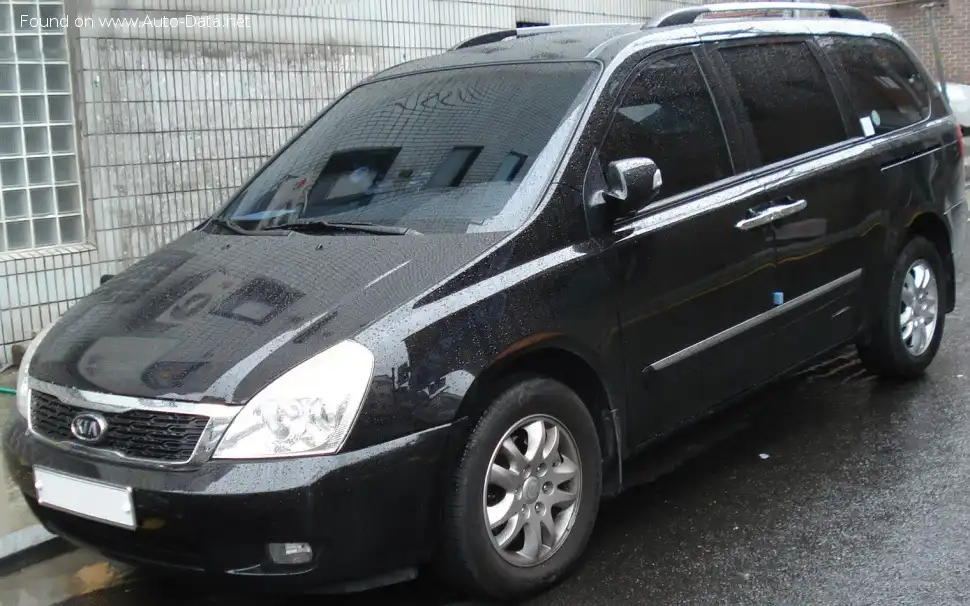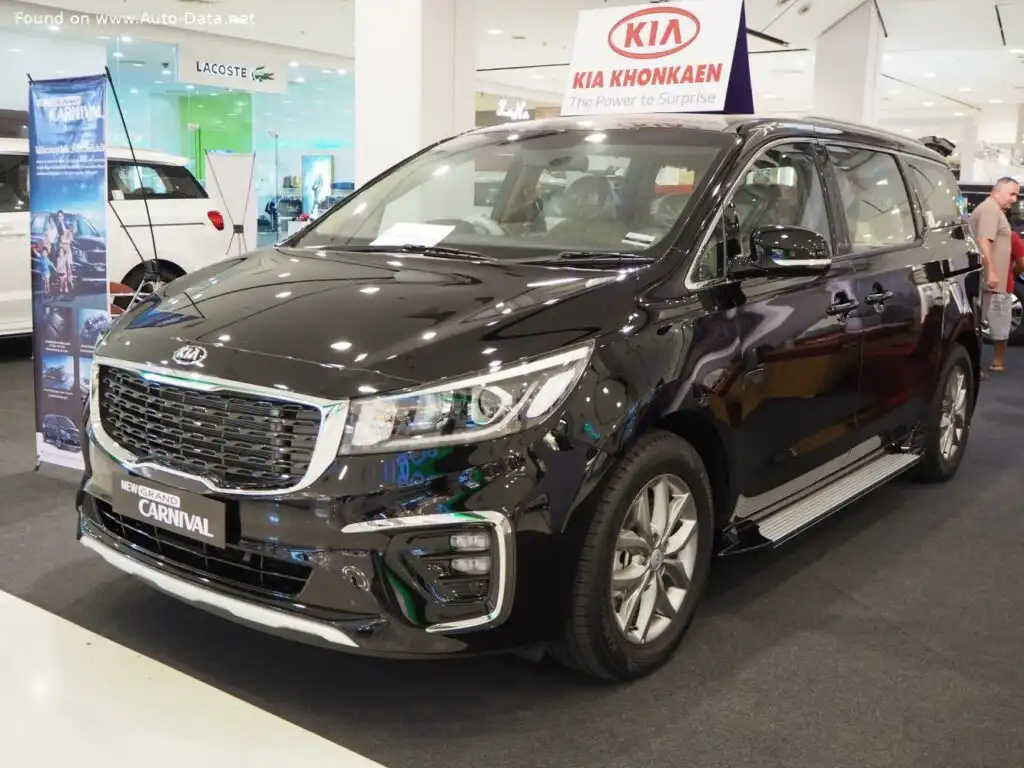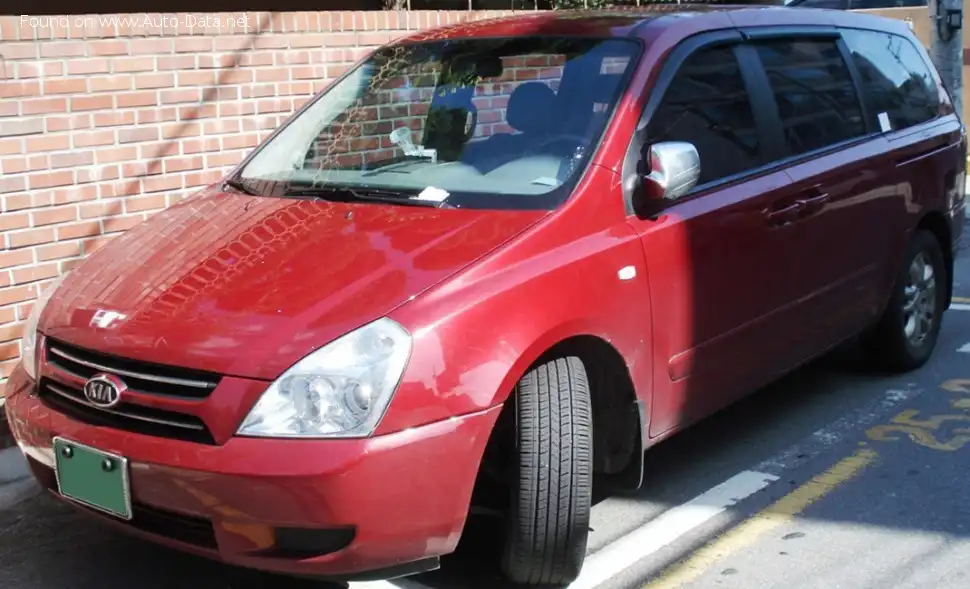
The Kia Grand Carnival II 2.9 CRDi Automatic, produced between 2006 and 2010, represented a significant step forward for Kia in the highly competitive minivan segment. This variant, powered by the 2.9-liter turbocharged diesel engine producing 192 horsepower, was positioned as a mid-range offering within the Grand Carnival II lineup, appealing to families seeking a blend of space, comfort, and reasonable fuel economy. It was primarily marketed in Asia, Australia, and parts of Europe, where larger MPVs were – and continue to be – popular. The Grand Carnival II, built on a dedicated minivan platform, aimed to provide a more refined and feature-rich experience compared to earlier Kia offerings.
Technical Specifications
| Brand | Kia |
| Model | Carnival |
| Generation | Grand Carnival II |
| Type (Engine) | 2.9 CRDi (192 Hp) Automatic |
| Start of production | 2006 |
| End of production | 2010 |
| Powertrain Architecture | Internal Combustion engine |
| Body type | Minivan |
| Seats | 7 |
| Doors | 5 |
| Fuel Type | Diesel |
| Weight-to-power ratio | 11.5 kg/Hp, 87.1 Hp/tonne |
| Weight-to-torque ratio | 6.4 kg/Nm, 155.6 Nm/tonne |
| Power | 192 Hp @ 3800 rpm |
| Power per litre | 66.2 Hp/l |
| Torque | 343 Nm @ 1750-3500 rpm (252.98 lb.-ft. @ 1750-3500 rpm) |
| Engine layout | Front, Transverse |
| Engine Model/Code | J3 |
| Engine displacement | 2902 cm3 (177.09 cu. in.) |
| Number of cylinders | 4 |
| Engine configuration | Inline |
| Cylinder Bore | 97.1 mm (3.82 in.) |
| Piston Stroke | 98 mm (3.86 in.) |
| Compression ratio | 18.4:1 |
| Number of valves per cylinder | 4 |
| Fuel injection system | Diesel Commonrail |
| Engine aspiration | Turbocharger, Intercooler |
| Valvetrain | DOHC |
| Engine oil capacity | 6.6 l (6.97 US qt | 5.81 UK qt) |
| Coolant | 10 l (10.57 US qt | 8.8 UK qt) |
| Kerb Weight | 2205 kg (4861.19 lbs.) |
| Trunk (boot) space – minimum | 912 l (32.21 cu. ft.) |
| Trunk (boot) space – maximum | 4007 l (141.51 cu. ft.) |
| Fuel tank capacity | 80 l (21.13 US gal | 17.6 UK gal) |
| Length | 5130 mm (201.97 in.) |
| Width | 1985 mm (78.15 in.) |
| Height | 1780 mm (70.08 in.) |
| Wheelbase | 3020 mm (118.9 in.) |
| Front track | 1685 mm (66.34 in.) |
| Rear (Back) track | 1685 mm (66.34 in.) |
| Drag coefficient (Cd) | 0.34 |
| Minimum turning circle | 12.1 m (39.7 ft.) |
| Drivetrain Architecture | The Internal combustion engine (ICE) drives the front wheels of the vehicle. |
| Drive wheel | Front wheel drive |
| Number of gears | 5 |
| Gearbox type | automatic transmission |
| Front suspension | Independent type McPherson |
| Rear suspension | Dependent spring suspension with transverse stabilizer |
| Front brakes | Ventilated discs |
| Rear brakes | Drum |
| Assisting systems | ABS (Anti-lock braking system) |
| Steering type | Steering rack and pinion |
| Tires size | 235/60 R17 |
| Wheel rims size | 17 |
Powertrain & Engine Architecture
The heart of the Grand Carnival II 2.9 CRDi Automatic is the J3 engine, a 2.9-liter inline-four cylinder diesel. This engine utilizes a second-generation common rail direct injection system, delivering fuel at extremely high pressures for improved combustion efficiency and reduced emissions. The turbocharger, coupled with an intercooler, provides increased air intake, boosting power output. The engine features a double overhead camshaft (DOHC) valvetrain with four valves per cylinder, optimizing gas flow. The 5-speed automatic transmission was a crucial component, chosen for its smooth operation and ease of use, catering to the target demographic of family buyers. While not offering the outright performance of a manual transmission, it prioritized comfort and convenience.
Driving Characteristics
The 192 horsepower and 343 Nm (253 lb-ft) of torque provided by the 2.9 CRDi engine offered adequate performance for a large minivan. Acceleration was respectable, though not sporty, with a focus on providing sufficient power for highway cruising and carrying a full load of passengers and cargo. The automatic transmission, while smooth, could sometimes feel hesitant during quick acceleration or when navigating hilly terrain. Compared to the available manual transmission, the automatic resulted in a slight decrease in fuel economy and a less engaging driving experience. However, the automatic’s ease of use was a significant advantage for many drivers, particularly in urban environments.
Equipment & Trim Levels
The 2.9 CRDi Automatic trim typically included features such as air conditioning, power windows and locks, a basic audio system, and standard safety equipment like ABS. Higher trim levels offered upgrades like leather upholstery, a sunroof, upgraded audio systems, and rear parking sensors. The interior was designed with practicality in mind, featuring durable materials and a flexible seating configuration. The seven-seat layout offered ample space for passengers, and the rear seats could be folded or removed to create a larger cargo area.
Chassis & Braking
The Grand Carnival II utilized an independent McPherson strut suspension in the front, providing a comfortable ride and decent handling. The rear suspension employed a dependent spring setup with a transverse stabilizer bar, which helped to reduce body roll during cornering. The braking system consisted of ventilated discs on the front wheels and drum brakes on the rear. While adequate for normal driving conditions, the rear drum brakes were a cost-saving measure and didn’t offer the same stopping power as disc brakes on all four wheels.
Market Reception & Comparison
The Kia Grand Carnival II 2.9 CRDi Automatic was generally well-received by critics as a practical and spacious family vehicle. It offered a compelling value proposition compared to more established competitors from Japan and Europe. Fuel economy was a strong point, particularly for a vehicle of its size. However, some reviewers noted the engine could be somewhat noisy and that the automatic transmission wasn’t as responsive as some rivals. Compared to the lower-powered 2.5-liter diesel variants, the 2.9 CRDi offered a noticeable performance improvement, making it a more suitable choice for those who frequently carried a full load or drove on highways.
Legacy
The Kia Grand Carnival II 2.9 CRDi Automatic has proven to be a relatively reliable vehicle, with many examples still on the road today. The J3 engine, while not without its quirks, is generally durable and capable of high mileage with proper maintenance. Common issues include turbocharger wear and potential problems with the fuel injection system. The automatic transmission, if serviced regularly, is also generally reliable. In the used car market, these Grand Carnivals represent a good value for buyers seeking a spacious and affordable minivan. Their practicality and relatively low running costs continue to make them a popular choice for families.