
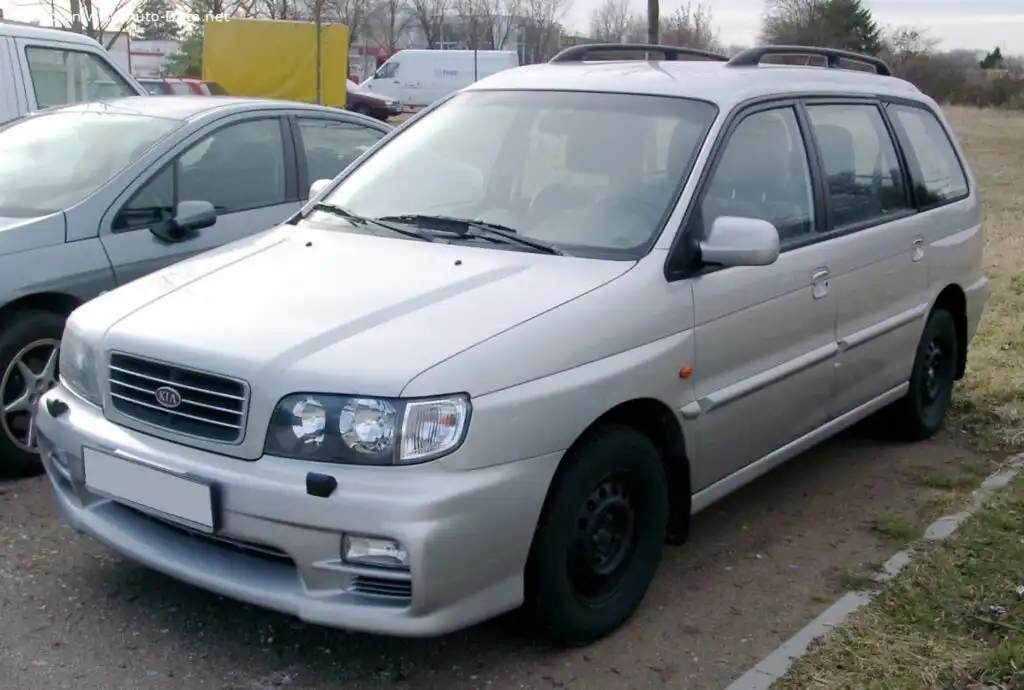
The Kia Joice 2.0i 16V Automatic, produced between 2001 and 2004, represents a significant offering in Kia’s early foray into the European and Asian minivan market. Positioned as a practical and spacious family vehicle, the Joice aimed to provide affordable seven-passenger transport. This particular variant, equipped with the 2.0-liter inline-four engine and a four-speed automatic transmission, served as a mid-range option within the Joice lineup, offering a balance between performance and convenience. It was primarily sold in markets where larger MPVs were less common, or where buyers prioritized value and practicality over outright performance.
Technical Specifications
| Brand | Kia |
| Model | Joice |
| Generation | Joice |
| Type (Engine) | 2.0i 16V (120 Hp) Automatic |
| Start of production | 2001 |
| End of production | 2004 |
| Powertrain Architecture | Internal Combustion engine |
| Body type | Minivan |
| Seats | 7 |
| Doors | 4 |
| Fuel consumption (urban) | 14.3 l/100 km (16.4 US mpg) |
| Fuel consumption (extra urban) | 8.4 l/100 km (28 US mpg) |
| Fuel Type | Petrol (Gasoline) |
| Acceleration 0 – 100 km/h | 14.5 sec |
| Acceleration 0 – 62 mph | 14.5 sec |
| Acceleration 0 – 60 mph | 13.8 sec |
| Maximum speed | 170 km/h (105.63 mph) |
| Weight-to-power ratio | 11.3 kg/Hp |
| Weight-to-torque ratio | 8.1 kg/Nm |
| Power | 120 Hp @ 5800 rpm |
| Torque | 167 Nm @ 2500 rpm (123.17 lb.-ft. @ 2500 rpm) |
| Engine layout | Front, Transverse |
| Engine Model/Code | Sirius / G4CP |
| Engine displacement | 1997 cm3 (121.86 cu. in.) |
| Number of cylinders | 4 |
| Engine configuration | Inline |
| Cylinder Bore | 85 mm (3.35 in.) |
| Piston Stroke | 88 mm (3.46 in.) |
| Compression ratio | 9:1 |
| Number of valves per cylinder | 4 |
| Fuel injection system | Multi-port manifold injection |
| Engine aspiration | Naturally aspirated engine |
| Engine oil capacity | 4.4 l (4.65 US qt | 3.87 UK qt) |
| Kerb Weight | 1350 kg (2976.24 lbs.) |
| Max. weight | 2070 kg (4563.57 lbs.) |
| Max load | 720 kg (1587.33 lbs.) |
| Trunk (boot) space – minimum | 165 l (5.83 cu. ft.) |
| Trunk (boot) space – maximum | 1907 l (67.35 cu. ft.) |
| Fuel tank capacity | 60 l (15.85 US gal | 13.2 UK gal) |
| Length | 4570 mm (179.92 in.) |
| Width | 1720 mm (67.72 in.) |
| Height | 1645 mm (64.76 in.) |
| Wheelbase | 2720 mm (107.09 in.) |
| Front track | 1460 mm (57.48 in.) |
| Rear (Back) track | 1460 mm (57.48 in.) |
| Drivetrain Architecture | The Internal combustion engine (ICE) drives the front wheels of the vehicle. |
| Drive wheel | Front wheel drive |
| Number of gears and type of gearbox | 4 gears, automatic transmission |
| Front suspension | Wishbone |
| Rear suspension | Coil spring |
| Front brakes | Ventilated discs |
| Rear brakes | Disc |
| Assisting systems | ABS (Anti-lock braking system) |
| Steering type | Steering rack and pinion |
| Power steering | Hydraulic Steering |
| Tires size | 195/70 R14 |
| Wheel rims size | 14 |
Powertrain & Engine Architecture
The Kia Joice 2.0i Automatic utilizes the Sirius/G4CP engine, a 1.997-liter inline-four cylinder gasoline engine. This engine features a single overhead camshaft (SOHC) design with four valves per cylinder (16V), contributing to reasonable breathing at higher RPMs. Fuel delivery is managed by a multi-point fuel injection system, a common setup for vehicles of this era. The engine produces 120 horsepower at 5800 rpm and 167 Nm (123.17 lb-ft) of torque at 2500 rpm. The four-speed automatic transmission, while providing convenience, is a relatively conventional unit. It lacks the sophistication of more modern automatic transmissions with more gears and electronic control. The transmission’s gear ratios are tuned for fuel efficiency and smooth operation rather than outright acceleration.
Driving Characteristics
The 2.0i Automatic Joice delivers adequate, but not exhilarating, performance. Acceleration from 0 to 60 mph takes approximately 13.8 seconds, and the top speed is around 105.63 mph. The automatic transmission contributes to a smooth driving experience, particularly in urban environments. However, the limited number of gears and the engine’s modest torque output mean that overtaking maneuvers require careful planning. Compared to the manual transmission versions of the Joice, the automatic suffers a slight performance penalty. The manual offered quicker acceleration and a more engaging driving experience, appealing to drivers who prioritized performance. The automatic, however, was favored by those seeking ease of use, especially in congested city traffic.
Equipment & Trim Levels
The 2.0i Automatic trim level typically included features such as power windows, central locking, and air conditioning as standard equipment. Interior upholstery was generally cloth, with options for upgraded materials available. The dashboard layout was functional and straightforward, prioritizing usability over aesthetic flair. Optional extras included a radio/cassette player (later upgraded to CD players), alloy wheels, and a sunroof. The Joice aimed to provide a comfortable and well-equipped interior for its price point, focusing on practicality for family use.
Chassis & Braking
The Joice utilizes a front-wheel-drive layout with a wishbone front suspension and a coil spring rear suspension. This setup provides a comfortable ride quality, although it’s not particularly sporty. The front brakes are ventilated discs, offering adequate stopping power, while the rear brakes are solid discs. Anti-lock Braking System (ABS) was included as a standard safety feature. The suspension tuning is geared towards absorbing bumps and providing a stable ride, making it suitable for everyday driving conditions. The relatively modest weight of the vehicle (1350 kg / 2976.24 lbs) helps to mitigate the effects of the engine’s limited power.
Market Reception & Comparison
The Kia Joice 2.0i Automatic received mixed reviews from automotive critics. While praised for its spacious interior, affordability, and practicality, it was often criticized for its lackluster performance and somewhat dated design. Fuel economy was considered average for its class, with urban consumption around 14.3 l/100 km (16.4 US mpg) and extra-urban consumption around 8.4 l/100 km (28 US mpg). Compared to other trims in the Joice lineup, the 2.0i Automatic offered a compromise between the base 1.6-liter engine’s fuel efficiency and the higher-performance options. It appealed to buyers who wanted a comfortable and practical minivan without prioritizing outright speed.
Legacy
The Kia Joice, while not a groundbreaking vehicle, played a role in establishing Kia as a viable competitor in the European and Asian markets. The 2.0i Automatic powertrain, while not known for exceptional reliability issues, requires regular maintenance to ensure longevity. Common issues include wear and tear on the automatic transmission and potential oil leaks from the engine. Today, the Joice 2.0i Automatic can be found on the used car market at very affordable prices. It represents a budget-friendly option for those seeking a spacious and practical family vehicle, but potential buyers should be aware of the vehicle’s age and potential maintenance requirements.
