
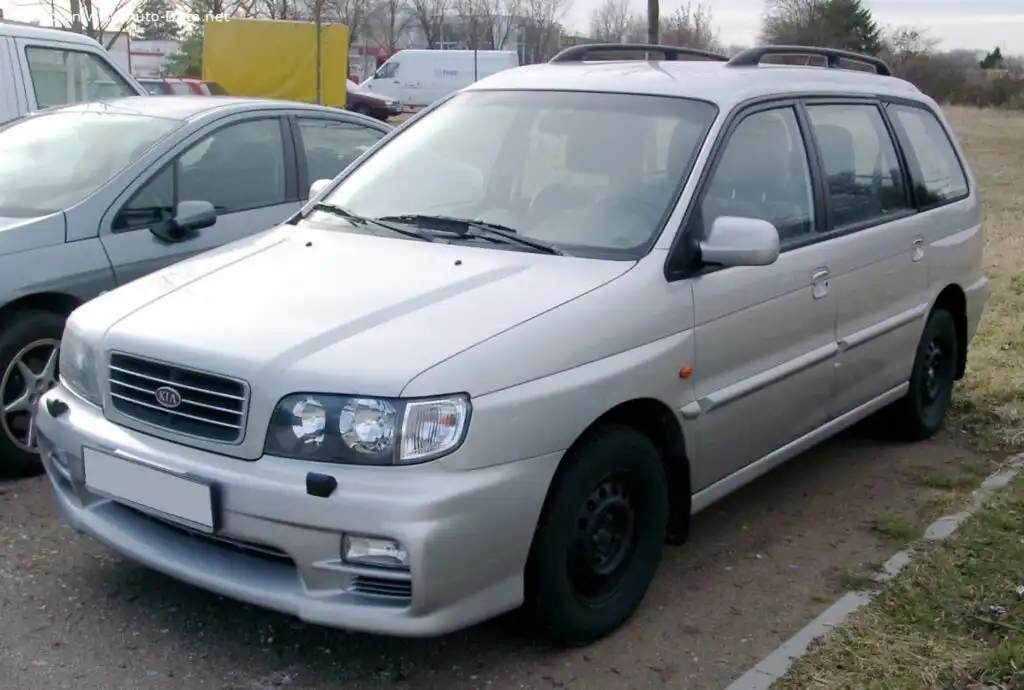
The Kia Joice 2.0i 16V, produced between 1999 and 2003, represented Kia’s entry into the compact minivan segment. Positioned as a practical and affordable family vehicle, the Joice aimed to provide seating for up to seven passengers in a relatively small footprint. This particular variant, equipped with the 2.0-liter inline-four engine producing 137 horsepower, was a mainstay of the Joice lineup, offering a balance between performance and fuel economy. It was primarily marketed towards families seeking a versatile vehicle for daily commuting and weekend trips. The Joice was not sold in the North American market, finding its primary customer base in Europe and Asia.
Technical Specifications
| Brand | Kia |
| Model | Joice |
| Generation | Joice |
| Type (Engine) | 2.0i 16V (137 Hp) |
| Start of production | 1999 |
| End of production | 2003 |
| Powertrain Architecture | Internal Combustion engine |
| Body type | Minivan |
| Seats | 7 |
| Doors | 4 |
| Fuel consumption (urban) | 13.4 l/100 km (17.6 US mpg, 21.1 UK mpg, 7.5 km/l) |
| Fuel consumption (extra urban) | 7.5 l/100 km (31.4 US mpg, 37.7 UK mpg, 13.3 km/l) |
| Fuel consumption (combined) | 9.7 l/100 km (24.2 US mpg, 29.1 UK mpg, 10.3 km/l) |
| Fuel Type | Petrol (Gasoline) |
| Acceleration 0 – 100 km/h | 12.8 sec |
| Acceleration 0 – 62 mph | 12.8 sec |
| Acceleration 0 – 60 mph | 12.2 sec |
| Maximum speed | 175 km/h (108.74 mph) |
| Power | 137 Hp @ 6000 rpm |
| Power per litre | 68.6 Hp/l |
| Torque | 188 Nm @ 4000 rpm (138.66 lb.-ft. @ 4000 rpm) |
| Engine layout | Front, Transverse |
| Engine displacement | 1997 cm3 (121.86 cu. in.) |
| Number of cylinders | 4 |
| Engine configuration | Inline |
| Cylinder Bore | 86 mm (3.39 in.) |
| Piston Stroke | 86 mm (3.39 in.) |
| Compression ratio | 9.5:1 |
| Number of valves per cylinder | 4 |
| Fuel injection system | Multi-port manifold injection |
| Engine aspiration | Naturally aspirated engine |
| Valvetrain | DOHC |
| Trunk (boot) space – minimum | 200 l (7.06 cu. ft.) |
| Trunk (boot) space – maximum | 1907 l (67.35 cu. ft.) |
| Fuel tank capacity | 60 l (15.85 US gal | 13.2 UK gal) |
| Length | 4570 mm (179.92 in.) |
| Width | 1720 mm (67.72 in.) |
| Height | 1645 mm (64.76 in.) |
| Wheelbase | 2720 mm (107.09 in.) |
| Front track | 1460 mm (57.48 in.) |
| Rear (Back) track | 1460 mm (57.48 in.) |
| Drivetrain Architecture | The Internal combustion engine (ICE) drives the front wheels of the vehicle. |
| Drive wheel | Front wheel drive |
| Number of gears and type of gearbox | 5 gears, manual transmission |
| Front suspension | Wishbone |
| Rear suspension | Coil spring |
| Front brakes | Ventilated discs |
| Rear brakes | Ventilated discs |
| Assisting systems | ABS (Anti-lock braking system) |
| Steering type | Steering rack and pinion |
| Power steering | Hydraulic Steering |
| Tires size | 195/70 R14 |
| Wheel rims size | 14 |
Powertrain & Engine Architecture
The heart of the Joice 2.0i 16V is the Kia-developed 1.997-liter inline-four cylinder engine. This engine, internally designated with various codes depending on the specific market, featured a double overhead camshaft (DOHC) valvetrain operating four valves per cylinder. This configuration allowed for improved breathing and higher engine speeds compared to older single overhead cam designs. Fuel delivery was handled by a multi-port fuel injection system, providing precise fuel metering for optimal combustion. The engine’s 9.5:1 compression ratio was a compromise between performance and the ability to run on readily available gasoline grades. The 137 horsepower output, while not exceptional, was sufficient for the Joice’s weight class and intended purpose. The engine was transversely mounted in the front of the vehicle, driving the front wheels. The standard transmission for this variant was a five-speed manual gearbox, offering a reasonable balance of fuel efficiency and driver control.
Driving Characteristics
The Joice 2.0i 16V with the five-speed manual transmission offered adequate, though not sporty, performance. Acceleration from 0 to 60 mph took approximately 12.2 seconds, and the top speed was around 108.74 mph. The engine delivered its peak torque of 138.66 lb.-ft. at 4000 rpm, providing reasonable pulling power for everyday driving and highway overtaking. The five-speed gearbox was well-matched to the engine’s characteristics, allowing drivers to keep the engine in its optimal power band. Compared to potential lower-powered variants (which were not widely available), the 2.0i offered a noticeable improvement in responsiveness. However, it didn’t possess the outright acceleration of larger or more powerful minivans available in other markets.
Equipment & Trim Levels
The Joice 2.0i 16V typically came equipped with a reasonable level of standard features. These included power steering, central locking, electric front windows, and an anti-lock braking system (ABS). Interior upholstery was typically cloth, with a functional, if somewhat basic, dashboard layout. Optional extras included air conditioning, a radio/cassette player (later upgraded to CD players), and alloy wheels. Higher trim levels might have added features such as a sunroof, upgraded interior trim, and additional safety equipment. The Joice was designed to be a value-oriented vehicle, so luxury features were generally kept to a minimum.
Chassis & Braking
The Joice utilized a front-wheel-drive layout with independent wishbone suspension at the front and a coil spring suspension at the rear. This setup provided a comfortable ride quality, suitable for everyday driving. The braking system consisted of ventilated discs on all four wheels, providing adequate stopping power. The ABS system further enhanced safety by preventing wheel lockup during hard braking. The steering was rack and pinion, offering precise and responsive handling. The vehicle rode on 14-inch wheels with 195/70 R14 tires, providing a good balance of grip and ride comfort.
Market Reception & Comparison
The Kia Joice 2.0i 16V was generally well-received in its target markets as a practical and affordable family vehicle. Critics praised its spacious interior, reasonable fuel economy, and competitive price point. However, some reviewers noted that the engine lacked refinement compared to some of its competitors. In terms of fuel economy, the Joice 2.0i 16V achieved around 24.2 US mpg on the combined cycle, which was competitive for its class. Reliability was generally good, although some owners reported minor issues with the electrical system. Compared to other minivans available at the time, the Joice offered a compelling value proposition, particularly for budget-conscious buyers.
Legacy
The Kia Joice, while not a groundbreaking vehicle, played an important role in establishing Kia as a credible player in the European and Asian automotive markets. The 2.0i 16V powertrain proved to be relatively durable and reliable, and many examples are still on the road today. In the used car market, the Joice 2.0i 16V remains an affordable and practical option for those seeking a spacious and versatile family vehicle. Its simple mechanical design and readily available parts make it relatively easy and inexpensive to maintain. While it may not offer the same level of sophistication as more modern minivans, the Joice continues to appeal to buyers who prioritize practicality and value.
