
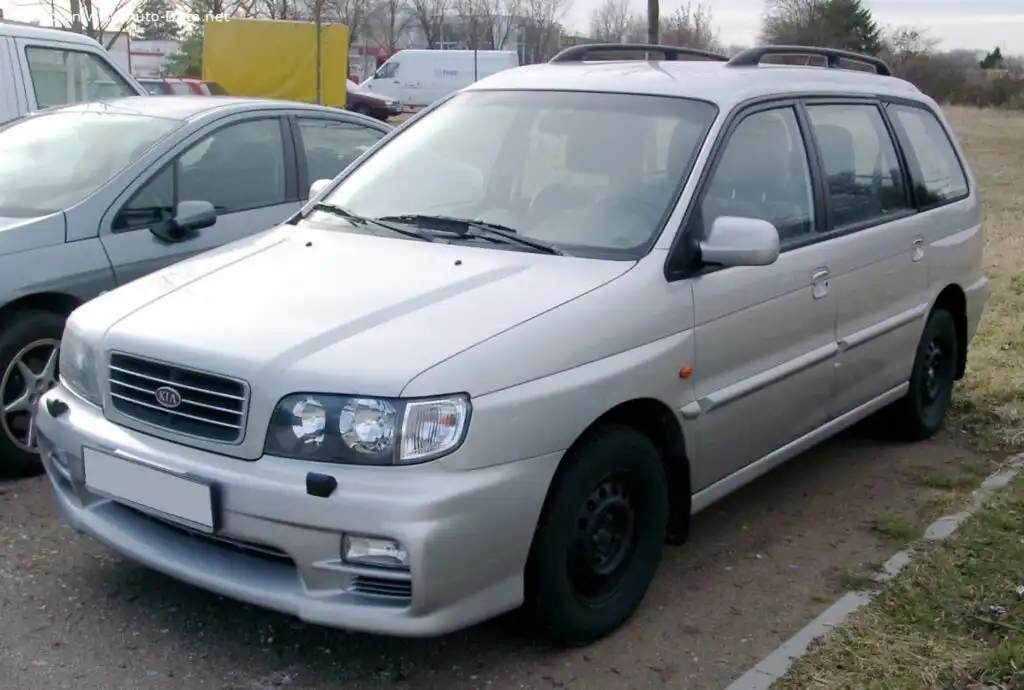
The Kia Joice 2.0i 16V, produced between 1999 and 2003, was a seven-seat minivan marketed primarily in Europe and Asia. Representing Kia’s entry into the increasingly popular compact MPV segment, the Joice aimed to provide affordable family transportation with a focus on practicality and space. This particular 2.0i 16V variant, equipped with a 139 horsepower engine, occupied a mid-range position within the Joice lineup, offering a balance between performance and fuel economy. It sat above the base 1.5 and 1.8 liter models, but below any potential future higher-performance trims.
Technical Specifications
| Brand | Kia |
| Model | Joice |
| Generation | Joice |
| Type (Engine) | 2.0i 16V (139 Hp) |
| Start of production | 1999 |
| End of production | 2003 |
| Powertrain Architecture | Internal Combustion engine |
| Body type | Minivan |
| Seats | 7 |
| Doors | 4 |
| Fuel consumption (urban) | 13.4 l/100 km (17.6 US mpg) |
| Fuel consumption (extra urban) | 7.5 l/100 km (31.4 US mpg) |
| Fuel Type | Petrol (Gasoline) |
| Acceleration 0 – 100 km/h | 12.8 sec |
| Acceleration 0 – 62 mph | 12.8 sec |
| Acceleration 0 – 60 mph | 12.2 sec |
| Maximum speed | 175 km/h (108.74 mph) |
| Weight-to-power ratio | 9.7 kg/Hp |
| Weight-to-torque ratio | 7.5 kg/Nm |
| Power | 139 Hp @ 5800 rpm |
| Power per litre | 69.6 Hp/l |
| Torque | 180 Nm @ 4000 rpm (132.76 lb.-ft. @ 4000 rpm) |
| Engine layout | Front, Transverse |
| Engine Model/Code | Sirius / G4CP |
| Engine displacement | 1997 cm3 (121.86 cu. in.) |
| Number of cylinders | 4 |
| Engine configuration | Inline |
| Cylinder Bore | 85 mm (3.35 in.) |
| Piston Stroke | 88 mm (3.46 in.) |
| Compression ratio | 9.5:1 |
| Number of valves per cylinder | 4 |
| Fuel injection system | Multi-port manifold injection |
| Engine aspiration | Naturally aspirated engine |
| Valvetrain | DOHC |
| Engine oil capacity | 4.4 l (4.65 US qt | 3.87 UK qt) |
| Kerb Weight | 1350 kg (2976.24 lbs.) |
| Max. weight | 2070 kg (4563.57 lbs.) |
| Max load | 720 kg (1587.33 lbs.) |
| Trunk (boot) space – minimum | 200 l (7.06 cu. ft.) |
| Trunk (boot) space – maximum | 1907 l (67.35 cu. ft.) |
| Fuel tank capacity | 60 l (15.85 US gal | 13.2 UK gal) |
| Length | 4570 mm (179.92 in.) |
| Width | 1720 mm (67.72 in.) |
| Height | 1645 mm (64.76 in.) |
| Wheelbase | 2720 mm (107.09 in.) |
| Front track | 1460 mm (57.48 in.) |
| Rear (Back) track | 1460 mm (57.48 in.) |
| Drivetrain Architecture | The Internal combustion engine (ICE) drives the front wheels of the vehicle. |
| Drive wheel | Front wheel drive |
| Number of gears and type of gearbox | 5 gears, manual transmission |
| Front suspension | Wishbone |
| Rear suspension | Coil spring |
| Front brakes | Ventilated discs |
| Rear brakes | Ventilated discs |
| Assisting systems | ABS (Anti-lock braking system) |
| Steering type | Steering rack and pinion |
| Power steering | Hydraulic Steering |
| Tires size | 195/70 R14 |
| Wheel rims size | 5.5J x 14 |
Powertrain & Engine Architecture
The Kia Joice 2.0i 16V was powered by the Sirius (G4CP) engine, a 1.997-liter inline-four cylinder gasoline engine. This engine featured a double overhead camshaft (DOHC) valvetrain with four valves per cylinder, contributing to its relatively high output for its displacement. Fuel delivery was managed by a multi-port fuel injection system, providing precise fuel metering for improved efficiency and performance. The engine produced 139 horsepower at 5800 rpm and 180 Nm (132.76 lb-ft) of torque at 4000 rpm. The engine’s 9.5:1 compression ratio was a typical value for naturally aspirated engines of this era. The five-speed manual transmission was the standard offering, providing drivers with full control over gear selection. The transmission was chosen for its durability and relatively simple design.
Driving Characteristics
The 2.0i 16V Joice offered a noticeable improvement in performance compared to the lower-displacement engine options. While not a particularly sporty vehicle, the 139 hp engine provided adequate power for highway cruising and overtaking maneuvers. Acceleration from 0 to 100 km/h (0-62 mph) took approximately 12.8 seconds. The five-speed manual transmission allowed drivers to keep the engine in its optimal power band, maximizing acceleration. The gear ratios were fairly conventional, prioritizing fuel economy at cruising speeds. Compared to a hypothetical higher-performance version, the 2.0i prioritized usability and fuel efficiency over outright speed. The front-wheel-drive configuration provided predictable handling, although it wasn’t particularly engaging for enthusiastic drivers.
Equipment & Trim Levels
The 2.0i 16V Joice typically came equipped with features such as power steering, central locking, electric front windows, and an anti-lock braking system (ABS). Interior upholstery was generally cloth, with a relatively simple dashboard layout. Optional extras included air conditioning, a radio/cassette player, and alloy wheels. The trim level often dictated the availability of these options, with higher trims offering more standard features. The Joice was designed to be a practical family vehicle, so luxury features were generally kept to a minimum.
Chassis & Braking
The Joice utilized a front-wheel-drive layout with independent wishbone suspension at the front and a coil spring suspension at the rear. This suspension setup provided a reasonable balance between ride comfort and handling. The front brakes were ventilated discs, offering good stopping power, while the rear brakes were also ventilated discs. The ABS system helped to prevent wheel lockup during hard braking, improving stability and control. The chassis was designed to maximize interior space, resulting in a relatively high center of gravity. Stabilizer bars were included to reduce body roll during cornering.
Market Reception & Comparison
The Kia Joice 2.0i 16V was generally well-received by critics as a practical and affordable family vehicle. It offered a good level of space and comfort for its price point. However, some reviewers noted that the engine could feel strained when fully loaded or driving uphill. Compared to competitors like the Renault Scenic or Citroën Xsara Picasso, the Joice offered a more basic interior and less refined driving experience, but it often undercut them on price. Fuel economy was respectable for its class, averaging around 31.4 US mpg on the highway. Reliability was generally considered to be good, although some owners reported minor issues with the electrical system.
Legacy
The Kia Joice, and specifically the 2.0i 16V variant, has become a relatively affordable and practical option in the used car market. The Sirius engine is known for its durability, although regular maintenance is essential to prevent issues. Parts availability is generally good, and the relatively simple mechanical design makes it accessible for DIY repairs. While it may not offer the prestige or refinement of some of its competitors, the Joice remains a viable option for those seeking a spacious and affordable family vehicle. Its legacy lies in providing a budget-friendly MPV option that helped establish Kia as a more prominent player in the European and Asian automotive markets.
