
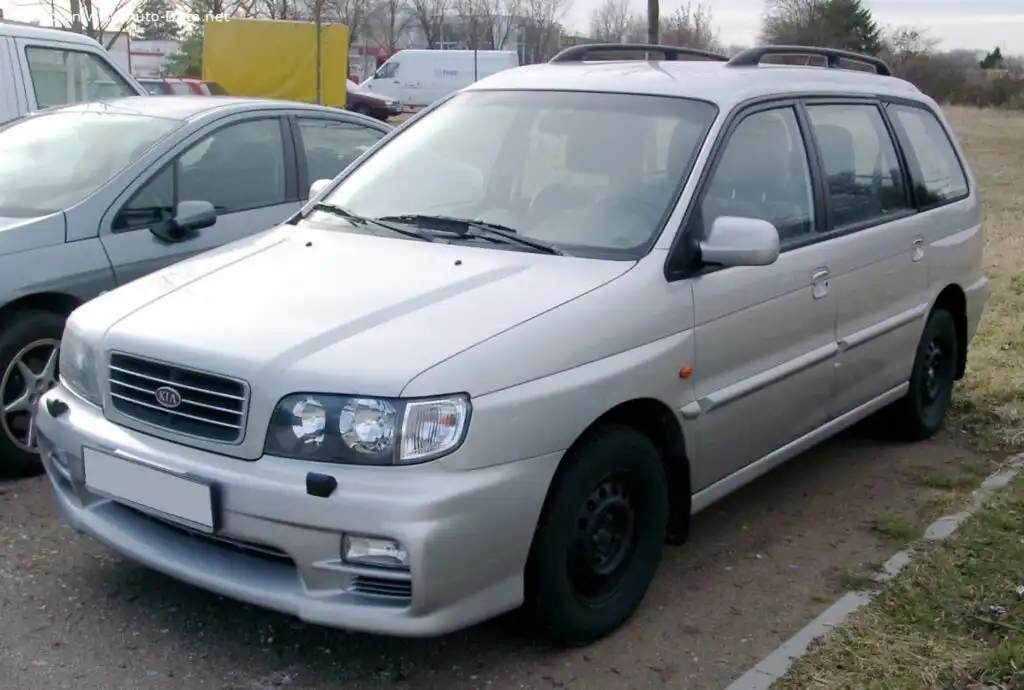
The Kia Joice 2.0i 16V Automatic, produced between 1999 and 2003, was a seven-seat minivan aimed at providing affordable family transportation. Positioned as a mid-range offering within the Joice lineup, it slotted above the base 1.5L models and below any potential higher-performance or luxury trims (which were not commonly offered). The Joice, Kia’s initial foray into the European MPV market, was largely based on the Mitsubishi Space Wagon, benefiting from a collaborative engineering effort. This variant, with its 2.0-liter engine and automatic transmission, was designed to appeal to buyers prioritizing convenience and ease of driving over outright performance.
Technical Specifications
| Brand | Kia |
| Model | Joice |
| Generation | Joice |
| Type (Engine) | 2.0i 16V (139 Hp) Automatic |
| Start of production | 1999 |
| End of production | 2003 |
| Powertrain Architecture | Internal Combustion engine |
| Body type | Minivan |
| Seats | 7 |
| Doors | 4 |
| Fuel consumption (urban) | 13.4 l/100 km (17.6 US mpg) |
| Fuel consumption (extra urban) | 7.5 l/100 km (31.4 US mpg) |
| Fuel Type | Petrol (Gasoline) |
| Acceleration 0 – 100 km/h | 12.8 sec |
| Acceleration 0 – 62 mph | 12.8 sec |
| Acceleration 0 – 60 mph | 12.2 sec |
| Maximum speed | 175 km/h (108.74 mph) |
| Weight-to-power ratio | 9.7 kg/Hp |
| Weight-to-torque ratio | 7.5 kg/Nm |
| Power | 139 Hp @ 5800 rpm |
| Power per litre | 69.6 Hp/l |
| Torque | 180 Nm @ 4000 rpm (132.76 lb.-ft. @ 4000 rpm) |
| Engine layout | Front, Transverse |
| Engine Model/Code | Sirius / G4CP |
| Engine displacement | 1997 cm3 (121.86 cu. in.) |
| Number of cylinders | 4 |
| Engine configuration | Inline |
| Cylinder Bore | 85 mm (3.35 in.) |
| Piston Stroke | 88 mm (3.46 in.) |
| Compression ratio | 9.5:1 |
| Number of valves per cylinder | 4 |
| Fuel injection system | Multi-port manifold injection |
| Engine aspiration | Naturally aspirated engine |
| Valvetrain | DOHC |
| Engine oil capacity | 4.4 l (4.65 US qt | 3.87 UK qt) |
| Kerb Weight | 1350 kg (2976.24 lbs.) |
| Max. weight | 2070 kg (4563.57 lbs.) |
| Max load | 720 kg (1587.33 lbs.) |
| Trunk (boot) space – minimum | 200 l (7.06 cu. ft.) |
| Trunk (boot) space – maximum | 1907 l (67.35 cu. ft.) |
| Fuel tank capacity | 60 l (15.85 US gal | 13.2 UK gal) |
| Length | 4570 mm (179.92 in.) |
| Width | 1720 mm (67.72 in.) |
| Height | 1645 mm (64.76 in.) |
| Wheelbase | 2720 mm (107.09 in.) |
| Front track | 1460 mm (57.48 in.) |
| Rear (Back) track | 1460 mm (57.48 in.) |
| Drivetrain Architecture | The Internal combustion engine (ICE) drives the front wheels of the vehicle. |
| Drive wheel | Front wheel drive |
| Number of gears and type of gearbox | 4 gears, automatic transmission |
| Front suspension | Wishbone |
| Rear suspension | Coil spring |
| Front brakes | Ventilated discs |
| Rear brakes | Ventilated discs |
| Assisting systems | ABS (Anti-lock braking system) |
| Steering type | Steering rack and pinion |
| Power steering | Hydraulic Steering |
| Tires size | 195/70 R14 |
| Wheel rims size | 5.5J x 14 |
Powertrain & Engine Architecture
The Kia Joice 2.0i Automatic utilized the Kia Sirius engine, internally designated as the G4CP. This 1997cc inline-four cylinder engine featured a double overhead camshaft (DOHC) valvetrain with four valves per cylinder, contributing to its 16V designation. The engine employed multi-point fuel injection, a common technology in the late 1990s and early 2000s, for precise fuel delivery. The 9.5:1 compression ratio was a typical value for naturally aspirated gasoline engines of the era, balancing performance and fuel efficiency. The automatic transmission was a conventional four-speed unit, chosen for its ease of use and suitability for family transport. While not particularly advanced, it provided smooth shifts and adequate performance for everyday driving. The engine’s design prioritized reliability and affordability over cutting-edge technology.
Driving Characteristics
The 139 horsepower and 180 Nm (132.76 lb-ft) of torque delivered by the 2.0i engine, coupled with the four-speed automatic transmission, resulted in a driving experience focused on comfort and practicality. Acceleration from 0-60 mph took around 12.2 seconds, and top speed was approximately 108.74 mph. Compared to the base 1.5L engine, the 2.0i offered noticeably improved acceleration and highway cruising ability. However, it wasn’t a sporty vehicle; the automatic transmission prioritized smooth shifts over aggressive downshifts. The gear ratios were tuned for fuel economy and relaxed driving, meaning the engine could feel somewhat strained when accelerating hard or climbing hills. The automatic transmission, while convenient, did diminish some of the engine’s potential compared to a manual transmission equipped model, if one were available.
Equipment & Trim Levels
The 2.0i Automatic trim typically included features such as power windows, central locking, and an AM/FM radio. Air conditioning was often standard, though it could be optional depending on the specific market. Interior upholstery was generally cloth, with a durable and practical design. Higher-spec Joice models might have offered features like alloy wheels, a sunroof, and upgraded audio systems, but these were less common on the 2.0i Automatic. The focus was on providing a well-equipped, family-friendly vehicle at a competitive price point.
Chassis & Braking
The Kia Joice featured a front-wheel-drive layout with a wishbone front suspension and a coil spring rear suspension. This setup provided a comfortable ride, although handling was not particularly sharp. The braking system consisted of ventilated discs on all four wheels, along with an Anti-lock Braking System (ABS) for improved safety. The ABS was a significant feature for the time, enhancing braking performance in slippery conditions. Steering was rack and pinion with hydraulic power assistance, providing reasonable steering feel and ease of maneuverability.
Market Reception & Comparison
The Kia Joice 2.0i Automatic was generally well-received as a practical and affordable family vehicle. Critics praised its spacious interior, comfortable ride, and reasonable fuel economy. However, it was often criticized for its somewhat bland styling and lack of driving excitement. Compared to other MPVs in its class, such as the Renault Scenic or Citroën Xsara Picasso, the Joice offered a more budget-friendly option. The 2.0i engine provided a noticeable improvement in performance over the base 1.5L, making it a more suitable choice for buyers who frequently carried passengers or drove on highways. Fuel economy was comparable to other vehicles in its segment, averaging around 21.1 UK mpg (37.7 US mpg) on the extra urban cycle.
Legacy
The Kia Joice, while not a groundbreaking vehicle, played an important role in establishing Kia as a credible player in the European market. The 2.0i engine, while not known for exceptional longevity, proved to be reasonably reliable with proper maintenance. Today, Joices are relatively rare sights on the road, and those that remain are typically well-maintained examples owned by enthusiasts. The 2.0i Automatic variant is considered a desirable option due to its improved performance and ease of driving. Parts availability can be a challenge, but many components are shared with Mitsubishi models, making sourcing replacements somewhat easier. The Joice represents a significant step forward for Kia, demonstrating their commitment to building affordable and practical vehicles.
