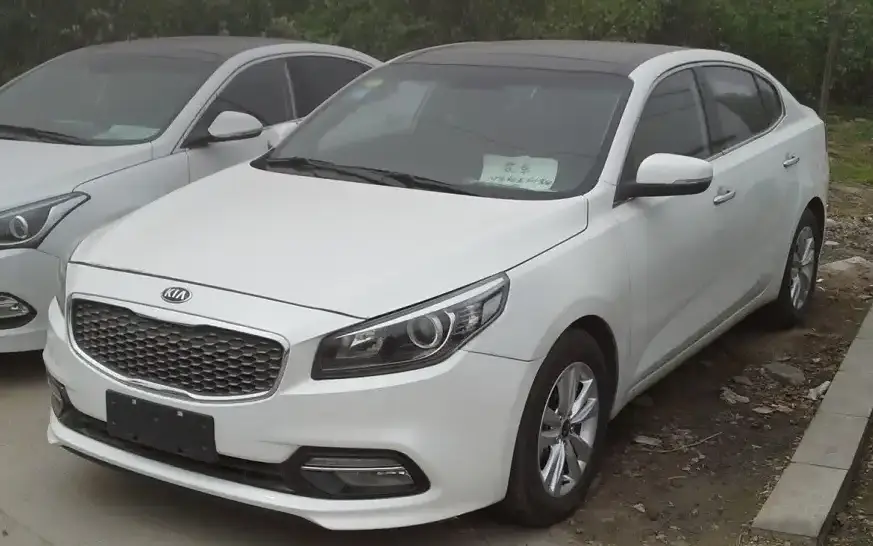
The Kia K4 (facelift, introduced in 2018) 1.6 GDI (175 hp) with a Dual Clutch Transmission (DCT) represents a significant iteration of Kia’s compact sedan, positioned as a mainstream offering within the K4 lineup. Produced from 2018 through October 2020, this variant aimed to balance performance, fuel efficiency, and modern technology, appealing to a broad segment of the family car market. It was primarily sold in markets where Kia sought to establish a stronger presence in the compact sedan class, offering a more sophisticated alternative to base-model competitors. This facelift brought updated styling and powertrain refinements to the existing K4 platform.
Technical Specifications
| Brand | Kia |
| Model | K4 |
| Generation | K4 (facelift 2018) |
| Type (Engine) | 1.6 GDI (175 Hp) DCT |
| Start of production | 2018 |
| End of production | October, 2020 |
| Powertrain Architecture | Internal Combustion engine |
| Body type | Sedan |
| Seats | 5 |
| Doors | 4 |
| Fuel consumption (combined) | 6.3-6.5 l/100 km (37.3 – 36.2 US mpg, 44.8 – 43.5 UK mpg, 15.9 – 15.4 km/l) |
| Fuel Type | Petrol (Gasoline) |
| Weight-to-power ratio | 8.4 kg/Hp, 119.5 Hp/tonne |
| Weight-to-torque ratio | 5.5 kg/Nm, 180.9 Nm/tonne |
| Power | 175 Hp @ 5500 rpm |
| Power per litre | 110 Hp/l |
| Torque | 265 Nm @ 1500-4500 rpm (195.45 lb.-ft. @ 1500-4500 rpm) |
| Engine layout | Front, Transverse |
| Engine Model/Code | Gamma II / G4FJ |
| Engine displacement | 1591 cm3 (97.09 cu. in.) |
| Number of cylinders | 4 |
| Engine configuration | Inline |
| Number of valves per cylinder | 4 |
| Fuel injection system | Direct injection |
| Engine aspiration | Turbocharger, Intercooler |
| Valvetrain | DOHC |
| Kerb Weight | 1465 kg (3229.77 lbs.) |
| Fuel tank capacity | 62 l (16.38 US gal | 13.64 UK gal) |
| Length | 4720 mm (185.83 in.) |
| Width | 1815 mm (71.46 in.) |
| Height | 1465 mm (57.68 in.) |
| Wheelbase | 2770 mm (109.06 in.) |
| Front track | 1567 mm (61.69 in.) |
| Rear track | 1577 mm (62.09 in.) |
| Ride height (ground clearance) | 117 mm (4.61 in.) |
| Minimum turning circle | 11.12 m (36.48 ft.) |
| Drivetrain Architecture | Front wheel drive, Internal Combustion engine |
| Number of gears and type of gearbox | 7 gears, automatic transmission DCT |
| Front suspension | Independent type McPherson |
| Rear suspension | Independent multi-link suspension |
| Front brakes | Ventilated discs |
| Rear brakes | Disc |
| Assisting systems | ABS (Anti-lock braking system) |
| Steering type | Steering rack and pinion |
| Tires size | 215/50 R17 |
| Wheel rims size | 17 |
Powertrain & Engine Architecture
At the heart of the K4 1.6 GDI DCT lies the Gamma II engine, specifically the G4FJ code. This 1.6-liter inline-four cylinder engine utilizes direct fuel injection (GDI) and a single turbocharger with an intercooler. The direct injection system allows for precise fuel delivery, enhancing both power and fuel efficiency. The turbocharger provides a boost in power output, overcoming the limitations of a smaller displacement engine. The engine employs a Double Overhead Camshaft (DOHC) valvetrain, optimizing airflow for improved performance. The DCT (Dual Clutch Transmission) is a seven-speed unit, offering quicker and smoother gear changes compared to a traditional automatic transmission. This transmission contributes to a more engaging driving experience and improved fuel economy. The engine is transversely mounted, a common configuration for front-wheel-drive vehicles.
Driving Characteristics
The 175 hp and 265 Nm (195 lb-ft) of torque delivered by the 1.6 GDI engine, coupled with the seven-speed DCT, provided a respectable level of performance for a compact sedan. Acceleration was brisk, particularly in the lower gears, thanks to the turbocharger’s boost. The DCT’s quick shifts minimized power loss during gear changes. Compared to lower-powered K4 variants, such as those with naturally aspirated engines, this version offered a noticeably more responsive and engaging driving experience. However, it didn’t match the outright performance of potential higher-output engine options (if available in other markets). The DCT’s programming prioritized fuel efficiency, resulting in slightly taller gear ratios, which contributed to good highway cruising but could sometimes feel a bit sluggish during quick overtaking maneuvers. Overall, the driving experience was refined and comfortable, suitable for daily commuting and longer journeys.
Equipment & Trim Levels
The K4 1.6 GDI DCT typically came equipped with a solid range of standard features. These generally included air conditioning, power windows and locks, a touchscreen infotainment system with Bluetooth connectivity, and a rearview camera. Higher trim levels, often denoted by specific packages, added features such as leather upholstery, a sunroof, automatic climate control, and advanced driver-assistance systems (ADAS) like lane departure warning and automatic emergency braking. Interior upholstery was typically cloth on base models, with leather options available on higher trims. Dashboard configurations were generally modern and functional, with a focus on ease of use. Optional extras often included navigation systems, premium audio systems, and alloy wheels.
Chassis & Braking
The K4’s chassis featured an independent McPherson strut suspension in the front and an independent multi-link suspension in the rear. This setup provided a good balance between ride comfort and handling. The front suspension utilized coil springs and stabilizer bars to reduce body roll during cornering. The rear suspension was designed to absorb bumps and provide a stable ride. Braking duties were handled by ventilated discs on the front wheels and solid discs on the rear. The inclusion of ABS (Anti-lock Braking System) was standard, enhancing safety during emergency braking situations. Steering was rack and pinion, providing precise and responsive control.
Market Reception & Comparison
The Kia K4 1.6 GDI DCT was generally well-received by automotive critics. It was praised for its combination of fuel efficiency, performance, and features. The DCT transmission was a highlight, offering a more engaging driving experience than traditional automatics. Fuel economy figures of 6.3-6.5 l/100 km (37.3-36.2 US mpg) were competitive within the compact sedan segment. Compared to other K4 trims, the 1.6 GDI DCT offered a noticeable performance upgrade without a significant penalty in fuel economy. Reliability reports were generally positive, with the Gamma II engine proving to be a durable and dependable unit. However, some critics noted that the interior materials, while well-assembled, weren’t as premium as those found in some competing models.
Legacy
The Kia K4 1.6 GDI DCT has established itself as a reliable and affordable option in the used car market. The Gamma II engine, when properly maintained, has proven to be quite durable. The DCT transmission, while requiring occasional servicing, has generally held up well over time. These vehicles represent a good value proposition for buyers seeking a well-equipped and fuel-efficient compact sedan. The K4’s success contributed to Kia’s growing reputation for quality and reliability, helping to establish the brand as a major player in the global automotive market. As a facelifted model, it benefited from the improvements and refinements made to the original K4 platform, making it a desirable choice for those seeking a modern and dependable vehicle.