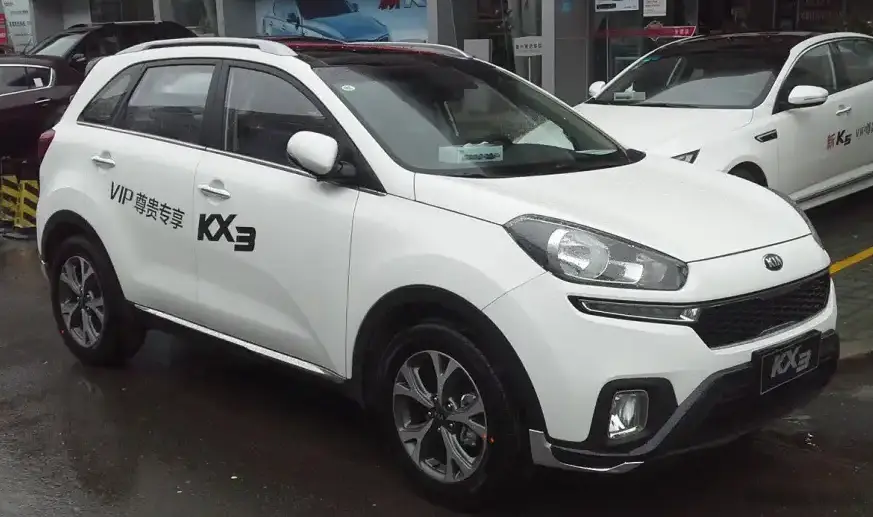
The Kia KX3, specifically the facelifted version introduced in 2017 and continuing into 2019, represents Kia’s entry into the burgeoning subcompact electric SUV market. This variant, equipped with a 45.2 kWh battery pack delivering 111 horsepower, was primarily aimed at the Chinese market, where demand for electric vehicles was rapidly increasing. The KX3 EV served as an important stepping stone for Kia in developing and refining its electric vehicle technology, offering a relatively affordable and practical option for urban commuters. It’s positioned as the base electric model within the KX3 lineup, offering a more accessible price point compared to potential higher-range or more powerful variants.
Technical Specifications
| Brand | Kia |
| Model | KX3 |
| Generation | KX3 (facelift 2017) |
| Type (Engine) | 45.2 kWh (111 Hp) EV |
| Start of production | 2019 |
| Powertrain Architecture | BEV (Electric Vehicle) |
| Body type | SUV |
| Seats | 5 |
| Doors | 5 |
| Fuel Type | Electricity |
| Maximum speed | 150 km/h (93.21 mph) |
| Weight-to-power ratio | 14.9 kg/Hp, 67.3 Hp/tonne |
| Gross battery capacity | 45.2 kWh |
| All-electric range | 300 km (186.41 mi) |
| Electric motor power | 111 Hp |
| Electric motor Torque | 285 Nm (210.21 lb.-ft.) |
| System power | 111 Hp |
| Kerb Weight | 1650 kg (3637.63 lbs.) |
| Length | 4290 mm (168.9 in.) |
| Width | 1780 mm (70.08 in.) |
| Height | 1650 mm (64.96 in.) |
| Wheelbase | 2590 mm (101.97 in.) |
| Ride height (ground clearance) | 180 mm (7.09 in.) |
| Drive wheel | Front wheel drive |
| Number of gears and type of gearbox | 1 gears, automatic transmission |
| Front suspension | Independent type McPherson |
| Rear suspension | Independent multi-link suspension |
| Front brakes | Ventilated discs |
| Rear brakes | Disc |
| Assisting systems | ABS (Anti-lock braking system) |
| Tires size | 215/60 R17 |
| Wheel rims size | 17 |
Powertrain & Engine Architecture
The Kia KX3 EV utilizes a fully electric powertrain, designated as a Battery Electric Vehicle (BEV). The heart of the system is a permanent magnet synchronous motor producing 111 horsepower and 285 Nm (210.21 lb.-ft.) of torque. This motor is directly coupled to the front wheels via a single-speed automatic transmission – a characteristic of most electric vehicles, as the motor provides instant torque across a wide RPM range, negating the need for multiple gears. The 45.2 kWh lithium-ion battery pack is positioned under the vehicle floor, contributing to a lower center of gravity and improved handling. The battery supports standard charging methods, including AC charging for overnight replenishment and DC fast charging for quicker top-ups. The vehicle’s electronic control unit (ECU) manages the power delivery, regenerative braking, and overall energy efficiency of the system.
Driving Characteristics
The 111 hp and 285 Nm of torque provide adequate performance for urban and suburban driving. Acceleration is brisk from a standstill, typical of electric motors, but the KX3 EV isn’t designed for high-speed performance. The single-speed transmission delivers a linear power curve, without the gear changes experienced in internal combustion engine vehicles. Top speed is limited to 150 km/h (93.21 mph). Compared to potential higher-powered variants (which were not widely available), this version prioritizes efficiency and affordability over outright speed. The regenerative braking system allows for one-pedal driving in certain conditions, enhancing convenience and maximizing energy recovery. The front-wheel-drive configuration provides predictable handling, although it may exhibit some torque steer under hard acceleration.
Equipment & Trim Levels
The KX3 EV, in its base configuration, typically included standard features such as air conditioning, power windows, power door locks, and a basic infotainment system with a touchscreen display. Safety features included ABS, airbags, and a rearview camera. Higher trim levels, if offered, might have added features like leather upholstery, a larger touchscreen display with navigation, automatic climate control, and advanced driver-assistance systems (ADAS) such as lane departure warning and automatic emergency braking. The interior design was generally functional and modern, reflecting Kia’s evolving design language at the time. The specific trim levels and available options varied depending on the region and market.
Chassis & Braking
The KX3 EV utilizes a McPherson strut suspension setup at the front and an independent multi-link suspension at the rear. This configuration provides a good balance between ride comfort and handling. The suspension is tuned to prioritize comfort for everyday driving, but it also offers reasonable control in corners. The braking system consists of ventilated discs at the front and solid discs at the rear, providing adequate stopping power. ABS (Anti-lock Braking System) is standard, enhancing safety during emergency braking situations. The vehicle rides on 17-inch alloy wheels with 215/60 R17 tires, offering a good compromise between grip and rolling resistance.
Market Reception & Comparison
The Kia KX3 EV was generally well-received in the Chinese market, where it competed with other subcompact electric SUVs. Critics praised its affordability, practicality, and decent range for urban commuting. However, some reviewers noted that the interior materials were not as premium as those found in some competitors. Compared to other trims within the KX3 lineup (primarily gasoline-powered versions), the EV offered a quieter and more environmentally friendly driving experience, but it came with a higher initial purchase price. Fuel economy, naturally, was a significant advantage for the EV, with electricity costs being considerably lower than gasoline costs in many areas. Reliability reports have been generally positive, with the electric powertrain proving to be relatively robust.
Legacy
The Kia KX3 EV played a crucial role in establishing Kia as a player in the electric vehicle market. It provided valuable data and experience that informed the development of subsequent electric models, such as the Niro EV and the EV6. While the KX3 EV itself is no longer in production, it remains a popular choice in the used car market, particularly in China. The 45.2 kWh battery pack and electric motor have proven to be relatively reliable, and the vehicle’s simple design makes it relatively easy to maintain. As the demand for electric vehicles continues to grow, the KX3 EV serves as a reminder of Kia’s early efforts in the electrification of its vehicle lineup.