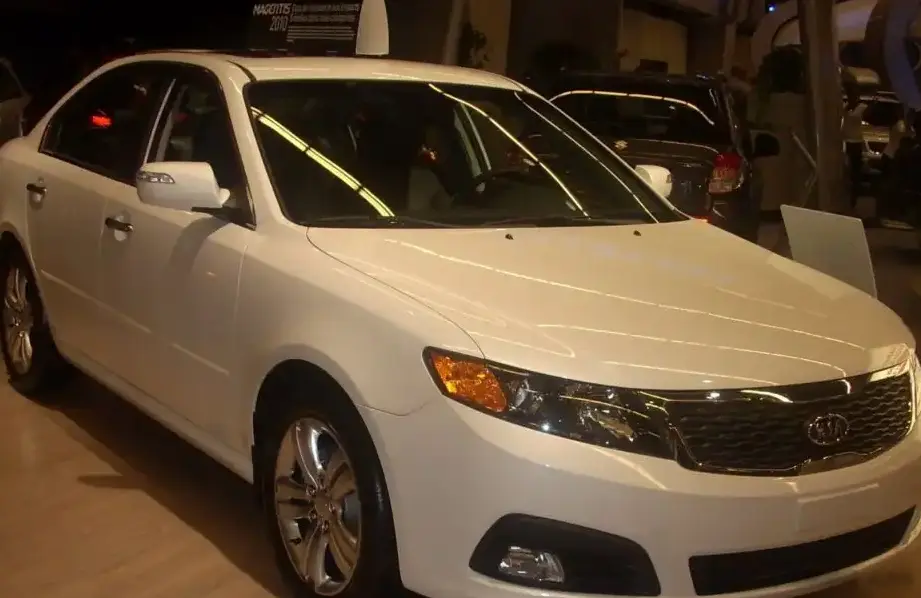
The Kia Magentis II 2.0 CVVT, produced between 2005 and 2008, represented a significant step forward for Kia in the mid-size sedan segment. This variant, equipped with the Theta II 2.0-liter engine producing 144 horsepower, was positioned as a mainstream offering within the Magentis II lineup, aiming to balance performance, fuel efficiency, and affordability. It built upon the foundation of the first-generation Magentis, offering improved styling, a more refined interior, and updated technology. The Magentis II, known as the Optima in some markets, was Kia’s attempt to gain a stronger foothold against established competitors like the Honda Accord and Toyota Camry, particularly in North America and Europe.
Technical Specifications
| Brand | Kia |
| Model | Magentis |
| Generation | Magentis II |
| Type (Engine) | 2.0 CVVT (144 Hp) |
| Start of production | 2005 |
| End of production | 2008 |
| Powertrain Architecture | Internal Combustion engine |
| Body type | Sedan |
| Seats | 5 |
| Doors | 4 |
| Fuel consumption (urban) | 10.5 l/100 km (22.4 US mpg, 26.9 UK mpg, 9.5 km/l) |
| Fuel consumption (extra urban) | 6.1 l/100 km (38.6 US mpg, 46.3 UK mpg, 16.4 km/l) |
| Fuel consumption (combined) | 7.7 l/100 km (30.5 US mpg, 36.7 UK mpg, 13 km/l) |
| CO2 emissions | 185 g/km |
| Fuel Type | Petrol (Gasoline) |
| Acceleration 0 – 100 km/h | 10.2 sec |
| Acceleration 0 – 62 mph | 10.2 sec |
| Acceleration 0 – 60 mph | 9.7 sec |
| Maximum speed | 208 km/h (129.25 mph) |
| Emission standard | Euro 4 |
| Weight-to-power ratio | 9.8 kg/Hp, 102.3 Hp/tonne |
| Weight-to-torque ratio | 7.5 kg/Nm, 133.5 Nm/tonne |
| Power | 144 Hp @ 6200 rpm |
| Power per litre | 72.1 Hp/l |
| Torque | 188 Nm @ 4250 rpm (138.66 lb.-ft. @ 4250 rpm) |
| Engine layout | Front, Transverse |
| Engine Model/Code | Theta II / G4KA |
| Engine displacement | 1998 cm3 (121.93 cu. in.) |
| Number of cylinders | 4 |
| Engine configuration | Inline |
| Cylinder Bore | 86 mm (3.39 in.) |
| Piston Stroke | 86 mm (3.39 in.) |
| Compression ratio | 10.5:1 |
| Number of valves per cylinder | 4 |
| Fuel injection system | Multi-port manifold injection |
| Engine aspiration | Naturally aspirated engine |
| Valvetrain | DOHC |
| Engine oil capacity | 4.3 l (4.54 US qt | 3.78 UK qt) |
| Coolant | 7.1 l (7.5 US qt | 6.25 UK qt) |
| Kerb Weight | 1408 kg (3104.11 lbs.) |
| Max. weight | 1960 kg (4321.06 lbs.) |
| Max load | 552 kg (1216.95 lbs.) |
| Trunk (boot) space – minimum | 496 l (17.52 cu. ft.) |
| Trunk (boot) space – maximum | 816 l (28.82 cu. ft.) |
| Fuel tank capacity | 62 l (16.38 US gal | 13.64 UK gal) |
| Max. roof load | 80 kg (176.37 lbs.) |
| Permitted trailer load with brakes (12%) | 1700 kg (3747.86 lbs.) |
| Permitted trailer load without brakes | 700 kg (1543.24 lbs.) |
| Permitted towbar download | 80 kg (176.37 lbs.) |
| Length | 4735 mm (186.42 in.) |
| Width | 1805 mm (71.06 in.) |
| Height | 1480 mm (58.27 in.) |
| Wheelbase | 2720 mm (107.09 in.) |
| Front track | 1563 mm (61.54 in.) |
| Rear (Back) track | 1552 mm (61.1 in.) |
| Minimum turning circle | 11.8 m (38.71 ft.) |
| Drivetrain Architecture | The Internal combustion engine (ICE) drives the front wheels of the vehicle. |
| Drive wheel | Front wheel drive |
| Number of gears and type of gearbox | 5 gears, manual transmission |
| Front suspension | Independent, type McPherson with coil spring and anti-roll bar |
| Rear suspension | Independent multi-link suspension |
| Front brakes | Ventilated discs |
| Rear brakes | Disc |
| Assisting systems | ABS (Anti-lock braking system) |
| Steering type | Steering rack and pinion |
| Power steering | Hydraulic Steering |
| Tires size | 205/60 R16 |
| Wheel rims size | 6.5J x 16 |
Powertrain & Engine Architecture
The heart of the Magentis II 2.0 CVVT is the Kia Theta II engine, specifically the G4KA variant. This 1998cc inline-four cylinder engine utilizes a cast iron block with an aluminum cylinder head. The “CVVT” designation stands for Continuously Variable Valve Timing, a technology that optimizes valve opening and closing events based on engine speed and load, improving both performance and fuel efficiency. The engine employs multi-point fuel injection, delivering fuel directly to each intake port. The Theta II engine is known for its relatively simple design and robust construction. The 5-speed manual transmission paired with this engine was a standard offering, providing a direct connection between the engine and the front wheels. The transmission’s gear ratios were tuned for a balance of acceleration and highway cruising, though it wasn’t particularly sporty in its feel.
Driving Characteristics
The 144 horsepower and 188 Nm (138.66 lb-ft) of torque produced by the 2.0L engine provided adequate, but not exhilarating, performance. Acceleration from 0-60 mph took around 9.7 seconds, making it competitive with other mainstream sedans in its class. The manual transmission offered a reasonable level of driver engagement, but the gear ratios were spaced to prioritize fuel economy over outright speed. Compared to higher-trim Magentis II models equipped with the 2.7L V6 engine, the 2.0L felt noticeably less powerful, especially when fully loaded or climbing hills. However, the 2.0L offered a more economical driving experience, and its lighter weight contributed to slightly better handling. The steering was light and precise, making it easy to maneuver in urban environments.
Equipment & Trim Levels
The 2.0 CVVT trim typically included standard features such as air conditioning, power windows and locks, a basic audio system, and ABS brakes. Higher trim levels added features like alloy wheels, a sunroof, upgraded audio systems, and cruise control. Interior upholstery was typically cloth, with optional leather available on higher trims. The dashboard layout was functional and straightforward, prioritizing ease of use over stylistic flair. Optional extras included a CD changer, upgraded speakers, and a rear spoiler.
Chassis & Braking
The Magentis II utilized a front-wheel-drive layout with an independent McPherson strut suspension in the front and an independent multi-link suspension in the rear. This suspension setup provided a comfortable ride quality, absorbing bumps and irregularities in the road surface effectively. Front brakes were ventilated discs, while rear brakes were solid discs. ABS (Anti-lock Braking System) was standard, enhancing braking performance and stability, particularly in emergency situations. The chassis was designed to provide a balance of rigidity and weight savings, contributing to the car’s overall handling characteristics.
Market Reception & Comparison
The Kia Magentis II 2.0 CVVT was generally well-received by automotive critics as a solid, value-oriented sedan. It was praised for its spacious interior, comfortable ride, and competitive price. However, it was often criticized for its somewhat bland styling and lack of sporty driving dynamics. Compared to the V6-powered Magentis II, the 2.0L offered significantly better fuel economy, making it a more practical choice for everyday commuting. Reliability was generally good, although some owners reported minor issues with the fuel injection system and the CVVT mechanism over the long term.
Legacy
The Kia Magentis II 2.0 CVVT represents an important milestone in Kia’s history. It demonstrated the company’s ability to produce a competitive mid-size sedan that offered a compelling combination of value, comfort, and reliability. While not a performance standout, the 2.0L engine proved to be durable and relatively easy to maintain. Today, used examples of the Magentis II 2.0 CVVT are readily available and can be a good option for budget-conscious buyers seeking a reliable and practical sedan. The Theta II engine family continued to be used in various Kia and Hyundai models for many years, solidifying its reputation as a dependable powerplant.