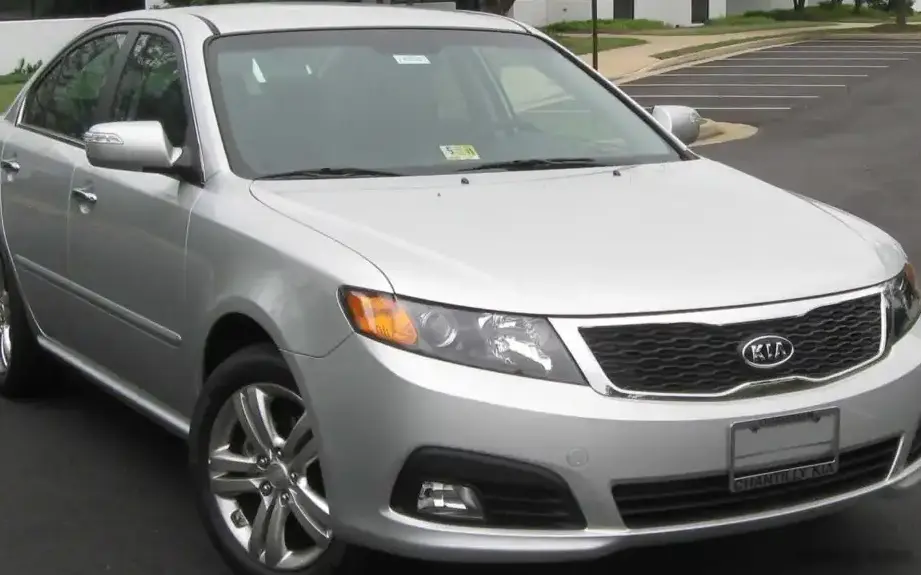
The Kia Optima II, specifically the facelifted version released in 2008, represented a significant step forward for the Korean automaker in the mid-size sedan segment. Produced from 2008 to 2009, this generation Optima aimed to offer a compelling blend of style, features, and value, challenging established competitors like the Honda Accord and Toyota Camry. The 2.4 CVVT variant, producing 177 horsepower, occupied a key position in the lineup, serving as the primary engine option for buyers seeking a balance between performance and fuel efficiency. It was positioned as the mainstream offering, slotting above the base engine (where available) and below any potential higher-performance trims.
Technical Specifications
| Brand | Kia |
| Model | Optima |
| Generation | Optima II (facelift 2008) |
| Type (Engine) | 2.4 CVVT (177 Hp) |
| Start of production | 2008 |
| End of production | 2009 |
| Powertrain Architecture | Internal Combustion engine |
| Body type | Sedan |
| Seats | 5 |
| Doors | 4 |
| Fuel Type | Petrol (Gasoline) |
| Weight-to-power ratio | 8.1 kg/Hp, 123.6 Hp/tonne |
| Weight-to-torque ratio | 6.3 kg/Nm, 159.9 Nm/tonne |
| Power | 177 Hp @ 6000 rpm |
| Power per litre | 75 Hp/l |
| Torque | 229 Nm @ 4000 rpm, 168.9 lb.-ft. @ 4000 rpm |
| Engine layout | Front, Transverse |
| Engine displacement | 2359 cm3, 143.96 cu. in. |
| Number of cylinders | 4 |
| Engine configuration | Inline |
| Cylinder Bore | 88 mm, 3.46 in. |
| Piston Stroke | 97 mm, 3.82 in. |
| Compression ratio | 10.5:1 |
| Number of valves per cylinder | 4 |
| Fuel injection system | Multi-port manifold injection |
| Engine aspiration | Naturally aspirated engine |
| Valvetrain | DOHC, CVVT |
| Engine oil capacity | 4.3 l, 4.54 US qt | 3.78 UK qt |
| Coolant | 6.4 l, 6.76 US qt | 5.63 UK qt |
| Kerb Weight | 1432 kg, 3157.02 lbs |
| Trunk (boot) space – minimum | 500 l, 17.66 cu. ft |
| Trunk (boot) space – maximum | 816 l, 28.82 cu. ft |
| Fuel tank capacity | 62 l, 16.38 US gal | 13.64 UK gal |
| Length | 4800 mm, 188.98 in |
| Width | 1805 mm, 71.06 in |
| Height | 1480 mm, 58.27 in |
| Wheelbase | 2720 mm, 107.09 in |
| Front track | 1560 mm, 61.42 in |
| Rear (Back) track | 1550 mm, 61.02 in |
| Minimum turning circle (turning diameter) | 11.8 m, 38.71 ft |
| Drivetrain Architecture | The Internal combustion engine (ICE) drives the front wheels of the vehicle. |
| Drive wheel | Front wheel drive |
| Number of gears and type of gearbox | 5 gears, manual transmission |
| Front suspension | Independent, type McPherson with coil spring and anti-roll bar |
| Rear suspension | Independent multi-link suspension |
| Front brakes | Ventilated discs |
| Rear brakes | Disc |
| Assisting systems | ABS (Anti-lock braking system) |
| Steering type | Steering rack and pinion |
| Power steering | Hydraulic Steering |
| Tires size | 205/60 R16 |
| Wheel rims size | 6.5J x 16 |
Powertrain & Engine Architecture
The heart of the 2008-2009 Kia Optima 2.4 CVVT was the 2.4-liter inline-four cylinder engine. This engine, internally designated as the G4KA, was a naturally aspirated powerplant featuring a cast iron block and an aluminum cylinder head. The “CVVT” designation stands for Continuously Variable Valve Timing, a technology employed on both the intake and exhaust valves to optimize engine performance and efficiency across a wider range of engine speeds. Fuel delivery was handled by a multi-point fuel injection system. The engine produced 177 horsepower at 6000 rpm and 229 Nm (168.9 lb-ft) of torque at 4000 rpm. This engine was paired with a 5-speed manual transmission as standard, providing drivers with direct control over gear selection. While an automatic transmission was offered in some markets, this article focuses on the manual configuration.
Driving Characteristics
The 2.4-liter engine, coupled with the 5-speed manual transmission, provided adequate performance for everyday driving. Acceleration was respectable, though not particularly sporty. The engine felt responsive in the mid-range, making it suitable for highway merging and passing maneuvers. The manual transmission offered a reasonably precise shift feel, enhancing driver engagement. Compared to a potential higher-output engine (had one been offered), the 2.4 CVVT prioritized fuel economy and smooth operation over outright speed. The gear ratios were tuned for a balance between acceleration and fuel efficiency, with fifth gear acting as an overdrive for comfortable cruising.
Equipment & Trim Levels
The 2.4 CVVT Optima typically came standard with features such as air conditioning, power windows and locks, a basic audio system, and anti-lock brakes (ABS). Higher trim levels added features like alloy wheels, a sunroof, upgraded audio systems, and leather upholstery. The interior design was functional and relatively spacious, offering comfortable seating for five passengers. The dashboard layout was straightforward and easy to use, with clearly labeled controls.
Chassis & Braking
The Optima II utilized a front-wheel-drive layout with an independent McPherson strut suspension in the front and an independent multi-link suspension in the rear. This suspension setup provided a comfortable ride quality, absorbing bumps and irregularities in the road surface effectively. The front brakes were ventilated discs, offering good stopping power, while the rear brakes were solid discs. The steering was rack-and-pinion with hydraulic power assistance, providing a reasonably responsive and predictable steering feel.
Market Reception & Comparison
The 2008-2009 Kia Optima 2.4 CVVT was generally well-received by automotive critics. It was praised for its stylish design, spacious interior, and competitive price point. However, some reviewers noted that the engine lacked the refinement and power of some of its Japanese competitors. Fuel economy was considered average for the class. Compared to other trims in the Optima lineup, the 2.4 CVVT offered a sweet spot between performance and affordability. It was a popular choice for buyers who wanted a comfortable and reliable mid-size sedan without breaking the bank.
Legacy
The Kia Optima II, and specifically the 2.4 CVVT variant, played a crucial role in establishing Kia as a credible competitor in the mid-size sedan market. The G4KA engine proved to be relatively reliable, with proper maintenance. In the used car market today, these Optimas are often sought after for their affordability and practicality. While they may not offer the latest technology or features, they remain a viable option for budget-conscious buyers seeking a dependable and spacious sedan. Common issues reported with these vehicles include wear and tear on suspension components and potential oil leaks as the engine ages. However, overall, the 2.4 CVVT Optima has proven to be a durable and long-lasting vehicle.