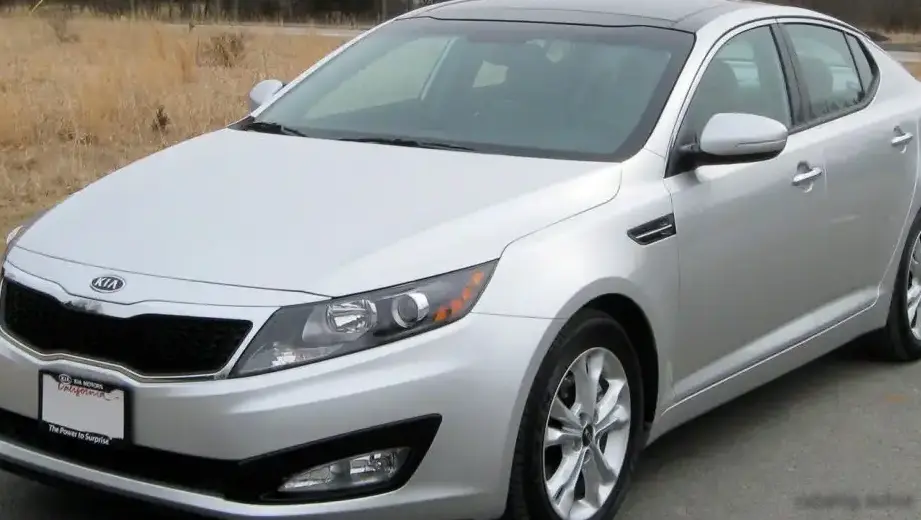
The Kia Optima III, launched in 2011, represented a significant step forward for the Korean automaker in the mid-size sedan segment. This generation, internally designated as the TF, aimed to challenge established players like the Toyota Camry and Honda Accord with a more stylish design and a focus on value. The 2.0 CVVT 16V (165 Hp) Automatic variant served as a core offering within the lineup, positioned as a balance between affordability and acceptable performance for the average family sedan buyer. Production of this specific configuration ran primarily during the 2011 model year, though availability varied by market. It was a key model for Kia as they expanded their presence in North America and Europe.
Technical Specifications
| Brand | Kia |
| Model | Optima |
| Generation | Optima III |
| Type (Engine) | 2.0 CVVT 16V (165 Hp) Automatic |
| Start of production | 2011 |
| End of production | 2011 |
| Powertrain Architecture | Internal Combustion engine |
| Body type | Sedan |
| Seats | 5 |
| Doors | 4 |
| Fuel consumption (combined) | 7.6 l/100 km |
| Fuel consumption (US mpg) | 30.9 US mpg |
| Fuel consumption (UK mpg) | 37.2 UK mpg |
| Fuel consumption (km/l) | 13.2 km/l |
| CO2 emissions | 180 g/km |
| Fuel Type | Petrol (Gasoline) |
| Acceleration 0 – 100 km/h | 10.9 sec |
| Acceleration 0 – 62 mph | 10.9 sec |
| Acceleration 0 – 60 mph | 10.4 sec |
| Maximum speed | 202 km/h (125.52 mph) |
| Emission standard | Euro 4 |
| Weight-to-power ratio | 8.6 kg/Hp |
| Weight-to-torque ratio | 7.2 kg/Nm |
| Power | 165 Hp @ 6200 rpm |
| Power per litre | 82.6 Hp/l |
| Torque | 198 Nm @ 4200 rpm (146.04 lb.-ft. @ 4200 rpm) |
| Engine layout | Front, Transverse |
| Engine Model/Code | G4KD |
| Engine displacement | 1998 cm3 (121.93 cu. in.) |
| Number of cylinders | 4 |
| Engine configuration | Inline |
| Cylinder Bore | 86 mm (3.39 in.) |
| Piston Stroke | 86 mm (3.39 in.) |
| Compression ratio | 10.5:1 |
| Number of valves per cylinder | 4 |
| Fuel injection system | Multi-port manifold injection |
| Engine aspiration | Naturally aspirated engine |
| Valvetrain | DOHC, CVVT |
| Engine oil capacity | 4.1 l (4.33 US qt | 3.61 UK qt) |
| Coolant capacity | 6.5 l (6.87 US qt | 5.72 UK qt) |
| Kerb Weight | 1417 kg (3123.95 lbs.) |
| Max. weight | 1980 kg (4365.15 lbs.) |
| Max load | 563 kg (1241.2 lbs.) |
| Trunk (boot) space – minimum | 436 l (15.4 cu. ft.) |
| Fuel tank capacity | 70 l (18.49 US gal | 15.4 UK gal) |
| Length | 4845 mm (190.75 in.) |
| Width | 1830 mm (72.05 in.) |
| Height | 1455 mm (57.28 in.) |
| Wheelbase | 2795 mm (110.04 in.) |
| Front track | 1601 mm (63.03 in.) |
| Rear track | 1601 mm (63.03 in.) |
| Front overhang | 965 mm (37.99 in.) |
| Rear overhang | 1085 mm (42.72 in.) |
| Minimum turning circle | 10.9 m (35.76 ft.) |
| Drivetrain Architecture | Front wheel drive |
| Number of gears | 6 |
| Gearbox type | Automatic transmission |
| Front suspension | Independent, McPherson with coil spring and anti-roll bar |
| Rear suspension | Independent multi-link suspension |
| Front brakes | Ventilated discs |
| Rear brakes | Disc |
| Assisting systems | ABS (Anti-lock braking system) |
| Steering type | Steering rack and pinion |
| Tires size | 205/65 R16 |
| Wheel rims size | 6.5J x 16 |
Powertrain & Engine Architecture
The heart of this Optima variant is the Kia-developed 2.0-liter inline-four cylinder engine, designated G4KD. This engine utilizes a cast iron block with an aluminum cylinder head, a common configuration for balancing durability and weight. The engine features a double overhead camshaft (DOHC) design with Kia’s Continuously Variable Valve Timing (CVVT) technology on both intake and exhaust valves. CVVT optimizes valve timing based on engine speed and load, improving both fuel efficiency and power output. Fuel delivery is handled by a multi-point fuel injection system. The engine produces 165 horsepower at 6,200 rpm and 198 Nm (146 lb-ft) of torque at 4,200 rpm. Paired with this engine is a six-speed automatic transmission, chosen for its smooth operation and ease of use, appealing to a broader customer base than a manual transmission. This transmission was a standard offering and didn’t feature any particularly advanced technologies like dual-clutch functionality.
Driving Characteristics
The 2.0L automatic Optima delivers adequate, but not exhilarating, performance. Acceleration from 0-60 mph takes around 10.4 seconds, making it competitive with other mainstream mid-size sedans of the era. The automatic transmission is tuned for comfort and fuel economy, resulting in relatively relaxed gear changes. Compared to the available 2.4L engine option, the 2.0L feels noticeably less powerful, especially when fully loaded or climbing hills. The six-speed automatic helps to keep the engine in its optimal power band, but it lacks the responsiveness of a manual transmission or a more aggressively tuned automatic. The gear ratios are geared towards fuel efficiency, prioritizing smooth cruising over spirited driving. Steering feel is light and predictable, contributing to a comfortable driving experience.
Equipment & Trim Levels
The 2.0 CVVT Automatic trim typically included standard features such as air conditioning, power windows and locks, a basic audio system with CD player and auxiliary input, and standard safety equipment like ABS and airbags. Higher trim levels, such as the EX and Limited, added features like leather upholstery, a sunroof, upgraded audio systems, and advanced safety features like electronic stability control. The base 2.0L model was often seen as an entry-level option, appealing to budget-conscious buyers. Optional extras included alloy wheels, a navigation system, and a rearview camera.
Chassis & Braking
The Optima III utilizes a front-wheel-drive layout with an independent McPherson strut suspension in the front and an independent multi-link suspension in the rear. This suspension setup provides a comfortable ride quality, absorbing bumps and irregularities in the road surface effectively. The front brakes are ventilated discs, while the rear brakes are solid discs. ABS (Anti-lock Braking System) is standard, enhancing braking performance and stability. The chassis is designed to provide a balance between handling and ride comfort, leaning towards the latter. Stabilizer bars are present on both axles to reduce body roll during cornering.
Market Reception & Comparison
The 2.0L automatic Optima received generally positive reviews, particularly for its value proposition. Critics praised its spacious interior, comfortable ride, and long warranty. However, the engine was often criticized for being underpowered, especially when compared to competitors offering larger displacement engines. Fuel economy was considered average for the segment, around 30.9 US mpg combined. Compared to the 2.4L Optima, the 2.0L offered lower initial cost but sacrificed performance. The 2.0L was often favored by buyers prioritizing fuel efficiency and affordability over outright speed.
Legacy
The G4KD engine, while not known for being exceptionally robust, proved to be reasonably reliable in the Optima III. Common issues included occasional oil consumption and, in some cases, timing chain wear over very high mileage. The six-speed automatic transmission also proved to be generally reliable, with fewer reported issues. Today, used Optima III 2.0L models are relatively affordable and represent a good value for buyers seeking a comfortable and practical mid-size sedan. Regular maintenance, including timely oil changes and fluid checks, is crucial for ensuring the longevity of this powertrain. The Optima III helped establish Kia as a serious contender in the mid-size sedan market, paving the way for future generations of the Optima and solidifying Kia’s reputation for offering well-equipped and reliable vehicles at competitive prices.