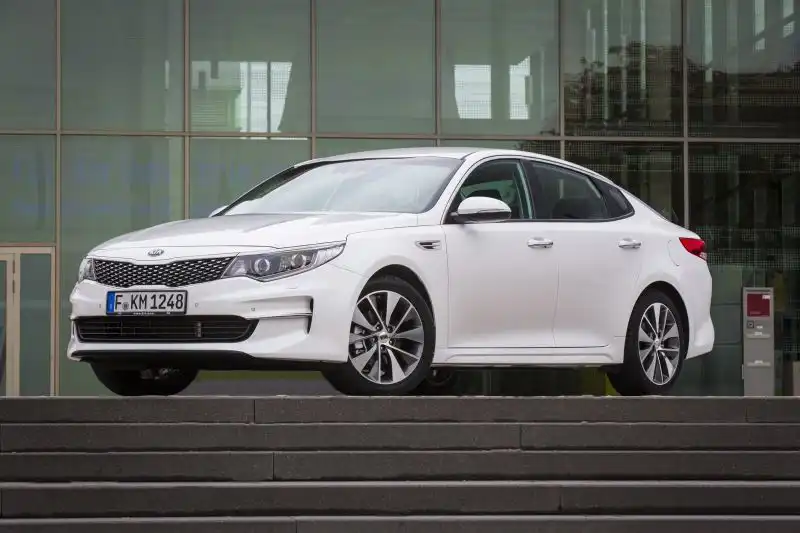
The Kia Optima IV 1.7 CRDi (141 hp) DCT represents a significant offering in the mid-size sedan segment, produced between 2015 and 2018. Positioned as a fuel-efficient and technologically advanced option within the fourth generation Optima (JF) lineup, it aimed to appeal to buyers seeking a balance between economy, comfort, and modern features. This variant was primarily marketed in Europe and other regions outside of North America, where diesel engines held a larger market share. It utilized Kia’s ongoing efforts to improve fuel efficiency and reduce emissions, incorporating a modern common-rail diesel engine paired with a dual-clutch transmission (DCT).
Technical Specifications
| Brand | Kia |
| Model | Optima |
| Generation | Optima IV |
| Type (Engine) | 1.7 CRDi (141 Hp) DCT |
| Start of production | 2015 |
| End of production | 2018 |
| Powertrain Architecture | Internal Combustion engine |
| Body type | Sedan |
| Seats | 5 |
| Doors | 4 |
| Fuel consumption (urban) | 5.1 l/100 km (46.1 US mpg, 55.4 UK mpg, 19.6 km/l) |
| Fuel consumption (extra urban) | 4.1 l/100 km (57.4 US mpg, 68.9 UK mpg, 24.4 km/l) |
| Fuel consumption (combined) | 4.4 l/100 km (53.5 US mpg, 64.2 UK mpg, 22.7 km/l) |
| CO2 emissions | 116 g/km |
| Fuel Type | Diesel |
| Acceleration 0 – 100 km/h | 11 sec |
| Acceleration 0 – 62 mph | 11 sec |
| Acceleration 0 – 60 mph | 10.5 sec |
| Maximum speed | 203 km/h (126.14 mph) |
| Emission standard | Euro 6 b |
| Weight-to-power ratio | 10.9 kg/Hp, 92.2 Hp/tonne |
| Weight-to-torque ratio | 4.5 kg/Nm, 222.2 Nm/tonne |
| Power | 141 Hp @ 4000 rpm |
| Power per litre | 83.7 Hp/l |
| Torque | 340 Nm @ 1750-2500 rpm (250.77 lb.-ft. @ 1750-2500 rpm) |
| Engine layout | Front, Transverse |
| Engine Model/Code | U II / D4FD |
| Engine displacement | 1685 cm3 (102.83 cu. in.) |
| Number of cylinders | 4 |
| Engine configuration | Inline |
| Cylinder Bore | 77.2 mm (3.04 in.) |
| Piston Stroke | 90 mm (3.54 in.) |
| Compression ratio | 15.7:1 |
| Number of valves per cylinder | 4 |
| Fuel injection system | Diesel Commonrail |
| Engine aspiration | Turbocharger, Intercooler |
| Valvetrain | DOHC |
| Engine oil capacity | 5.3 l (5.6 US qt | 4.66 UK qt) |
| Coolant | 7.1 l (7.5 US qt | 6.25 UK qt) |
| Kerb Weight | 1530 kg (3373.07 lbs.) |
| Max. weight | 2080 kg (4585.62 lbs.) |
| Max load | 550 kg (1212.54 lbs.) |
| Trunk (boot) space – minimum | 510 l (18.01 cu. ft.) |
| Fuel tank capacity | 70 l (18.49 US gal | 15.4 UK gal) |
| Permitted trailer load with brakes (12%) | 1500 kg (3306.93 lbs.) |
| Permitted trailer load without brakes | 750 kg (1653.47 lbs.) |
| Length | 4855 mm (191.14 in.) |
| Width | 1860 mm (73.23 in.) |
| Height | 1465 mm (57.68 in.) |
| Wheelbase | 2805 mm (110.43 in.) |
| Front track | 1607 mm (63.27 in.) |
| Rear (Back) track | 1614 mm (63.54 in.) |
| Ride height (ground clearance) | 135 mm (5.31 in.) |
| Minimum turning circle (turning diameter) | 10.9 m (35.76 ft.) |
| Drivetrain Architecture | The Internal combustion engine (ICE) drives the front wheels of the vehicle. |
| Drive wheel | Front wheel drive |
| Number of gears and type of gearbox | 7 gears, automatic transmission DCT |
| Front suspension | Independent, type McPherson with coil spring and anti-roll bar |
| Rear suspension | Double wishbone |
| Front brakes | Ventilated discs |
| Rear brakes | Disc |
| Assisting systems | ABS (Anti-lock braking system) |
| Steering type | Steering rack and pinion |
| Power steering | Electric Steering |
| Tires size | 215/60 R16; 215/55 R17; 235/45 R18 |
| Wheel rims size | 16; 17; 18 |
INTRODUCTION
The Kia Optima IV, launched in 2015, represented a significant step forward in design and technology for the Korean automaker. The 1.7 CRDi DCT variant was specifically tailored for European markets and other regions prioritizing fuel efficiency. Built on the PF platform (shared with the Hyundai Sonata), the Optima IV aimed to compete with established players like the Ford Mondeo, Volkswagen Passat, and Toyota Camry. The 1.7 CRDi engine, coupled with the 7-speed dual-clutch transmission, offered a compelling alternative to traditional automatic transmissions, promising quicker shifts and improved fuel economy. This trim level generally sat in the mid-range of the Optima IV lineup, offering a good balance of features and affordability.
Powertrain & Engine Architecture
The heart of the Optima IV 1.7 CRDi is the U II / D4FD engine, a 1.7-liter inline-four cylinder diesel. This engine utilizes a second-generation common-rail direct injection system, delivering fuel at extremely high pressures for optimized combustion. The engine features a variable geometry turbocharger (VGT) and an intercooler to enhance power and efficiency. The DOHC (Double Overhead Camshaft) valvetrain, with four valves per cylinder, further contributes to the engine’s performance. The 7-speed dual-clutch transmission (DCT) is a key component, offering smooth and rapid gear changes. Unlike a traditional torque converter automatic, the DCT uses two separate clutches for odd and even gears, pre-selecting the next gear for near-instantaneous shifts. This transmission is known for its responsiveness and contribution to improved fuel economy.
Driving Characteristics
The 141 hp and 340 Nm (250 lb-ft) of torque produced by the 1.7 CRDi engine provide adequate performance for everyday driving. Acceleration from 0-60 mph takes around 10.5 seconds, and top speed is rated at 126 mph. While not a sports car, the engine delivers a usable amount of power for overtaking and highway cruising. The DCT transmission contributes to a more engaging driving experience compared to a traditional automatic, with quicker shifts and a more direct feel. However, some drivers may find the DCT slightly less smooth at low speeds compared to a conventional automatic. The gear ratios are tuned for fuel efficiency, meaning the engine doesn’t rev as high as some gasoline counterparts. Compared to the higher-output 2.0-liter gasoline engines available in the Optima IV range, the 1.7 CRDi prioritizes fuel economy over outright performance.
Equipment & Trim Levels
The 1.7 CRDi DCT trim typically included standard features such as air conditioning, power windows, central locking, and a basic audio system. Higher trim levels added features like leather upholstery, a touchscreen infotainment system with navigation, a rearview camera, parking sensors, and automatic climate control. Optional extras included a panoramic sunroof, heated seats, and advanced driver-assistance systems (ADAS) such as lane departure warning and automatic emergency braking. Interior upholstery was generally cloth on base models, with leather options available on higher trims. The dashboard layout was modern and functional, with a focus on ergonomics and ease of use.
Chassis & Braking
The Optima IV utilizes a McPherson strut front suspension and a multi-link rear suspension, providing a comfortable and controlled ride. The suspension is tuned to balance ride comfort with handling stability. Braking duties are handled by ventilated discs at the front and solid discs at the rear. Anti-lock Braking System (ABS) is standard, enhancing safety during emergency braking situations. The steering is electrically assisted, providing a light and responsive feel. Stabilizer bars are fitted to both the front and rear axles to reduce body roll during cornering.
Market Reception & Comparison
The Kia Optima IV 1.7 CRDi DCT was generally well-received by automotive critics for its fuel efficiency, comfortable ride, and modern features. It was often praised as a strong competitor in the mid-size sedan segment, offering a compelling value proposition. Compared to the gasoline-powered Optima variants, the 1.7 CRDi offered significantly better fuel economy, making it an attractive option for drivers covering long distances. However, some critics noted that the diesel engine was slightly noisier than the gasoline engines. Compared to rivals like the Ford Mondeo and Volkswagen Passat, the Optima IV offered a similar level of equipment and performance at a competitive price point.
Legacy
The 1.7 CRDi engine, while generally reliable, requires regular maintenance, including oil changes and filter replacements. The DCT transmission, while offering performance benefits, can be more complex and potentially more expensive to repair than a traditional automatic. In the used car market, the Optima IV 1.7 CRDi DCT remains a popular choice for buyers seeking a fuel-efficient and well-equipped mid-size sedan. Its reputation for reliability and affordability has helped it maintain a strong resale value. However, potential buyers should be aware of the potential maintenance costs associated with the diesel engine and DCT transmission, and ensure that the vehicle has been properly serviced throughout its life.