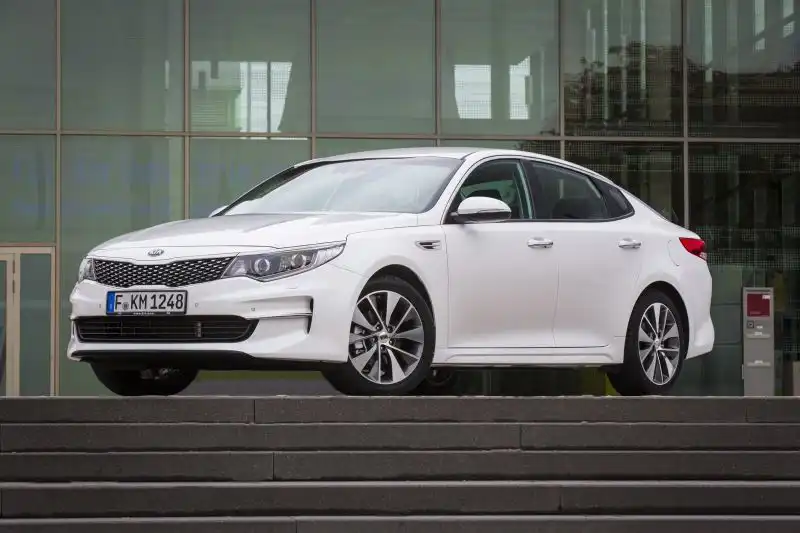
The Kia Optima IV, produced from 2015 to 2018, represented a significant step forward for the Korean automaker in the mid-size sedan segment. Within the fourth generation (JF), the 2.0 CVVL variant, generating 163 horsepower, served as a popular choice for buyers seeking a balance of fuel efficiency, reasonable performance, and a well-equipped package. This model occupied a middle ground in the Optima IV lineup, positioned above the base 1.6L engine and below the more powerful 2.4L and turbocharged options. It was primarily marketed towards family-oriented consumers and commuters prioritizing value and practicality.
Technical Specifications
| Brand | Kia |
| Model | Optima |
| Generation | Optima IV |
| Type (Engine) | 2.0 CVVL (163 Hp) |
| Start of production | 2015 |
| End of production | 2018 |
| Powertrain Architecture | Internal Combustion engine |
| Body type | Sedan |
| Seats | 5 |
| Doors | 4 |
| Fuel consumption (urban) | 10 l/100 km (23.5 US mpg) |
| Fuel consumption (extra urban) | 5.9 l/100 km (39.9 US mpg) |
| Fuel consumption (combined) | 7.4 l/100 km (31.8 US mpg) |
| CO2 emissions | 173 g/km |
| Fuel Type | Petrol (Gasoline) |
| Acceleration 0 – 100 km/h | 9.4 sec |
| Acceleration 0 – 62 mph | 9.4 sec |
| Acceleration 0 – 60 mph | 8.9 sec |
| Maximum speed | 210 km/h (130.49 mph) |
| Emission standard | Euro 6 b |
| Weight-to-power ratio | 8.9 kg/Hp |
| Weight-to-torque ratio | 7.4 kg/Nm |
| Power | 163 Hp @ 6500 rpm |
| Torque | 196 Nm @ 4800 rpm (144.56 lb.-ft. @ 4800 rpm) |
| Engine layout | Front, Transverse |
| Engine Model/Code | G4ND |
| Engine displacement | 1999 cm3 (121.99 cu. in.) |
| Number of cylinders | 4 |
| Engine configuration | Inline |
| Cylinder Bore | 81 mm (3.19 in.) |
| Piston Stroke | 97 mm (3.82 in.) |
| Compression ratio | 10.3:1 |
| Number of valves per cylinder | 4 |
| Fuel injection system | Multi-port manifold injection |
| Engine aspiration | Naturally aspirated engine |
| Engine oil capacity | 4.3 l (4.54 US qt | 3.78 UK qt) |
| Coolant capacity | 5.9 l (6.23 US qt | 5.19 UK qt) |
| Kerb Weight | 1455 kg (3207.73 lbs.) |
| Max. weight | 2000 kg (4409.25 lbs.) |
| Max load | 545 kg (1201.52 lbs.) |
| Trunk (boot) space – minimum | 510 l (18.01 cu. ft.) |
| Fuel tank capacity | 70 l (18.49 US gal | 15.4 UK gal) |
| Permitted trailer load with brakes (12%) | 1700 kg (3747.86 lbs.) |
| Permitted trailer load without brakes | 750 kg (1653.47 lbs.) |
| Length | 4855 mm (191.14 in.) |
| Width | 1860 mm (73.23 in.) |
| Height | 1465 mm (57.68 in.) |
| Wheelbase | 2805 mm (110.43 in.) |
| Front track | 1607 mm (63.27 in.) |
| Rear (Back) track | 1614 mm (63.54 in.) |
| Ride height (ground clearance) | 135 mm (5.31 in.) |
| Minimum turning circle (turning diameter) | 10.9 m (35.76 ft.) |
| Drivetrain Architecture | Front wheel drive |
| Number of gears and type of gearbox | 6 gears, manual transmission |
| Front suspension | Independent, type McPherson with coil spring and anti-roll bar |
| Rear suspension | Double wishbone |
| Front brakes | Ventilated discs |
| Rear brakes | Disc |
| Assisting systems | ABS (Anti-lock braking system) |
| Steering type | Steering rack and pinion |
| Power steering | Electric Steering |
| Tires size | 215/60 R16; 215/55 R17; 235/45 R18 |
| Wheel rims size | 16; 17; 18 |
Powertrain & Engine Architecture
The heart of the Optima IV 2.0 CVVL is the Hyundai-Kia G4ND engine, a 1.999-liter (2.0L) inline-four cylinder gasoline engine. “CVVL” stands for Continuously Variable Valve Lift, a technology designed to improve both fuel efficiency and performance. This system adjusts the valve lift based on engine load and speed, optimizing cylinder filling and combustion. The G4ND utilizes multi-point fuel injection and a naturally aspirated configuration. The engine produces 163 horsepower at 6,500 rpm and 196 Nm (144.56 lb-ft) of torque at 4,800 rpm. The engine’s design prioritizes smooth operation and reliability over outright performance. The 6-speed manual transmission was standard, offering drivers a direct connection to the engine.
Driving Characteristics
The 2.0L Optima delivers adequate, but not exhilarating, performance. Acceleration from 0-60 mph takes approximately 8.9 seconds, making it suitable for everyday commuting and highway merging. The manual transmission provides a reasonable level of driver engagement, although the gear ratios are tuned for fuel economy rather than sporty driving. Compared to the more powerful 2.4L or turbocharged models, the 2.0L feels noticeably less responsive, particularly during overtaking maneuvers. However, the lighter engine weight contributes to slightly better handling balance. The CVVL system helps to maintain a usable powerband across a wider range of engine speeds, minimizing the need for frequent downshifts.
Equipment & Trim Levels
The 2.0L Optima typically came standard with features such as air conditioning, power windows and locks, a touchscreen infotainment system with Bluetooth connectivity, and a rearview camera. Higher trim levels added features like leather upholstery, a sunroof, heated front seats, and advanced safety technologies such as blind-spot monitoring and rear cross-traffic alert. Interior materials were generally of good quality for the price point, with a focus on comfort and practicality. The dashboard layout was clean and intuitive, with easy-to-use controls. Optional extras included a premium sound system and navigation system.
Chassis & Braking
The Optima IV utilizes a front-wheel-drive layout with an independent McPherson strut suspension in the front and a multi-link double wishbone suspension in the rear. This suspension setup provides a comfortable ride quality, absorbing bumps and imperfections in the road effectively. The front brakes are ventilated discs, while the rear brakes are solid discs. ABS (Anti-lock Braking System) is standard. The steering is electrically assisted, providing light and precise control. The chassis is designed to prioritize ride comfort and stability over sporty handling.
Market Reception & Comparison
The Kia Optima IV 2.0 CVVL was generally well-received by automotive critics. It was praised for its stylish design, spacious interior, and long list of standard features. Fuel economy was also a strong point, with the 2.0L engine achieving around 31.8 US mpg in combined driving. Compared to competitors like the Honda Accord and Toyota Camry, the Optima offered a more aggressive design and a more generous warranty. However, some critics noted that the 2.0L engine lacked the power and refinement of some of its rivals. The 1.6L base engine was often criticized for being underpowered, making the 2.0L a more appealing option for many buyers. The higher-trim 2.4L and turbocharged models offered significantly more performance but came at a higher price.
Legacy
The G4ND engine, while not known for being a high-performance unit, has proven to be relatively reliable over the long term. Common issues are typically related to routine maintenance items such as oil leaks and sensor failures. The Optima IV, in general, has established a reputation for being a dependable and affordable mid-size sedan. On the used car market, the 2.0L variant represents a good value proposition, offering a comfortable and well-equipped vehicle at a reasonable price. Its fuel efficiency and relatively low maintenance costs make it an attractive option for budget-conscious buyers.