Technical Specifications
| Brand | Kia |
| Model | Optima |
| Generation | Optima IV |
| Type (Engine) | 2.0 GDI (205 Hp) Plug-in Hybrid Automatic |
| Start of production | 2016 |
| End of production | 2018 |
| Powertrain Architecture | PHEV (Plug-in Hybrid Electric Vehicle) |
| Body type | Sedan |
| Seats | 5 |
| Doors | 4 |
| Fuel consumption (economy) – combined (NEDC) | 1.6 l/100 km (147 US mpg, 176.6 UK mpg, 62.5 km/l) |
| CO2 emissions (NEDC) | 37 g/km |
| Fuel Type | Petrol / electricity |
| Acceleration 0 – 100 km/h | 9.4 sec |
| Acceleration 0 – 62 mph | 9.4 sec |
| Acceleration 0 – 60 mph | 8.9 sec |
| Maximum speed | 192 km/h (119.3 mph) |
| Emission standard | Euro 6 |
| Weight-to-power ratio | 8.3 kg/Hp, 120.2 Hp/tonne |
| Weight-to-torque ratio | 4.5 kg/Nm, 219.9 Nm/tonne |
| Gross battery capacity | 9.8 kWh |
| Net (usable) battery capacity | 7.8 kWh |
| Battery voltage | 360 V |
| Battery technology | Lithium-polymer (LiPo) |
| Battery weight | 131 kg (288.81 lbs.) |
| Battery location | Under the trunk |
| All-electric range (NEDC) | 54 km (33.55 mi) |
| Average Energy consumption (NEDC) | 12.2 kWh/100 km (19.63 kWh/100 mi, 172 MPGe, 8.2 km/kWh, 5.1 mi/kWh) |
| Max speed (electric) | 120 km/h (74.56 mph) |
| Electric motor power | 68 Hp @ 2330-3300 rpm |
| Electric motor Torque | 205 Nm @ 0-2330 rpm (151.2 lb.-ft. @ 0-2330 rpm) |
| Electric motor location | Between the combustion engine and the transmission |
| System power | 205 Hp @ 6000 rpm |
| System torque | 375 Nm @ 2330 rpm (276.59 lb.-ft. @ 2330 rpm) |
| Power | 156 Hp @ 6000 rpm |
| Torque | 189 Nm @ 5000 rpm (139.4 lb.-ft. @ 5000 rpm) |
| Engine layout | Front, Transverse |
| Engine Model/Code | G4NG |
| Engine displacement | 1999 cm3 (121.99 cu. in.) |
| Number of cylinders | 4 |
| Engine configuration | Inline |
| Cylinder Bore | 81 mm (3.19 in.) |
| Piston Stroke | 97 mm (3.82 in.) |
| Compression ratio | 13.5:1 |
| Number of valves per cylinder | 4 |
| Fuel injection system | Direct injection |
| Engine aspiration | Naturally aspirated engine |
| Valvetrain | DOHC, Dual CVVT |
| Engine oil capacity | 4.1 l (4.33 US qt | 3.61 UK qt) |
| Coolant | 6.7 l (7.08 US qt | 5.9 UK qt) |
| Kerb Weight | 1705-1775 kg (3758.88 – 3913.21 lbs.) |
| Max. weight | 2200 kg (4850.17 lbs.) |
| Max load | 425-495 kg (936.96 – 1091.29 lbs.) |
| Trunk (boot) space – minimum | 307 l (10.84 cu. ft.) |
| Fuel tank capacity | 55 l (14.53 US gal | 12.1 UK gal) |
| Max. roof load | 100 kg (220.46 lbs.) |
| Length | 4855 mm (191.14 in.) |
| Width | 1860 mm (73.23 in.) |
| Height | 1465 mm (57.68 in.) |
| Wheelbase | 2805 mm (110.43 in.) |
| Front track | 1602 mm (63.07 in.) |
| Rear (Back) track | 1609 mm (63.35 in.) |
| Front overhang | 965 mm (37.99 in.) |
| Rear overhang | 1085 mm (42.72 in.) |
| Ride height (ground clearance) | 135 mm (5.31 in.) |
| Drag coefficient (Cd) | 0.25 |
| Minimum turning circle (turning diameter) | 10.9 m (35.76 ft.) |
| Drivetrain Architecture | The Internal combustion engine (ICE) and electric motor drive the front wheels of the car with the ability to work in full electric or mixed mode. |
| Drive wheel | Front wheel drive |
| Number of gears and type of gearbox | 6 gears, automatic transmission |
| Front suspension | Independent, type McPherson with coil spring and anti-roll bar |
| Rear suspension | Independent multi-link spring suspension with stabilizer |
| Front brakes | Ventilated discs, 300 mm |
| Rear brakes | Disc, 300 mm |
| Assisting systems | ABS (Anti-lock braking system) |
| Steering type | Steering rack and pinion |
| Power steering | Electric Steering |
| Tires size | 215/55 R17 |
| Wheel rims size | 7J x 17 |
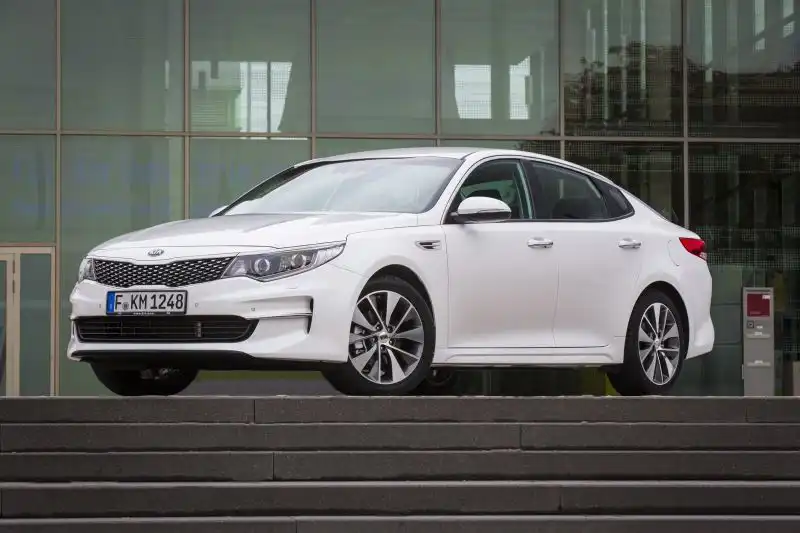
The Kia Optima IV 2.0 GDI Plug-in Hybrid Automatic, launched for the 2016 model year, was a key component of Kia’s strategy to expand its presence in the environmentally conscious automotive market. Built on the Optima IV platform (also known as the JF), which underpinned a significant redesign of the Optima, this plug-in hybrid variant offered a compelling blend of fuel efficiency, practicality, and technology. It aimed to appeal to buyers seeking a stylish mid-size sedan with the added benefit of electric driving capability. Production continued through 2018, with minor updates throughout its lifespan. The Optima PHEV was primarily marketed in Europe and North America, where government incentives and growing environmental awareness drove demand for plug-in vehicles.
Powertrain & Engine Architecture
At the heart of the Optima PHEV lies Kia’s 2.0-liter ‘Nu’ family GDI engine, designated G4NG. This naturally aspirated inline-four cylinder engine produces 156 horsepower and 139.4 lb-ft of torque. The engine utilizes direct fuel injection, enhancing efficiency and power output. It also features a dual continuously variable valve timing (DOHC, Dual CVVT) system, optimizing valve timing for improved performance and reduced emissions. The electric motor, delivering 68 horsepower and 151.2 lb-ft of torque, is integrated between the engine and the six-speed automatic transmission. This configuration allows for both electric-only driving and combined operation, where the engine and motor work in tandem to provide a total system output of 205 horsepower and 276.59 lb-ft of torque. The 9.8 kWh lithium-polymer battery pack is located under the trunk floor, impacting cargo space but providing a usable capacity of 7.8 kWh. The battery can be charged via a standard 120V or 240V outlet, or a DC fast charger (charging times vary depending on the charging infrastructure).
Driving Characteristics
The Optima PHEV’s driving experience is characterized by its smooth and quiet operation, particularly in electric mode. The electric motor provides instant torque, resulting in brisk acceleration at lower speeds. In hybrid mode, the transition between electric and gasoline power is generally seamless, although some drivers may notice a slight shift in engine engagement. The six-speed automatic transmission is well-tuned for both efficiency and responsiveness, offering smooth gear changes. Compared to the standard 1.6L turbocharged Optima, the PHEV offers similar overall performance, but with a greater emphasis on fuel economy. Compared to higher-horsepower Optima trims (like the 2.4L), the PHEV prioritizes efficiency over outright speed. The added weight of the battery pack (approximately 289 lbs) does slightly impact handling, making it feel less agile than its non-hybrid counterparts.
Equipment & Trim Levels
The Optima PHEV was typically offered in a single, well-equipped trim level. Standard features generally included leather upholstery, a touchscreen infotainment system with navigation, a rearview camera, automatic climate control, and a suite of advanced safety features such as lane departure warning and forward collision warning. Optional extras often included a panoramic sunroof, premium audio system, and adaptive cruise control. Interior appointments were generally upscale, reflecting the PHEV’s positioning as a premium model. The dashboard layout was similar to other Optima IV trims, but with unique hybrid-specific displays showing energy flow and battery status.
Chassis & Braking
The Optima PHEV utilizes a McPherson strut front suspension and a multi-link rear suspension, providing a comfortable and controlled ride. Stabilizer bars are fitted to both axles to reduce body roll during cornering. Braking duties are handled by ventilated discs at the front and solid discs at the rear. The anti-lock braking system (ABS) is standard, enhancing safety and stability. Due to the added weight of the battery pack, the suspension was slightly retuned compared to standard Optima models to maintain ride quality and handling balance. The steering is electrically assisted, providing light and precise control.
Market Reception & Comparison
The Kia Optima PHEV was generally well-received by automotive critics, who praised its fuel efficiency, comfortable ride, and generous standard features. However, some reviewers noted the reduced trunk space due to the battery pack. Compared to other plug-in hybrid sedans of the time, such as the Toyota Prius Prime and the Hyundai Sonata Plug-in Hybrid, the Optima PHEV offered a more stylish design and a more engaging driving experience. Its fuel economy was competitive, achieving an estimated 147 mpg in combined driving according to NEDC standards. Reliability reports have been generally positive, with few major issues reported with the powertrain.
Legacy
The Kia Optima IV 2.0 GDI Plug-in Hybrid Automatic played a crucial role in establishing Kia as a serious contender in the plug-in hybrid market. The powertrain proved to be relatively reliable, and many examples remain on the road today. On the used car market, these models are often sought after by buyers looking for an affordable and fuel-efficient vehicle with electric driving capability. While battery degradation is a concern with any electric or plug-in hybrid vehicle, the Optima PHEV’s lithium-polymer battery pack has generally demonstrated good longevity. The Optima PHEV paved the way for Kia’s continued development of electrified vehicles, including the Niro PHEV and the Sorento PHEV.