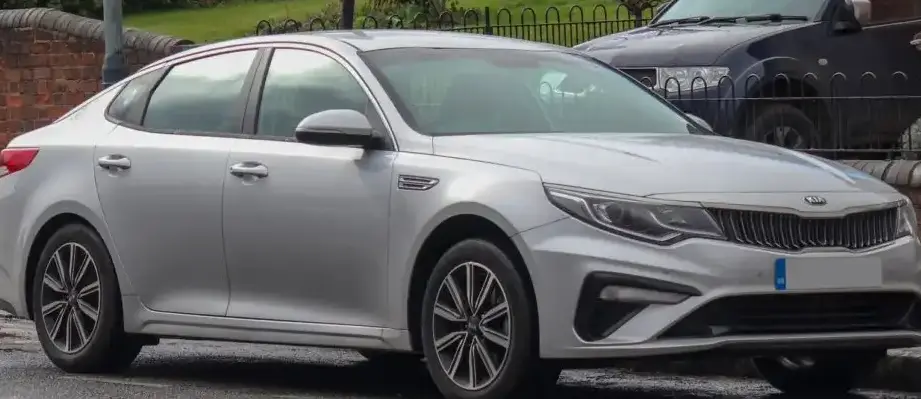
The Kia Optima IV, specifically the 2.0 T-GDI (238 Hp) GPF Sportmatic variant produced from 2018 to 2020, represents a significant step forward in Kia’s mid-size sedan offerings. This facelifted version of the fourth-generation Optima (introduced in 2015) aimed to enhance both performance and refinement, targeting a more discerning buyer within the competitive D-segment. Positioned as a near-top-trim level, it offered a compelling blend of power, technology, and features, bridging the gap between the base engine options and the potentially more expensive, fully-loaded trims. The Optima IV, in general, was crucial for Kia’s brand elevation in key markets like North America and Europe, demonstrating a commitment to quality and design.
Technical Specifications
| Brand | Kia |
| Model | Optima |
| Generation | Optima IV (facelift 2018) |
| Type (Engine) | 2.0 T-GDI (238 Hp) GPF Sportmatic |
| Start of production | 2018 |
| End of production | 2020 |
| Powertrain Architecture | Internal Combustion engine |
| Body type | Sedan |
| Seats | 5 |
| Doors | 4 |
| Fuel consumption (economy) – urban (NEDC) | 13.1-13.2 l/100 km (18 – 17.8 US mpg, 21.6 – 21.4 UK mpg, 7.6 – 7.6 km/l) |
| Fuel consumption (economy) – extra urban (NEDC) | 6.4-7 l/100 km (36.8 – 33.6 US mpg, 44.1 – 40.4 UK mpg, 15.6 – 14.3 km/l) |
| Fuel consumption (economy) – combined (NEDC) | 8.9-9.3 l/100 km (26.4 – 25.3 US mpg, 31.7 – 30.4 UK mpg, 11.2 – 10.8 km/l) |
| CO2 emissions (NEDC) | 203-212 g/km |
| Fuel Type | Petrol (Gasoline) |
| Acceleration 0 – 100 km/h | 7.4 sec |
| Acceleration 0 – 62 mph | 7.4 sec |
| Acceleration 0 – 60 mph | 7 sec |
| Maximum speed | 240 km/h (149.13 mph) |
| Emission standard | Euro 6d Temp |
| Weight-to-power ratio | 6.6 kg/Hp, 150.6 Hp/tonne |
| Weight-to-torque ratio | 4.5 kg/Nm, 223.4 Nm/tonne |
| Power | 238 Hp @ 6000 rpm |
| Power per litre | 119.1 Hp/l |
| Torque | 353 Nm @ 1350-4000 rpm (260.36 lb.-ft. @ 1350-4000 rpm) |
| Engine layout | Front, Transverse |
| Engine Model/Code | Theta II / G4KH |
| Engine displacement | 1998 cm3 (121.93 cu. in.) |
| Number of cylinders | 4 |
| Engine configuration | Inline |
| Cylinder Bore | 86 mm (3.39 in.) |
| Piston Stroke | 86 mm (3.39 in.) |
| Compression ratio | 10:1 |
| Number of valves per cylinder | 4 |
| Fuel injection system | Direct injection |
| Engine aspiration | Twin-scroll turbo, Intercooler |
| Valvetrain | DOHC |
| Engine oil capacity | 4.8 l (5.07 US qt | 4.22 UK qt) |
| Coolant | 7.3 l (7.71 US qt | 6.42 UK qt) |
| Kerb Weight | 1580-1680 kg (3483.3 – 3703.77 lbs.) |
| Max. weight | 2120 kg (4673.8 lbs.) |
| Max load | 440-540 kg (970.03 – 1190.5 lbs.) |
| Trunk (boot) space – minimum | 510 l (18.01 cu. ft.) |
| Fuel tank capacity | 70 l (18.49 US gal | 15.4 UK gal) |
| Permitted trailer load with brakes (12%) | 1400 kg (3086.47 lbs.) |
| Permitted trailer load without brakes | 700 kg (1543.24 lbs.) |
| Permitted towbar download | 80 kg (176.37 lbs.) |
| Length | 4855 mm (191.14 in.) |
| Width | 1860 mm (73.23 in.) |
| Height | 1465-1475 mm (57.68 – 58.07 in.) |
| Wheelbase | 2805 mm (110.43 in.) |
| Front track | 1597-1607 mm (62.87 – 63.27 in.) |
| Rear (Back) track | 1604-1614 mm (63.15 – 63.54 in.) |
| Front overhang | 965 mm (37.99 in.) |
| Rear overhang | 1085 mm (42.72 in.) |
| Minimum turning circle (turning diameter) | 10.9 m (35.76 ft.) |
| Drivetrain Architecture | The Internal combustion engine (ICE) drives the front wheels of the vehicle. |
| Drive wheel | Front wheel drive |
| Number of gears and type of gearbox | 6 gears, automatic transmission Sportmatic |
| Front suspension | Independent, type McPherson with coil spring and anti-roll bar |
| Rear suspension | Independent multi-link spring suspension with stabilizer |
| Front brakes | Ventilated discs |
| Rear brakes | Disc |
| Assisting systems | ABS (Anti-lock braking system) |
| Steering type | Steering rack and pinion |
| Power steering | Electric Steering |
| Tires size | 215/60 R16; 215/55 R17; 235/45 R18 |
| Wheel rims size | 6.5J x 16; 7.5J x 17; 7.5J x 18 |
Powertrain & Engine Architecture
At the heart of the 2018-2020 Kia Optima 2.0 T-GDI Sportmatic lies the Theta II 2.0-liter turbocharged inline-four cylinder engine, designated G4KH. This engine is a cornerstone of Hyundai-Kia’s powertrain strategy, known for its robust construction and relatively high output. The engine utilizes direct injection (GDI) technology, which precisely meters fuel directly into the combustion chamber, improving efficiency and power. A twin-scroll turbocharger, coupled with an intercooler, minimizes turbo lag and maximizes boost across a wider RPM range. The engine produces 238 horsepower at 6000 rpm and 353 Nm (260.36 lb.-ft.) of torque between 1350 and 4000 rpm. The Sportmatic transmission is a 6-speed automatic, offering a degree of driver control through a selectable shift mode. While not a dual-clutch transmission, it’s tuned for relatively quick and smooth shifts. The inclusion of a Gasoline Particulate Filter (GPF) was a response to increasingly stringent European emission regulations.
Driving Characteristics
The 2.0 T-GDI Sportmatic Optima delivers a noticeably more engaging driving experience compared to the base engine options. Acceleration to 60 mph takes approximately 7 seconds, and the engine feels responsive in most driving situations. The automatic transmission is generally well-behaved, providing smooth gear changes during normal driving. In Sport mode, it holds gears longer, allowing the engine to stay within its peak power band. However, it doesn’t offer the lightning-fast shifts of a dual-clutch transmission. The steering is light and precise, but lacks significant feedback. Overall, the driving experience is comfortable and refined, leaning towards a grand touring feel rather than outright sportiness. The torque delivery is strong from low RPMs, making it easy to navigate city traffic and execute passing maneuvers.
Equipment & Trim Levels
The 2.0 T-GDI Sportmatic trim typically included a generous array of standard features. These commonly included leather upholstery, heated and ventilated front seats, a large touchscreen infotainment system with navigation, a premium sound system (often Harman Kardon), automatic climate control, and a suite of advanced driver-assistance systems (ADAS) such as adaptive cruise control, lane departure warning, and automatic emergency braking. Optional extras often included a panoramic sunroof, upgraded interior trim materials, and a rear cross-traffic alert system. The overall interior design was modern and well-appointed, with a focus on user-friendliness and comfort.
Chassis & Braking
The Optima IV utilizes a front-wheel-drive platform with an independent McPherson strut suspension in the front and an independent multi-link suspension in the rear. This setup provides a good balance between ride comfort and handling. Stabilizer bars are included at both ends to reduce body roll during cornering. Braking duties are handled by ventilated discs at the front and solid discs at the rear. ABS (Anti-lock Braking System) is standard, providing enhanced stopping power and control. The steering system is an electric power-assisted rack and pinion, offering light and precise steering feel.
Market Reception & Comparison
The 2.0 T-GDI Sportmatic Optima was generally well-received by automotive critics. It was praised for its strong engine performance, comfortable ride, and generous feature set. However, some reviewers noted that the automatic transmission wasn’t as responsive as some competitors, and the interior materials, while improved, didn’t quite match the quality of some European rivals. Compared to the base 2.4-liter engine, the 2.0 T-GDI offered a significant performance upgrade. Compared to the diesel options available in Europe, the gasoline engine provided a different driving character, prioritizing responsiveness over fuel economy. Fuel economy figures were respectable, but not class-leading, averaging around 26.4 – 25.3 US mpg in combined driving.
Legacy
The Kia Optima IV 2.0 T-GDI Sportmatic has proven to be a relatively reliable vehicle in the used car market. The Theta II engine, while having experienced some issues in earlier iterations, has been generally dependable in this application. Regular maintenance, including oil changes and timing belt replacements (where applicable), is crucial for long-term reliability. The Sportmatic transmission is also generally robust, but proper fluid changes are essential. Today, these Optimas represent a good value proposition for buyers seeking a stylish, well-equipped, and reasonably powerful mid-size sedan. Their continued presence on the used car market is a testament to their overall quality and durability.