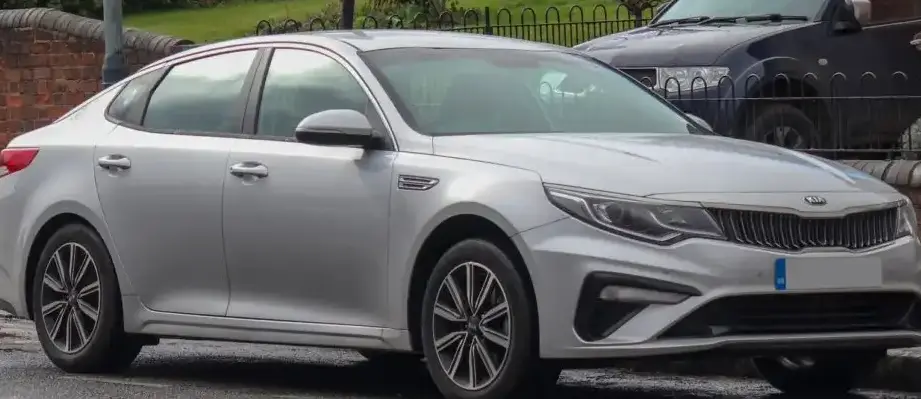
The Kia Optima IV, specifically the 2.0 T-GDI (245 Hp) Sportmatic variant produced from 2018 to 2020, represents a significant step forward in Kia’s mid-size sedan offerings. This facelifted version of the fourth-generation Optima (introduced in 2015) aimed to enhance the vehicle’s appeal with a more powerful engine option and refined transmission, targeting buyers seeking a blend of performance and comfort. Positioned as a near-top-trim level, it sat above the base 2.4L engine and below any potential hybrid offerings, appealing to those desiring a sporty driving experience without sacrificing practicality. The Optima IV was a crucial model for Kia in the North American market, helping to establish the brand as a serious competitor to established Japanese and American automakers.
Technical Specifications
| Brand | Kia |
| Model | Optima |
| Generation | Optima IV (facelift 2018) |
| Type (Engine) | 2.0 T-GDI (245 Hp) Sportmatic |
| Start of production | 2018 |
| End of production | 2020 |
| Powertrain Architecture | Internal Combustion engine |
| Body type | Sedan |
| Seats | 5 |
| Doors | 4 |
| Fuel consumption (economy) – urban (EPA) | 11.2 l/100 km (21 US mpg, 25.2 UK mpg, 8.9 km/l) |
| Fuel consumption (economy) – extra urban (EPA) | 7.8 l/100 km (30.2 US mpg, 36.2 UK mpg, 12.8 km/l) |
| Fuel consumption (economy) – combined (EPA) | 9.8 l/100 km (24 US mpg, 28.8 UK mpg, 10.2 km/l) |
| Fuel Type | Petrol (Gasoline) |
| Emission standard | ULEV 70 – LEV III |
| Weight-to-power ratio | 6.6 kg/Hp, 151.8 Hp/tonne |
| Weight-to-torque ratio | 4.6 kg/Nm, 218.7 Nm/tonne |
| Power | 245 Hp @ 6000 rpm |
| Power per litre | 122.6 Hp/l |
| Torque | 353 Nm @ 1350-4000 rpm (260.36 lb.-ft. @ 1350-4000 rpm) |
| Engine layout | Front, Transverse |
| Engine Model/Code | G4KH |
| Engine displacement | 1998 cm3 (121.93 cu. in.) |
| Number of cylinders | 4 |
| Engine configuration | Inline |
| Cylinder Bore | 86 mm (3.39 in.) |
| Piston Stroke | 86 mm (3.39 in.) |
| Compression ratio | 10:1 |
| Number of valves per cylinder | 4 |
| Fuel injection system | Direct injection |
| Engine aspiration | Twin-scroll turbo, Intercooler |
| Valvetrain | DOHC |
| Engine oil capacity | 4.8 l (5.07 US qt | 4.22 UK qt) |
| Coolant | 7.3 l (7.71 US qt | 6.42 UK qt) |
| Kerb Weight | 1614 kg (3558.26 lbs.) |
| Trunk (boot) space – minimum | 510 l (18.01 cu. ft.) |
| Fuel tank capacity | 70 l (18.49 US gal | 15.4 UK gal) |
| Length | 4855 mm (191.14 in.) |
| Width | 1860 mm (73.23 in.) |
| Height | 1466 mm (57.72 in.) |
| Wheelbase | 2804 mm (110.39 in.) |
| Front track | 1598 mm (62.91 in.) |
| Rear (Back) track | 1605 mm (63.19 in.) |
| Front overhang | 965 mm (37.99 in.) |
| Rear overhang | 1085 mm (42.72 in.) |
| Ride height (ground clearance) | 135 mm (5.31 in.) |
| Drag coefficient (Cd) | 0.27 |
| Minimum turning circle (turning diameter) | 10.9 m (35.76 ft.) |
| Drivetrain Architecture | The Internal combustion engine (ICE) drives the front wheels of the vehicle. |
| Drive wheel | Front wheel drive |
| Number of gears and type of gearbox | 6 gears, automatic transmission Sportmatic |
| Front suspension | Independent, type McPherson with coil spring and anti-roll bar |
| Rear suspension | Independent multi-link spring suspension with stabilizer |
| Front brakes | Ventilated discs, 320 mm |
| Rear brakes | Disc, 284 mm |
| Assisting systems | ABS (Anti-lock braking system) |
| Steering type | Steering rack and pinion |
| Power steering | Electric Steering |
| Tires size | 235/45 R18 |
| Wheel rims size | 7.5J x 18 |
Powertrain & Engine Architecture
At the heart of the 2018-2020 Kia Optima 2.0 T-GDI Sportmatic lies the G4KH engine, a 1.998-liter (121.93 cubic inches) turbocharged inline-four cylinder. This engine utilizes direct injection technology, enhancing fuel efficiency and power output. The twin-scroll turbocharger design minimizes turbo lag, providing a more responsive driving experience. The engine’s DOHC (Dual Overhead Camshaft) valvetrain further optimizes airflow for improved performance. The engine produces 245 horsepower at 6,000 rpm and 260 lb-ft of torque between 1,350 and 4,000 rpm. This broad torque curve is a key characteristic of the engine, providing strong acceleration in various driving situations.
The “Sportmatic” transmission refers to Kia’s 6-speed automatic transmission with a manual shift mode. While not a dual-clutch transmission, the Sportmatic feature allows drivers to select gears manually for more control, particularly during spirited driving. The transmission is tuned to balance fuel efficiency with responsive shifts, and features a torque converter for smooth operation.
Driving Characteristics
The 2.0 T-GDI Sportmatic Optima delivers a noticeably more engaging driving experience compared to the base 2.4L engine. The turbocharger provides a surge of power, making overtaking and merging onto highways effortless. The Sportmatic transmission allows for quick downshifts when needed, enhancing responsiveness. While not a dedicated sports sedan, the Optima 2.0 T-GDI offers a good balance of comfort and performance. The gear ratios are optimized for both city and highway driving, providing adequate acceleration in both environments. Compared to a manual transmission equipped Optima, the automatic offers convenience, but sacrifices some driver engagement.
Equipment & Trim Levels
The 2.0 T-GDI Sportmatic trim typically included features such as leather upholstery, a power-adjustable driver’s seat, a touchscreen infotainment system with Apple CarPlay and Android Auto compatibility, and a suite of advanced driver-assistance systems (ADAS) including automatic emergency braking, lane departure warning, and adaptive cruise control. Optional extras included a panoramic sunroof, premium audio system, and ventilated front seats. The interior design featured a modern aesthetic with a focus on user-friendliness.
Chassis & Braking
The Optima IV utilizes a McPherson strut front suspension and a multi-link rear suspension, providing a comfortable ride while maintaining good handling characteristics. The suspension is tuned to balance ride comfort with body control. The 2.0 T-GDI models typically featured larger brakes compared to the base models, with ventilated discs up front and solid discs in the rear. ABS (Anti-lock Braking System) was standard, enhancing safety during emergency braking situations. The steering is electrically assisted, providing a light and responsive feel.
Market Reception & Comparison
The 2018-2020 Kia Optima 2.0 T-GDI Sportmatic was generally well-received by automotive critics. It was praised for its stylish design, spacious interior, and strong performance. Fuel economy was considered competitive for its class, although not class-leading. Compared to rivals like the Honda Accord and Toyota Camry, the Optima offered a more aggressive driving experience and a more modern interior design. The 1.8L base engine Optima offered better fuel economy but lacked the performance of the 2.0T. The 2.0T was a step up in price and performance, appealing to buyers who prioritized driving enjoyment.
Legacy
The G4KH engine and the 6-speed automatic transmission have proven to be relatively reliable in the Kia Optima. While some owners have reported minor issues with the turbocharger or fuel injectors, these are not widespread problems. The Optima IV, particularly the 2.0 T-GDI variant, has maintained a reasonable resale value in the used car market. Its combination of style, performance, and features continues to make it an attractive option for buyers seeking a mid-size sedan. The Optima helped solidify Kia’s reputation for building well-equipped and reliable vehicles, challenging the dominance of established brands in the segment.