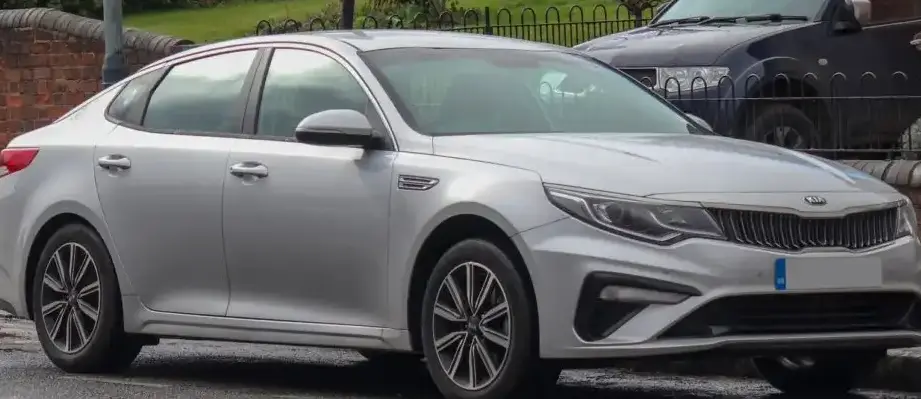
Technical Specifications
| Brand | Kia |
| Model | Optima |
| Generation | Optima IV (facelift 2018) |
| Type (Engine) | 2.4 GDI (185 Hp) Sportmatic |
| Start of production | 2018 |
| End of production | 2020 |
| Powertrain Architecture | Internal Combustion engine |
| Body type | Sedan |
| Seats | 5 |
| Doors | 4 |
| Fuel consumption (economy) – urban (EPA) | 9.4-9.8 l/100 km (25 – 24 US mpg) |
| Fuel consumption (economy) – extra urban (EPA) | 6.7-7.4 l/100 km (35.1 – 31.8 US mpg) |
| Fuel consumption (economy) – combined (EPA) | 8.1-8.7 l/100 km (29 – 27 US mpg) |
| Fuel Type | Petrol (Gasoline) |
| Emission standard | ULEV 70 – LEV III |
| Weight-to-power ratio | 7.9 kg/Hp, 126.3 Hp/tonne |
| Weight-to-torque ratio | 6.1 kg/Nm, 164.5 Nm/tonne |
| Power | 185 Hp @ 6000 rpm |
| Power per litre | 78.4 Hp/l |
| Torque | 241 Nm @ 4000 rpm (177.75 lb.-ft. @ 4000 rpm) |
| Engine layout | Front, Transverse |
| Engine Model/Code | Theta II / G4KJ |
| Engine displacement | 2359 cm3 (143.96 cu. in.) |
| Number of cylinders | 4 |
| Engine configuration | Inline |
| Cylinder Bore | 88 mm (3.46 in.) |
| Piston Stroke | 97 mm (3.82 in.) |
| Compression ratio | 11.3:1 |
| Number of valves per cylinder | 4 |
| Fuel injection system | Direct injection |
| Engine aspiration | Naturally aspirated engine |
| Valvetrain | DOHC |
| Engine oil capacity | 4.8 l (5.07 US qt | 4.22 UK qt) |
| Coolant | 7.2 l (7.61 US qt | 6.34 UK qt) |
| Kerb Weight | 1465-1496 kg (3229.77 – 3298.12 lbs.) |
| Trunk (boot) space – minimum | 510 l (18.01 cu. ft.) |
| Fuel tank capacity | 70 l (18.49 US gal | 15.4 UK gal) |
| Length | 4855 mm (191.14 in.) |
| Width | 1860 mm (73.23 in.) |
| Height | 1465 mm (57.68 in.) |
| Wheelbase | 2804 mm (110.39 in.) |
| Front track | 1597-1613 mm (62.87 – 63.5 in.) |
| Rear (Back) track | 1604-1621 mm (63.15 – 63.82 in.) |
| Front overhang | 965 mm (37.99 in.) |
| Rear overhang | 1085 mm (42.72 in.) |
| Ride height (ground clearance) | 135 mm (5.31 in.) |
| Drag coefficient (Cd) | 0.27 |
| Minimum turning circle (turning diameter) | 10.9 m (35.76 ft.) |
| Drivetrain Architecture | The Internal combustion engine (ICE) drives the front wheels of the vehicle. |
| Drive wheel | Front wheel drive |
| Number of gears and type of gearbox | 6 gears, automatic transmission Sportmatic |
| Front suspension | Independent, type McPherson with coil spring and anti-roll bar |
| Rear suspension | Independent multi-link spring suspension with stabilizer |
| Front brakes | Ventilated discs, 305 mm |
| Rear brakes | Disc, 284 mm |
| Assisting systems | ABS (Anti-lock braking system) |
| Steering type | Steering rack and pinion |
| Power steering | Electric Steering |
| Tires size | 205/65 R16; 215/55 R17; 235/45 R18 |
| Wheel rims size | 6.5J x 16; 7J x 17; 7.5J 18 |
The Kia Optima IV, specifically the 2.4 GDI (185 Hp) Sportmatic variant produced from 2018 to 2020, represents a significant refinement of Kia’s mid-size sedan. This facelifted version of the fourth-generation Optima (introduced in 2015) focused on improving the vehicle’s styling, technology, and overall driving experience. Positioned as a mid-range offering within the Optima lineup, the 2.4 GDI Sportmatic bridged the gap between the base 1.6L turbocharged engine and the more powerful 2.0L turbocharged models. It was primarily marketed towards buyers seeking a balance of fuel efficiency, comfortable ride quality, and adequate performance for daily commuting and family transportation within the North American market.
Powertrain & Engine Architecture
At the heart of the 2018-2020 Kia Optima 2.4 GDI Sportmatic is the Theta II 2.4-liter inline-four cylinder engine, designated G4KJ. This engine is a naturally aspirated powerplant featuring multi-point direct fuel injection (GDI) technology. The GDI system allows for precise fuel delivery, enhancing both power and fuel efficiency. The engine utilizes a dual continuously variable valve timing (CVVT) system, optimizing valve timing for improved performance across the rev range. The 6-speed automatic transmission, marketed as “Sportmatic,” offers a degree of driver control with a manual shift mode. While not a dual-clutch transmission, it provides smooth and responsive gear changes. The transmission is designed to balance fuel economy with acceptable acceleration.
Driving Characteristics
The 185 horsepower and 177.75 lb-ft of torque produced by the 2.4 GDI engine provide adequate, though not exhilarating, performance. Acceleration from 0 to 60 mph typically takes around 8.5 to 9 seconds. The Sportmatic transmission is tuned for comfort, with gear ratios prioritizing fuel efficiency over aggressive acceleration. Compared to the more powerful 2.0L turbocharged Optima, the 2.4 GDI feels noticeably less responsive, particularly during highway merging and overtaking maneuvers. However, it offers a smoother and more predictable driving experience than the base 1.6L turbo. The automatic transmission’s shift points are generally well-placed, but can sometimes feel hesitant during quick downshifts.
Equipment & Trim Levels
The 2.4 GDI Sportmatic trim typically included standard features such as automatic headlights, a rearview camera, a 7-inch touchscreen infotainment system with Apple CarPlay and Android Auto compatibility, Bluetooth connectivity, and a six-speaker audio system. Higher trim levels added features like leather upholstery, a power-adjustable driver’s seat, a panoramic sunroof, and advanced safety technologies like blind-spot monitoring and rear cross-traffic alert. Optional extras included a premium Harman Kardon audio system and navigation. Interior materials were generally of good quality for the price point, with a focus on comfort and practicality.
Chassis & Braking
The Optima IV utilizes a front-wheel-drive platform with an independent McPherson strut suspension in the front and an independent multi-link suspension in the rear. This suspension setup provides a comfortable ride quality, effectively absorbing bumps and road imperfections. The 2.4 GDI models typically featured ventilated front disc brakes and solid rear disc brakes. Anti-lock Braking System (ABS) was standard. Steering is provided by an electric power steering system, offering light and precise control. The chassis is tuned for comfort rather than sporty handling, prioritizing a smooth and stable ride.
Market Reception & Comparison
The 2018-2020 Kia Optima 2.4 GDI Sportmatic received generally positive reviews from automotive critics. It was praised for its spacious interior, comfortable ride, and generous standard features. However, some critics noted that the engine lacked the punch of its turbocharged counterparts. Fuel economy was considered competitive for its class, averaging around 29 mpg combined. Compared to rivals like the Honda Accord and Toyota Camry, the Optima offered a more stylish design and a longer warranty, but lacked the same level of refinement and driving dynamics. The 2.4 GDI offered a more affordable alternative to the turbocharged models, appealing to buyers who prioritized value and fuel efficiency.
Legacy
The Theta II 2.4 GDI engine, while generally reliable, has been subject to some reports of carbon buildup on the intake valves, potentially leading to reduced performance and fuel economy over time. Regular maintenance, including the use of quality fuel and occasional intake valve cleaning, can help mitigate this issue. The 2018-2020 Optima 2.4 GDI Sportmatic remains a popular choice in the used car market, offering a compelling combination of value, comfort, and practicality. Its relatively simple powertrain and readily available parts contribute to its affordability and ease of maintenance. It represents a solid and dependable mid-size sedan for buyers seeking a well-rounded and reliable vehicle.