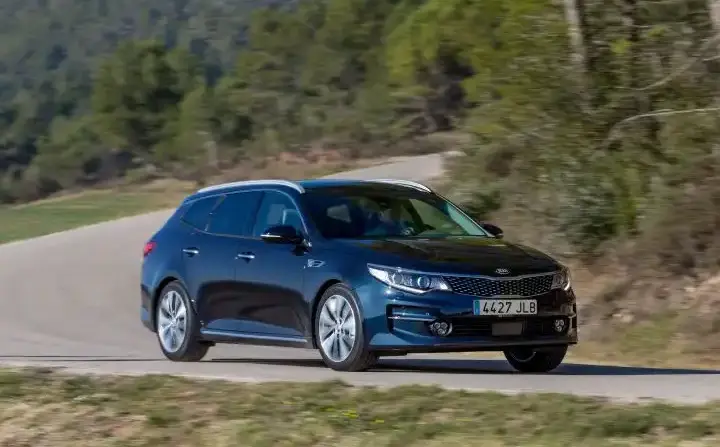
The Kia Optima IV Sportswagon 2.0 CVVL (163 hp) was a front-wheel-drive station wagon produced between 2016 and 2018. Positioned as a mid-range offering within the fourth-generation Optima (JF) lineup, it aimed to provide a practical and stylish alternative to traditional sedans, particularly in European markets where the wagon body style remains popular. This variant combined a naturally aspirated 2.0-liter gasoline engine with a six-speed automatic transmission, offering a balance between fuel efficiency and acceptable performance for everyday driving. It represented Kia’s continued effort to expand its presence in the European market with vehicles designed to appeal to a broader range of customer needs.
Technical Specifications
| Brand | Kia |
| Model | Optima |
| Generation | Optima IV Sportswagon |
| Type (Engine) | 2.0 CVVL (163 Hp) |
| Start of production | 2016 |
| End of production | 2018 |
| Powertrain Architecture | Internal Combustion engine |
| Body type | Station wagon (estate) |
| Seats | 5 |
| Doors | 5 |
| Fuel consumption (economy) – urban | 10.5 l/100 km (22.4 US mpg, 26.9 UK mpg, 9.5 km/l) |
| Fuel consumption (economy) – extra urban | 5.9 l/100 km (39.9 US mpg, 47.9 UK mpg, 16.9 km/l) |
| Fuel consumption (economy) – combined | 7.6 l/100 km (30.9 US mpg, 37.2 UK mpg, 13.2 km/l) |
| CO2 emissions | 174 g/km |
| Fuel Type | Petrol (Gasoline) |
| Acceleration 0 – 100 km/h | 9.6 sec |
| Acceleration 0 – 62 mph | 9.6 sec |
| Acceleration 0 – 60 mph | 9.1 sec |
| Maximum speed | 206 km/h (128 mph) |
| Emission standard | Euro 6 |
| Weight-to-power ratio | 9 kg/Hp, 110.5 Hp/tonne |
| Weight-to-torque ratio | 7.5 kg/Nm, 132.9 Nm/tonne |
| Power | 163 Hp @ 6500 rpm |
| Power per litre | 81.5 Hp/l |
| Torque | 196 Nm @ 4800 rpm (144.56 lb.-ft. @ 4800 rpm) |
| Engine layout | Front, Transverse |
| Engine Model/Code | G4ND |
| Engine displacement | 1999 cm3 (121.99 cu. in.) |
| Number of cylinders | 4 |
| Engine configuration | Inline |
| Cylinder Bore | 81 mm (3.19 in.) |
| Piston Stroke | 97 mm (3.82 in.) |
| Compression ratio | 10.3:1 |
| Number of valves per cylinder | 4 |
| Fuel injection system | Multi-port manifold injection |
| Engine aspiration | Naturally aspirated engine |
| Engine oil capacity | 4.3 l (4.54 US qt | 3.78 UK qt) |
| Coolant | 5.9 l (6.23 US qt | 5.19 UK qt) |
| Kerb Weight | 1475-1600 kg (3251.82 – 3527.4 lbs.) |
| Max. weight | 2070 kg (4563.57 lbs.) |
| Max load | 470-595 kg (1036.17 – 1311.75 lbs.) |
| Trunk (boot) space – minimum | 552 l (19.49 cu. ft.) |
| Trunk (boot) space – maximum | 1686 l (59.54 cu. ft.) |
| Fuel tank capacity | 70 l (18.49 US gal | 15.4 UK gal) |
| Max. roof load | 100 kg (220.46 lbs.) |
| Permitted trailer load with brakes (12%) | 1700 kg (3747.86 lbs.) |
| Permitted trailer load without brakes | 750 kg (1653.47 lbs.) |
| Permitted towbar download | 80 kg (176.37 lbs.) |
| Length | 4855 mm (191.14 in.) |
| Width | 1860 mm (73.23 in.) |
| Width including mirrors | 2120 mm (83.46 in.) |
| Height | 1470 mm (57.87 in.) |
| Wheelbase | 2805 mm (110.43 in.) |
| Front track | 1597-1607 mm (62.87 – 63.27 in.) |
| Rear (Back) track | 1604-1614 mm (63.15 – 63.54 in.) |
| Front overhang | 965 mm (37.99 in.) |
| Rear overhang | 1085 mm (42.72 in.) |
| Ride height (ground clearance) | 135 mm (5.31 in.) |
| Minimum turning circle (turning diameter) | 10.9 m (35.76 ft.) |
| Drivetrain Architecture | The Internal combustion engine (ICE) drives the front wheels of the vehicle. |
| Drive wheel | Front wheel drive |
| Number of gears and type of gearbox | 6 gears, automatic transmission |
| Front suspension | Independent, type McPherson with coil spring and anti-roll bar |
| Rear suspension | Independent multi-link suspension |
| Front brakes | Ventilated discs |
| Rear brakes | Disc |
| Assisting systems | ABS (Anti-lock braking system) |
| Steering type | Steering rack and pinion |
| Power steering | Electric Steering |
| Tires size | 215/60 R16 95V; 215/55 R17 94W; 235/45 ZR18 98Y |
| Wheel rims size | 6.5J x 16; 7.5J x 17; 7.5J x 18 |
Powertrain & Engine Architecture
The heart of this Optima Sportswagon variant is the Kia-developed G4ND 2.0-liter inline-four cylinder engine. This engine utilizes a continuously variable valve lift (CVVL) system, designed to optimize engine performance and fuel efficiency by adjusting valve timing and lift based on driving conditions. The G4ND engine employs multi-point fuel injection, delivering fuel directly into the intake ports. The engine’s architecture is relatively conventional, featuring a cast iron block and an aluminum cylinder head. The six-speed automatic transmission, while providing smooth shifts, wasn’t known for being particularly sporty or quick to respond. It was a standard torque-converter automatic, prioritizing comfort and fuel economy over outright performance.
Driving Characteristics
The 163 hp and 196 Nm (144.56 lb-ft) of torque delivered by the 2.0 CVVL engine, coupled with the six-speed automatic, resulted in a comfortable but not particularly exhilarating driving experience. Acceleration from 0-60 mph took around 9.1 seconds, and top speed was limited to 128 mph. The automatic transmission, while smooth, could feel somewhat sluggish during quick acceleration or overtaking maneuvers. The gear ratios were tuned for fuel efficiency rather than performance, meaning the engine often felt strained when pushed hard. Compared to the more powerful GT trim with its turbocharged engine, or even the diesel variants, this 2.0L automatic felt noticeably less responsive. However, it offered a more refined and quieter driving experience than the diesel, and was generally considered adequate for everyday commuting and long-distance cruising.
Equipment & Trim Levels
The 2.0 CVVL automatic trim typically included standard features such as air conditioning, power windows and locks, a touchscreen infotainment system with Bluetooth connectivity, and a suite of safety features including ABS, electronic stability control, and multiple airbags. Interior upholstery was generally cloth, with options for leather upgrades. Higher trim levels within the Sportswagon range offered features like a panoramic sunroof, heated seats, and advanced driver-assistance systems. The specific equipment level varied depending on the market and optional packages selected by the original buyer.
Chassis & Braking
The Optima Sportswagon featured a McPherson strut front suspension and a multi-link rear suspension, providing a comfortable ride quality. The braking system consisted of ventilated discs at the front and solid discs at the rear. ABS (Anti-lock Braking System) was standard. The suspension tuning was geared towards comfort and stability, rather than sporty handling. Stabilizer bars were fitted front and rear to reduce body roll during cornering, but the overall handling characteristics were more focused on providing a relaxed and predictable driving experience.
Market Reception & Comparison
The Kia Optima IV Sportswagon 2.0 CVVL was generally well-received by critics as a practical and stylish alternative to traditional sedans. However, the 2.0-liter engine and automatic transmission combination were often criticized for being underpowered and lacking in responsiveness. Fuel economy was considered decent, but not class-leading. Compared to the diesel variants, the 2.0L petrol offered a smoother and quieter driving experience, but at the expense of fuel efficiency and low-end torque. The automatic transmission was seen as a good compromise for drivers prioritizing convenience over performance.
Legacy
The Kia Optima IV Sportswagon 2.0 CVVL, while not the most exciting variant in the lineup, proved to be a reliable and practical choice for buyers seeking a spacious and comfortable station wagon. The G4ND engine, while not without its quirks, is generally considered to be a durable unit with reasonable long-term reliability. In the used car market, these models represent a good value proposition, offering a well-equipped and reasonably priced family vehicle. Maintenance costs are generally moderate, and parts availability is good. However, potential buyers should be aware of the potential for minor issues with the automatic transmission and the CVVL system.