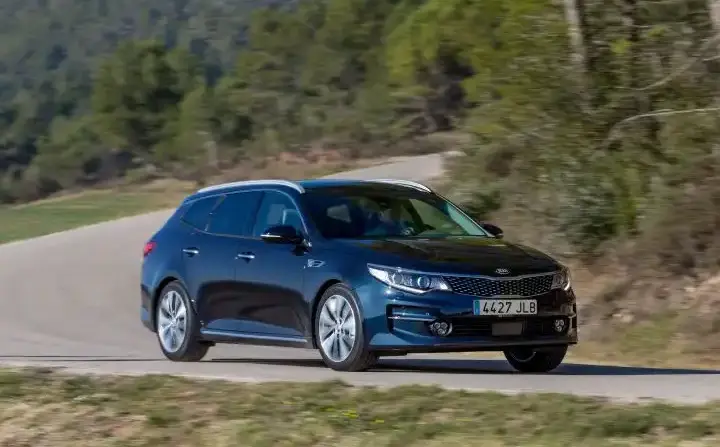
The Kia Optima IV Sportswagon 2.0 CVVL Automatic, produced from 2016 to 2018, represents Kia’s entry into the European and global market for practical, stylish station wagons. Positioned as a mid-range offering within the fourth-generation Optima (JF) lineup, this variant aimed to provide a balance of fuel efficiency, reasonable performance, and family-friendly versatility. It was designed to compete with established European brands like Volkswagen, Ford, and Skoda, offering a compelling alternative with Kia’s renowned warranty and value proposition. The Sportswagon body style, introduced with this generation, broadened the Optima’s appeal beyond the traditional sedan market, catering to customers needing increased cargo capacity.
Technical Specifications
| Brand | Kia |
| Model | Optima |
| Generation | Optima IV Sportswagon |
| Type (Engine) | 2.0 CVVL (163 Hp) Automatic |
| Start of production | 2016 |
| End of production | 2018 |
| Powertrain Architecture | Internal Combustion engine |
| Body type | Station wagon (estate) |
| Seats | 5 |
| Doors | 5 |
| Fuel consumption (urban) | 10.4 l/100 km (22.6 US mpg, 27.2 UK mpg, 9.6 km/l) |
| Fuel consumption (extra urban) | 5.9 l/100 km (39.9 US mpg, 47.9 UK mpg, 16.9 km/l) |
| Fuel consumption (combined) | 7.6 l/100 km (30.9 US mpg, 37.2 UK mpg, 13.2 km/l) |
| CO2 emissions | 173 g/km |
| Fuel Type | Petrol (Gasoline) |
| Acceleration 0 – 100 km/h | 10.7 sec |
| Acceleration 0 – 62 mph | 10.7 sec |
| Acceleration 0 – 60 mph | 10.2 sec |
| Maximum speed | 205 km/h (127.38 mph) |
| Emission standard | Euro 6 |
| Weight-to-power ratio | 9.2 kg/Hp, 109 Hp/tonne |
| Weight-to-torque ratio | 7.6 kg/Nm, 131.1 Nm/tonne |
| Power | 163 Hp @ 6500 rpm |
| Power per litre | 81.5 Hp/l |
| Torque | 196 Nm @ 4800 rpm (144.56 lb.-ft. @ 4800 rpm) |
| Engine layout | Front, Transverse |
| Engine Model/Code | G4ND |
| Engine displacement | 1999 cm3 (121.99 cu. in.) |
| Number of cylinders | 4 |
| Engine configuration | Inline |
| Cylinder Bore | 81 mm (3.19 in.) |
| Piston Stroke | 97 mm (3.82 in.) |
| Compression ratio | 10.3:1 |
| Number of valves per cylinder | 4 |
| Fuel injection system | Multi-port manifold injection |
| Engine aspiration | Naturally aspirated engine |
| Engine oil capacity | 4.3 l (4.54 US qt | 3.78 UK qt) |
| Coolant | 5.8 l (6.13 US qt | 5.1 UK qt) |
| Kerb Weight | 1495-1625 kg (3295.91 – 3582.51 lbs.) |
| Max. weight | 2090 kg (4607.66 lbs.) |
| Max load | 465-595 kg (1025.15 – 1311.75 lbs.) |
| Trunk (boot) space – minimum | 552 l (19.49 cu. ft.) |
| Trunk (boot) space – maximum | 1686 l (59.54 cu. ft.) |
| Fuel tank capacity | 70 l (18.49 US gal | 15.4 UK gal) |
| Max. roof load | 100 kg (220.46 lbs.) |
| Permitted trailer load with brakes (12%) | 1300 kg (2866.01 lbs.) |
| Permitted trailer load without brakes | 650 kg (1433 lbs.) |
| Permitted towbar download | 80 kg (176.37 lbs.) |
| Length | 4855 mm (191.14 in.) |
| Width | 1860 mm (73.23 in.) |
| Width including mirrors | 2120 mm (83.46 in.) |
| Height | 1470 mm (57.87 in.) |
| Wheelbase | 2805 mm (110.43 in.) |
| Front track | 1597-1607 mm (62.87 – 63.27 in.) |
| Rear (Back) track | 1604-1614 mm (63.15 – 63.54 in.) |
| Front overhang | 965 mm (37.99 in.) |
| Rear overhang | 1085 mm (42.72 in.) |
| Ride height (ground clearance) | 135 mm (5.31 in.) |
| Minimum turning circle (turning diameter) | 10.9 m (35.76 ft.) |
| Drivetrain Architecture | The Internal combustion engine (ICE) drives the front wheels of the vehicle. |
| Drive wheel | Front wheel drive |
| Number of gears and type of gearbox | 6 gears, automatic transmission |
| Front suspension | Independent, type McPherson with coil spring and anti-roll bar |
| Rear suspension | Independent multi-link suspension |
| Front brakes | Ventilated discs |
| Rear brakes | Disc |
| Assisting systems | ABS (Anti-lock braking system) |
| Steering type | Steering rack and pinion |
| Power steering | Electric Steering |
| Tires size | 215/60 R16 95V; 215/55 R17 94W; 235/45 ZR18 98Y |
| Wheel rims size | 6.5J x 16; 7.5J x 17; 7.5J x 18 |
Powertrain & Engine Architecture
The heart of this Optima Sportswagon variant is the G4ND 2.0-liter naturally aspirated inline-four cylinder engine. This engine falls under Kia’s CVVL (Continuously Variable Valve Lift) technology, designed to optimize engine efficiency and performance across a wider range of engine speeds. The CVVL system adjusts the valve lift based on driving conditions, improving both low-end torque and high-end horsepower. Fuel delivery is managed by a multi-port fuel injection system. The engine produces 163 horsepower at 6,500 rpm and 196 Nm (144.56 lb-ft) of torque at 4,800 rpm. Paired with this engine is a six-speed automatic transmission, chosen for its smooth operation and ease of use, catering to a broader customer base than a manual transmission. The transmission is tuned for comfort and fuel economy rather than outright performance.
Driving Characteristics
The 2.0L automatic Optima Sportswagon delivers a comfortable and predictable driving experience. Acceleration from 0-60 mph takes around 10.2 seconds, which is adequate for everyday driving but doesn’t offer particularly sporty performance. The automatic transmission provides smooth gear changes, but can sometimes feel hesitant during quick acceleration maneuvers. The gear ratios are optimized for fuel efficiency, meaning the engine can feel strained when climbing hills or overtaking at higher speeds. Compared to the more powerful turbocharged engines available in the Optima lineup, this variant prioritizes fuel economy and ease of driving over outright performance. The steering is light and precise, making it easy to maneuver in urban environments.
Equipment & Trim Levels
The 2.0 CVVL Automatic Sportswagon typically came equipped with a respectable level of standard features. These included air conditioning, power windows and locks, a touchscreen infotainment system with Bluetooth connectivity, and a rearview camera. Higher trim levels added features such as leather upholstery, a panoramic sunroof, heated front seats, and advanced driver-assistance systems like lane departure warning and automatic emergency braking. Interior upholstery was typically cloth on base models, with leather options available on higher trims. Dashboard configuration was consistent across the range, featuring a modern and user-friendly design.
Chassis & Braking
The Optima Sportswagon utilizes an independent suspension setup, with McPherson struts at the front and a multi-link system at the rear. This configuration provides a comfortable ride quality and decent handling characteristics. Braking duties are handled by ventilated discs at the front and solid discs at the rear. ABS (Anti-lock Braking System) is standard. The suspension is tuned for comfort, prioritizing ride quality over sporty handling. Stabilizer bars are present at both the front and rear to reduce body roll during cornering.
Market Reception & Comparison
The Kia Optima IV Sportswagon 2.0 CVVL Automatic was generally well-received by critics as a practical and well-equipped family car. However, its performance was often criticized as being somewhat underwhelming compared to competitors offering turbocharged engines. Fuel economy was considered good, averaging around 30.9 US mpg in combined driving. Compared to the more powerful Optima variants, this model offered a lower price point and lower running costs, making it an attractive option for budget-conscious buyers. Reliability reports have been generally positive, with few major issues reported with the 2.0L engine and automatic transmission.
Legacy
The Kia Optima IV Sportswagon 2.0 CVVL Automatic has proven to be a reliable and durable vehicle in the used car market. The G4ND engine is known for its longevity, and the six-speed automatic transmission has a good track record. While not the most exciting vehicle to drive, it offers a practical and affordable solution for families needing a spacious and versatile wagon. Its value proposition, combined with Kia’s generous warranty, has contributed to its continued popularity in the used car market.