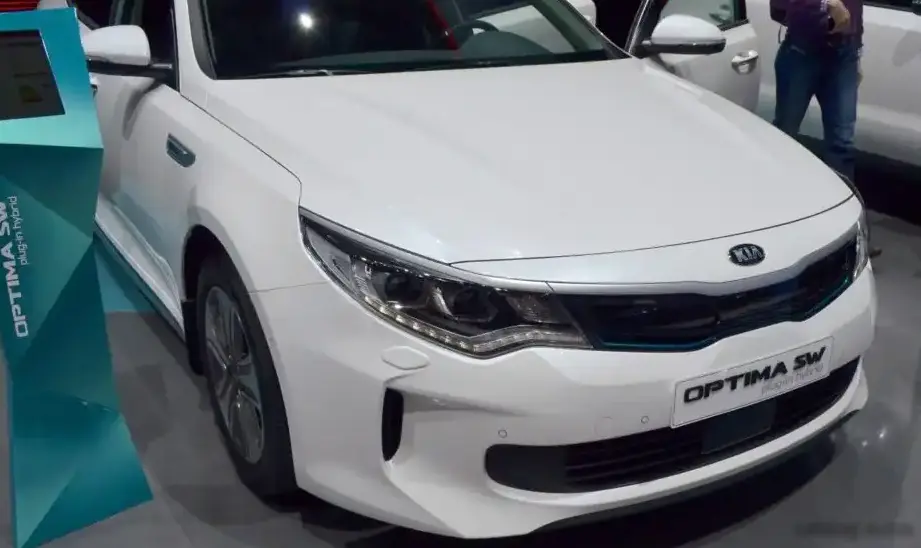
The Kia Optima IV Sportswagon 2.0 GDI Plug-in Hybrid Automatic, produced from 2017 to 2018, represents Kia’s entry into the increasingly popular plug-in hybrid estate (station wagon) market. Positioned as a premium offering within the Optima Sportswagon range, it combined a gasoline engine with an electric motor and battery pack to deliver enhanced fuel efficiency and reduced emissions. This variant was primarily aimed at European and select global markets where the demand for practical, fuel-conscious vehicles was high. It utilized the PF platform, shared with the fourth-generation Optima sedan, offering a blend of comfort, space, and technology.
Technical Specifications
| Brand | Kia |
| Model | Optima |
| Generation | Optima IV Sportswagon |
| Type (Engine) | 2.0 GDI (205 Hp) Plug-in Hybrid Automatic |
| Start of production | 2017 |
| End of production | 2018 |
| Powertrain Architecture | PHEV (Plug-in Hybrid Electric Vehicle) |
| Body type | Station wagon (estate) |
| Seats | 5 |
| Doors | 5 |
| Fuel consumption (combined) | 1.4 l/100 km (168 US mpg, 201.8 UK mpg, 71.4 km/l) |
| CO2 emissions | 33 g/km |
| Fuel Type | Petrol / electricity |
| Acceleration 0 – 100 km/h | 9.7 sec |
| Acceleration 0 – 62 mph | 9.7 sec |
| Acceleration 0 – 60 mph | 9.2 sec |
| Maximum speed | 192 km/h (119.3 mph) |
| Emission standard | Euro 6 |
| Weight-to-power ratio | 8.5 kg/Hp, 117.8 Hp/tonne |
| Weight-to-torque ratio | 4.6 kg/Nm, 215.5 Nm/tonne |
| Gross battery capacity | 11.3 kWh |
| Net (usable) battery capacity | 9 kWh |
| Battery voltage | 360 V |
| Battery technology | Lithium-polymer (LiPo) |
| Battery weight | 131 kg (288.81 lbs) |
| Battery location | Under the trunk |
| All-electric range | 62 km (38.53 mi) |
| Average Energy consumption | 12.3 kWh/100 km (19.79 kWh/100 mi, 170 MPGe, 8.1 km/kWh, 5.1 mi/kWh) |
| Max speed (electric) | 120 km/h (74.56 mph) |
| Electric motor power | 68 Hp @ 2330-3300 rpm |
| Electric motor Torque | 205 Nm @ 0-2330 rpm (151.2 lb.-ft. @ 0-2330 rpm) |
| Electric motor location | Between the combustion engine and the transmission |
| System power | 205 Hp @ 6000 rpm |
| System torque | 375 Nm @ 2300 rpm (276.59 lb.-ft. @ 2300 rpm) |
| Engine Power | 156 Hp @ 6000 rpm |
| Engine Torque | 189 Nm @ 5000 rpm (139.4 lb.-ft. @ 5000 rpm) |
| Engine layout | Front, Transverse |
| Engine Model/Code | G4NG |
| Engine displacement | 1999 cm3 (121.99 cu. in.) |
| Number of cylinders | 4 |
| Engine configuration | Inline |
| Cylinder Bore | 81 mm (3.19 in.) |
| Piston Stroke | 97 mm (3.82 in.) |
| Compression ratio | 13.5:1 |
| Number of valves per cylinder | 4 |
| Fuel injection system | Direct injection |
| Engine aspiration | Naturally aspirated engine |
| Valvetrain | DOHC, Dual CVVT |
| Engine oil capacity | 4.1 l (4.33 US qt | 3.61 UK qt) |
| Coolant capacity | 6.7 l (7.08 US qt | 5.9 UK qt) |
| Kerb Weight | 1740-1805 kg (3836.04 – 3979.34 lbs) |
| Max. weight | 2270 kg (5004.49 lbs) |
| Max load | 465-530 kg (1025.15 – 1168.45 lbs) |
| Trunk (boot) space – minimum | 440 l (15.54 cu. ft.) |
| Trunk (boot) space – maximum | 1574 l (55.59 cu. ft.) |
| Fuel tank capacity | 55 l (14.53 US gal | 12.1 UK gal) |
| Max. roof load | 100 kg (220.46 lbs) |
| Permitted trailer load with brakes (12%) | 1500 kg (3306.93 lbs) |
| Permitted trailer load without brakes | 750 kg (1653.47 lbs) |
| Permitted towbar download | 80 kg (176.37 lbs) |
| Length | 4855 mm (191.14 in.) |
| Width | 1860 mm (73.23 in.) |
| Height | 1470 mm (57.87 in.) |
| Wheelbase | 2805 mm (110.43 in.) |
| Front track | 1602 mm (63.07 in.) |
| Rear track | 1609 mm (63.35 in.) |
| Front overhang | 965 mm (37.99 in.) |
| Rear overhang | 1085 mm (42.72 in.) |
| Ride height (ground clearance) | 135 mm (5.31 in.) |
| Drag coefficient (Cd) | 0.28 |
| Minimum turning circle | 10.9 m (35.76 ft.) |
| Drivetrain Architecture | Front wheel drive. PHEV. ICE and electric motor drive the front wheels. |
| Drive wheel | Front wheel drive |
| Number of gears | 6 |
| Gearbox type | automatic transmission |
| Front suspension | Independent, type McPherson with coil spring and anti-roll bar |
| Rear suspension | Independent multi-link spring suspension with stabilizer |
| Front brakes | Ventilated discs, 300 mm |
| Rear brakes | Disc, 300 mm |
| Assisting systems | ABS (Anti-lock braking system) |
| Steering type | Steering rack and pinion |
| Power steering | Electric Steering |
| Tires size | 215/55 R17 |
| Wheel rims size | 7J x 17 |
INTRODUCTION
The Kia Optima IV Sportswagon 2.0 GDI Plug-in Hybrid Automatic, launched in 2017 and discontinued in 2018, was a significant addition to Kia’s European lineup. Built on the PF platform, also underpinning the fourth-generation Optima sedan, the Sportswagon offered the practicality of a station wagon combined with the efficiency of a plug-in hybrid powertrain. This model aimed to appeal to environmentally conscious buyers seeking a spacious and well-equipped vehicle. It represented Kia’s commitment to expanding its hybrid and electric vehicle offerings in response to tightening emissions regulations and growing consumer demand for alternative fuel vehicles.
Powertrain & Engine Architecture
At the heart of the Optima Sportswagon PHEV lies a 2.0-liter ‘G4NG’ inline-four cylinder gasoline engine. This engine, utilizing direct injection (GDI) technology, produces 156 horsepower at 6000 rpm and 139.4 lb-ft of torque at 5000 rpm. The engine features a dual continuously variable valve timing (DOHC, Dual CVVT) system to optimize performance and efficiency. Paired with the gasoline engine is a 68 horsepower electric motor, delivering 151.2 lb-ft of torque, integrated between the engine and the six-speed automatic transmission. The electric motor draws power from a 9 kWh lithium-polymer battery pack located under the trunk floor. The combined system output is 205 horsepower and 276.59 lb-ft of torque. The transmission is a conventional six-speed automatic, chosen for its smooth operation and reliability, adapted to work seamlessly with the electric motor. The vehicle can operate in all-electric mode for up to 38.53 miles (62 km) on a full charge, and can achieve a combined fuel economy of 168 US mpg.
Driving Characteristics
The 2.0 GDI Plug-in Hybrid Automatic Optima Sportswagon offers a refined and comfortable driving experience. In electric mode, acceleration is brisk and quiet, ideal for urban driving. When the gasoline engine engages, the transition is generally smooth, although a slight increase in noise is noticeable. The six-speed automatic transmission provides adequate gear changes, but isn’t particularly sporty. Compared to the standard gasoline-powered Optima Sportswagon, the PHEV variant feels slightly heavier due to the battery pack, impacting handling marginally. However, the lower center of gravity contributes to improved stability. The electric motor’s instant torque provides a noticeable boost during acceleration, making the PHEV feel more responsive than the base 1.6L gasoline engine. Compared to the higher-output gasoline engines, this variant prioritizes efficiency over outright performance.
Equipment & Trim Levels
The Optima Sportswagon 2.0 GDI Plug-in Hybrid Automatic typically came well-equipped, reflecting its position as a premium trim level. Standard features included leather upholstery, heated front seats, a touchscreen infotainment system with navigation, a rearview camera, and a suite of advanced driver-assistance systems (ADAS) such as lane departure warning, automatic emergency braking, and adaptive cruise control. Optional extras included a panoramic sunroof, premium sound system, and ventilated front seats. Interior trim was generally dark, with accents of chrome and piano black. The dashboard layout was similar to other Optima Sportswagon models, but with unique hybrid-specific displays showing energy flow and battery status.
Chassis & Braking
The Optima Sportswagon PHEV utilizes a McPherson strut front suspension and a multi-link rear suspension, tuned for comfort and stability. Stabilizer bars are fitted to both axles to reduce body roll. Braking duties are handled by ventilated discs at the front and solid discs at the rear, providing adequate stopping power. The vehicle is equipped with ABS (Anti-lock Braking System) and electronic stability control. The added weight of the battery pack necessitated slightly stiffer spring rates compared to the standard Optima Sportswagon, but the overall ride quality remained comfortable. The steering is electrically assisted, providing light and precise control.
Market Reception & Comparison
The Kia Optima Sportswagon 2.0 GDI Plug-in Hybrid Automatic received generally positive reviews from automotive critics. It was praised for its fuel efficiency, spacious interior, and generous equipment levels. However, some reviewers noted that the all-electric range was relatively short compared to some competitors. Compared to the standard gasoline-powered Optima Sportswagon, the PHEV variant offered significantly better fuel economy, but at a higher purchase price. Compared to other plug-in hybrid estates, such as the Volkswagen Passat GTE, the Optima Sportswagon offered a competitive package in terms of price and features. Reliability reports have been generally positive, with few major issues reported with the powertrain.
Legacy
The Kia Optima IV Sportswagon 2.0 GDI Plug-in Hybrid Automatic, despite its short production run, played a role in establishing Kia as a serious contender in the plug-in hybrid market. The powertrain, while not without its limitations, proved to be relatively reliable. On the used car market, these models are sought after by buyers looking for a fuel-efficient and well-equipped estate car. The battery pack’s longevity is a key consideration for potential buyers, but with proper maintenance, it can provide many years of service. The Optima Sportswagon PHEV paved the way for Kia’s continued development of hybrid and electric vehicles, contributing to the brand’s growing reputation for innovation and value.