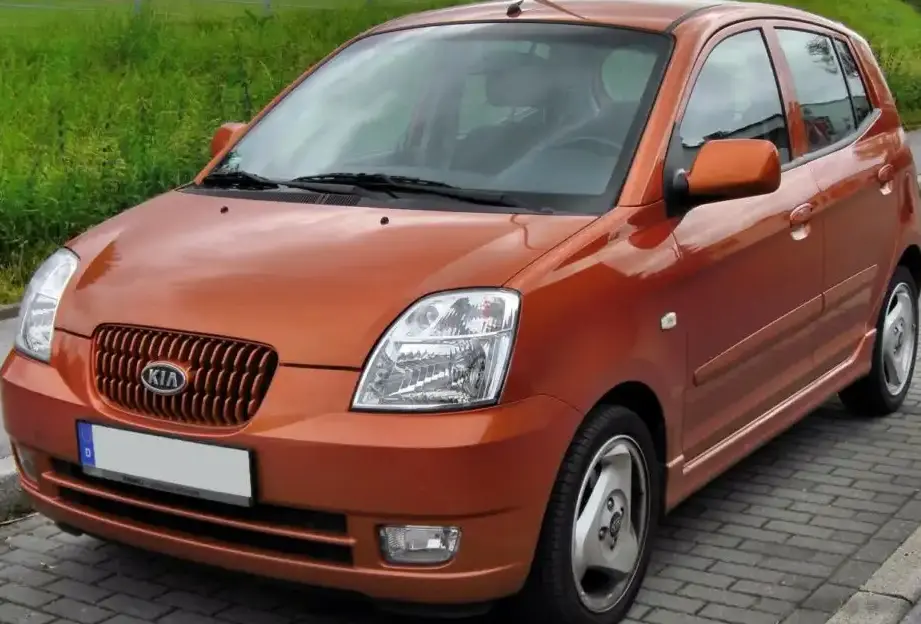
The Kia Picanto I 1.1 CRDi, produced from 2006 to 2007, represented a significant step for Kia in the European city car segment. This variant, powered by a small-displacement diesel engine, was designed to appeal to buyers seeking exceptional fuel economy and low running costs. It occupied the entry-level position within the first generation Picanto (TA) lineup, offering a more economical alternative to the gasoline-powered models. The Picanto I, built on the SA platform, aimed to provide a practical and affordable option in a market dominated by established competitors like the Fiat Panda and Renault Twingo.
Technical Specifications
| Brand | Kia |
| Model | Picanto |
| Generation | Picanto I |
| Type (Engine) | 1.1 CRDi (75 Hp) |
| Start of production | 2006 |
| End of production | 2007 |
| Powertrain Architecture | Internal Combustion engine |
| Body type | Hatchback |
| Doors | 5 |
| Fuel consumption (urban) | 4.9 l/100 km (48 US mpg, 57.6 UK mpg, 20.4 km/l) |
| Fuel consumption (extra urban) | 3.8 l/100 km (61.9 US mpg, 74.3 UK mpg, 26.3 km/l) |
| Fuel consumption (combined) | 4.2 l/100 km (56 US mpg, 67.3 UK mpg, 23.8 km/l) |
| Fuel Type | Diesel |
| Maximum speed | 162 km/h (100.66 mph) |
| Power | 75 Hp @ 4000 rpm |
| Power per litre | 67 Hp/l |
| Torque | 153 Nm @ 1900 rpm (112.85 lb.-ft. @ 1900 rpm) |
| Engine layout | Front, Transverse |
| Engine Model/Code | D3FA |
| Engine displacement | 1120 cm3 (68.35 cu. in.) |
| Number of cylinders | 3 |
| Engine configuration | Inline |
| Cylinder Bore | 75 mm (2.95 in.) |
| Piston Stroke | 84.5 mm (3.33 in.) |
| Compression ratio | 17.8:1 |
| Number of valves per cylinder | 4 |
| Fuel injection system | Diesel Commonrail |
| Engine aspiration | Turbocharger, Intercooler |
| Valvetrain | DOHC |
| Engine oil capacity | 5.3 l (5.6 US qt | 4.66 UK qt) |
| Coolant capacity | 5.3 l (5.6 US qt | 4.66 UK qt) |
| Fuel tank capacity | 35 l (9.25 US gal | 7.7 UK gal) |
| Length | 3495 mm (137.6 in.) |
| Width | 1595 mm (62.8 in.) |
| Wheelbase | 2370 mm (93.31 in.) |
| Front track | 1400 mm (55.12 in.) |
| Rear track | 1385 mm (54.53 in.) |
| Drivetrain Architecture | Front wheel drive, Internal Combustion Engine |
Powertrain & Engine Architecture
The heart of the Picanto 1.1 CRDi is the D3FA engine, a 1.1-liter inline-three cylinder diesel. This engine utilized a second-generation common rail direct injection system, allowing for precise fuel delivery and improved combustion efficiency. A small turbocharger with an intercooler was employed to boost power output and compensate for the engine’s small displacement. The engine featured a double overhead camshaft (DOHC) valvetrain with four valves per cylinder, contributing to its relatively high specific output for its size. The engine’s 17.8:1 compression ratio was typical for a diesel engine, maximizing thermal efficiency. The engine was paired with a four-speed automatic transmission, a relatively uncommon offering in this class at the time. This transmission was chosen to provide ease of use, particularly in congested urban environments, appealing to a broader range of drivers.
Driving Characteristics
The 1.1 CRDi automatic Picanto prioritized fuel economy over outright performance. With 75 horsepower and 153 Nm (113 lb-ft) of torque, acceleration was modest. The four-speed automatic transmission, while convenient, wasn’t particularly quick-shifting, and the gear ratios were optimized for fuel efficiency rather than spirited driving. Compared to the 1.0-liter gasoline version, the CRDi offered significantly more torque at lower engine speeds, making it feel more responsive in everyday driving situations. However, the diesel engine was noticeably louder and produced more vibration than the gasoline counterpart. The automatic transmission, while smooth, lacked the engagement and control offered by the five-speed manual gearbox available on other Picanto models.
Equipment & Trim Levels
The 1.1 CRDi automatic typically came with a basic level of equipment, reflecting its position as the entry-level trim. Standard features generally included power steering, central locking, electric front windows, and a basic audio system. Air conditioning was often an optional extra. Interior upholstery was typically cloth, and the dashboard featured a simple, functional design. Safety features were limited, with dual airbags being a common inclusion, but ABS brakes were often an optional upgrade. The overall interior ambiance was utilitarian, focusing on durability and practicality rather than luxury.
Chassis & Braking
The Picanto I utilized a simple, yet effective chassis design. It featured a MacPherson strut front suspension and a torsion beam rear suspension. The torsion beam rear setup was a cost-effective solution that provided adequate ride comfort for city driving. Braking was typically accomplished with disc brakes on the front wheels and drum brakes on the rear. The braking system was adequate for the vehicle’s weight and performance, but lacked the stopping power of more sophisticated setups. Stabilizer bars were often omitted on the base models to further reduce costs.
Market Reception & Comparison
The Kia Picanto 1.1 CRDi was generally well-received by critics for its exceptional fuel economy and low running costs. It was praised as a practical and affordable city car, particularly appealing to drivers who primarily used their vehicles for short trips. However, the engine’s noise and vibration, along with the relatively slow performance of the automatic transmission, were common criticisms. Compared to the gasoline-powered Picanto models, the CRDi offered superior fuel economy but at the expense of refinement. Against competitors like the Fiat Panda and Renault Twingo, the Picanto offered a competitive price point and a longer warranty, which were key selling points.
Legacy
The Kia Picanto I 1.1 CRDi, while not a performance icon, established Kia as a serious contender in the European city car market. The D3FA engine proved to be relatively reliable, although regular maintenance, including oil changes and fuel filter replacements, was crucial for longevity. In the used car market today, these Picantos are often sought after by buyers looking for an incredibly economical and practical vehicle. While finding well-maintained examples can be challenging due to their age, they remain a viable option for those prioritizing fuel efficiency and low running costs. The 1.1 CRDi automatic represents a unique combination of features that appealed to a specific segment of the market, and its legacy as a fuel-efficient city car endures.