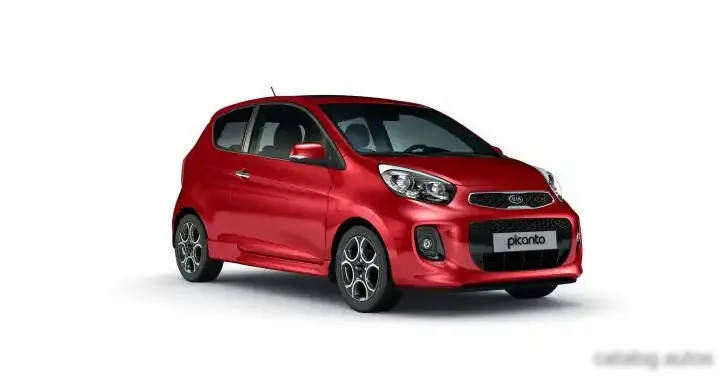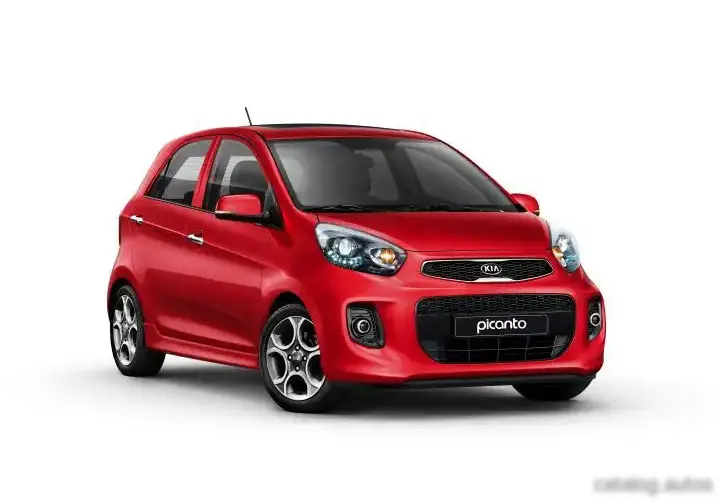
The Kia Picanto II 5D (facelift 2015) 1.0, producing 66 horsepower, represents an entry-level offering within the second generation of Kia’s city car. Introduced as part of the facelift in 2015 and continuing through 2017, this variant was primarily aimed at the European and Asian markets, where fuel efficiency and affordability are key considerations. It slots into the Picanto lineup as the base model, offering a cost-effective and economical option for urban commuters. The Picanto II, built on the TA platform, aimed to provide a more refined and spacious alternative to other microcars available at the time.
Technical Specifications
| Brand | Kia |
| Model | Picanto |
| Generation | Picanto II 5D (facelift 2015) |
| Type (Engine) | 1.0 (66 Hp) |
| Start of production | 2015 |
| End of production | 2017 |
| Powertrain Architecture | Internal Combustion engine |
| Body type | Hatchback |
| Seats | 5 |
| Doors | 5 |
| Fuel consumption (urban) | 5.5-5.8 l/100 km (42.8 – 40.6 US mpg) |
| Fuel consumption (extra urban) | 3.8 l/100 km (61.9 US mpg) |
| Fuel consumption (combined) | 4.4-4.5 l/100 km (53.5 – 52.3 US mpg) |
| CO2 emissions | 105-102 g/km |
| Fuel Type | Petrol (Gasoline) |
| Acceleration 0 – 100 km/h | 14.6 sec |
| Acceleration 0 – 62 mph | 14.6 sec |
| Acceleration 0 – 60 mph | 13.9 sec |
| Maximum speed | 158 km/h (98.18 mph) |
| Emission standard | Euro 6 |
| Weight-to-power ratio | 13 kg/Hp |
| Weight-to-torque ratio | 9 kg/Nm |
| Power | 66 Hp @ 5500 rpm |
| Torque | 95 Nm @ 3500 rpm (70.07 lb.-ft. @ 3500 rpm) |
| Engine layout | Front, Transverse |
| Engine Model/Code | B3LA |
| Engine displacement | 998 cm3 (60.9 cu. in.) |
| Number of cylinders | 3 |
| Engine configuration | Inline |
| Cylinder Bore | 71 mm (2.8 in.) |
| Piston Stroke | 84 mm (3.31 in.) |
| Compression ratio | 10.5:1 |
| Number of valves per cylinder | 4 |
| Fuel injection system | Multi-port manifold injection |
| Engine aspiration | Naturally aspirated engine |
| Engine oil capacity | 2.9 l (3.06 US qt | 2.55 UK qt) |
| Coolant capacity | 5.1 l (5.39 US qt | 4.49 UK qt) |
| Kerb Weight | 855-964 kg (1884.95 – 2125.26 lbs.) |
| Max. weight | 1400 kg (3086.47 lbs.) |
| Max load | 436-545 kg (961.22 – 1201.52 lbs.) |
| Trunk (boot) space – minimum | 200 l (7.06 cu. ft.) |
| Trunk (boot) space – maximum | 870 l (30.72 cu. ft.) |
| Fuel tank capacity | 35 l (9.25 US gal | 7.7 UK gal) |
| Length | 3595 mm (141.54 in.) |
| Width | 1595 mm (62.8 in.) |
| Width including mirrors | 1880 mm (74.02 in.) |
| Height | 1480 mm (58.27 in.) |
| Wheelbase | 2385 mm (93.9 in.) |
| Front track | 1409-1421 mm (55.47 – 55.94 in.) |
| Rear (Back) track | 1412-1424 mm (55.59 – 56.06 in.) |
| Minimum turning circle | 9.6 m (31.5 ft.) |
| Drivetrain Architecture | Front wheel drive |
| Number of gears and type of gearbox | 5 gears, manual transmission |
| Front suspension | Independent, type McPherson with coil spring and anti-roll bar |
| Rear suspension | Semi-independent, coil spring |
| Front brakes | Ventilated discs |
| Rear brakes | Disc |
| Assisting systems | ABS (Anti-lock braking system) |
| Steering type | Steering rack and pinion |
| Power steering | Electric Steering |
| Tires size | 155/70 R13 75T; 165/60 R14 75H; 175/50 R15 75H |
| Wheel rims size | 4.5J x 13 ET 46; 5.0J x 14 ET 49; 5.5J x 15 |
INTRODUCTION
The Kia Picanto II 5D (facelift 2015) 1.0 is a five-door hatchback designed as an affordable and practical city car. The facelift brought minor cosmetic updates and refinements to the existing Picanto II platform (introduced in 2011). This particular 1.0-liter variant, producing 66 horsepower, served as the entry point to the Picanto range, targeting buyers prioritizing fuel economy and low running costs. It was a key model for Kia in Europe and Asia, competing with vehicles like the Hyundai i10, Fiat 500, and Toyota Aygo.
Powertrain & Engine Architecture
At the heart of the Picanto 1.0 is the Kia B3LA engine, a 998cc inline-three cylinder petrol engine. This engine utilizes a multi-point fuel injection system and a naturally aspirated design. The engine features four valves per cylinder and a compression ratio of 10.5:1. The B3LA engine is known for its simplicity and reliability, though it doesn’t offer particularly high performance. The 66 horsepower is delivered at 5500 rpm, with a torque output of 95 Nm (70.07 lb-ft) at 3500 rpm. This variant was exclusively offered with a 5-speed manual transmission, designed to maximize fuel efficiency. The transmission is a standard front-wheel-drive setup.
Driving Characteristics
The Picanto 1.0 with the manual transmission offers modest performance. Acceleration from 0 to 60 mph takes approximately 13.9 seconds, and the top speed is around 98 mph. The engine feels strained when accelerating hard, particularly when fully loaded or on inclines. The gear ratios are optimized for fuel economy rather than outright speed. The light weight of the vehicle (around 855-964 kg) helps to mitigate the lack of power to some extent. Steering is light and easy, making it ideal for navigating tight city streets. The suspension is tuned for comfort, providing a reasonably smooth ride, although it can feel somewhat bouncy on uneven surfaces.
Equipment & Trim Levels
The base-level Picanto 1.0 typically came with a fairly basic specification. Standard features included central locking, power steering, electric front windows, and an ABS anti-lock braking system. Air conditioning was often an optional extra, as were features like alloy wheels and a radio/CD player. Interior upholstery was typically cloth, and the dashboard featured a simple, functional design. Higher trim levels, available with the 1.0 engine or with larger engines, added features like a touchscreen infotainment system, rear electric windows, and upgraded interior trim.
Chassis & Braking
The Picanto II utilizes a McPherson strut front suspension with a coil spring and anti-roll bar, providing decent handling characteristics for a city car. The rear suspension is a semi-independent coil spring setup. Braking is handled by ventilated discs at the front and discs at the rear, providing adequate stopping power for the vehicle’s weight and performance. The electric power steering offers light and precise control, making it easy to maneuver in urban environments.
Market Reception & Comparison
The Kia Picanto 1.0 was generally well-received by critics as a practical and affordable city car. Its fuel economy was a major selling point, with combined fuel consumption figures ranging from 4.4 to 4.5 liters per 100 kilometers. Compared to other Picanto variants, such as those with larger engines, the 1.0-liter model offered significantly better fuel efficiency but at the expense of performance. The 1.0 was often seen as a sensible choice for drivers who primarily used the car for short urban journeys and were not concerned with rapid acceleration. Reliability was also a positive aspect, with Kia’s reputation for build quality improving during this period.
Legacy
The Kia Picanto II 1.0 has proven to be a relatively reliable and durable vehicle. The simple engine design and robust construction contribute to its longevity. On the used car market, these models are often sought after by first-time buyers or those looking for an inexpensive and economical runabout. While not known for its performance or luxurious features, the Picanto 1.0 remains a practical and affordable option for urban transportation. Common maintenance issues are generally minor, relating to wear and tear on components like brakes, tires, and suspension parts. The B3LA engine is known to be fairly robust if properly maintained with regular oil changes.