
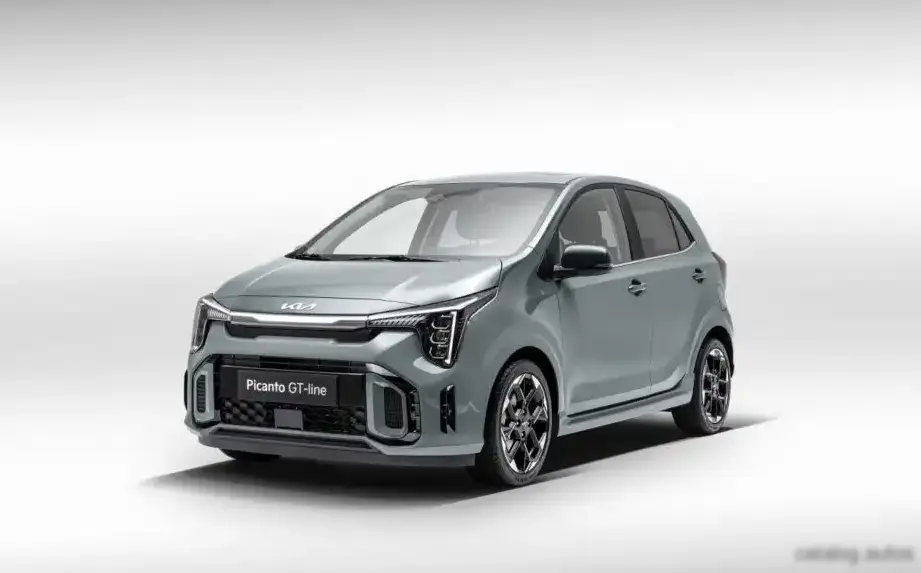
The Kia Picanto III (facelift, introduced in May 2024) 1.0-liter (63 horsepower) variant represents the entry point into the third generation of Kia’s city car. Positioned as an affordable and economical option, this model aimed to provide basic transportation with Kia’s renowned warranty and a surprisingly spacious interior for its diminutive size. Production of this specific configuration ran through July 2025. The Picanto III, built on the Kia/Hyundai HA platform, is primarily marketed in Europe and other regions where small, fuel-efficient vehicles are in high demand. This facelift brought minor cosmetic updates and refinements to the existing Picanto III, maintaining its core value proposition.
Technical Specifications
| Brand | Kia |
| Model | Picanto |
| Generation | Picanto III (facelift 2023) |
| Type (Engine) | 1.0 (63 Hp) |
| Start of production | May, 2024 |
| End of production | July, 2025 |
| Powertrain Architecture | Internal Combustion engine |
| Body type | Hatchback |
| Seats | 5 |
| Doors | 5 |
| Fuel consumption at Low speed (WLTP) | 6.5 l/100 km (36.2 US mpg, 43.5 UK mpg, 15.4 km/l) |
| Fuel consumption at Medium speed (WLTP) | 5.1 l/100 km (46.1 US mpg, 55.4 UK mpg, 19.6 km/l) |
| Fuel consumption at high speed (WLTP) | 4.9 l/100 km (48 US mpg, 57.6 UK mpg, 20.4 km/l) |
| Fuel consumption at very high speed (WLTP) | 5.9 l/100 km (39.9 US mpg, 47.9 UK mpg, 16.9 km/l) |
| Combined fuel consumption (WLTP) | 5.5 l/100 km (42.8 US mpg, 51.4 UK mpg, 18.2 km/l) |
| CO2 emissions (WLTP) | 124 g/km |
| Fuel Type | Petrol (Gasoline) |
| Acceleration 0 – 100 km/h | 15.6 sec |
| Acceleration 0 – 62 mph | 15.6 sec |
| Acceleration 0 – 60 mph | 14.8 sec |
| Maximum speed | 145 km/h (90.1 mph) |
| Emission standard | Euro 6e |
| Weight-to-power ratio | 14.4 kg/Hp, 69.2 Hp/tonne |
| Weight-to-torque ratio | 9.8 kg/Nm, 102.2 Nm/tonne |
| Power | 63 Hp @ 5000 rpm |
| Torque | 93 Nm @ 3750 rpm (68.59 lb.-ft. @ 3750 rpm) |
| Engine layout | Front, Transverse |
| Engine Model/Code | G3LD |
| Engine displacement | 998 cm3 (60.9 cu. in.) |
| Number of cylinders | 3 |
| Engine configuration | Inline |
| Cylinder Bore | 71 mm (2.8 in.) |
| Piston Stroke | 84 mm (3.31 in.) |
| Compression ratio | 11:1 |
| Number of valves per cylinder | 4 |
| Fuel injection system | Multi-port manifold injection |
| Engine aspiration | Naturally aspirated engine |
| Engine oil capacity | 3.1 l (3.28 US qt | 2.73 UK qt) |
| Coolant | 5.2 l (5.49 US qt | 4.58 UK qt) |
| Kerb Weight | 910-1010 kg (2006.21 – 2226.67 lbs.) |
| Max. weight | 1400 kg (3086.47 lbs.) |
| Max load | 390-490 kg (859.8 – 1080.27 lbs.) |
| Trunk (boot) space – minimum | 255 l (9.01 cu. ft.) |
| Trunk (boot) space – maximum | 1010 l (35.67 cu. ft.) |
| Fuel tank capacity | 35 l (9.25 US gal | 7.7 UK gal) |
| Max. roof load | 60 kg (132.28 lbs.) |
| Length | 3605 mm (141.93 in.) |
| Width | 1595 mm (62.8 in.) |
| Height | 1485 mm (58.46 in.) |
| Wheelbase | 2400 mm (94.49 in.) |
| Front track | 1394-1414 mm (54.88 – 55.67 in.) |
| Rear (Back) track | 1402 mm (55.2 in.) |
| Front overhang | 685 mm (26.97 in.) |
| Rear overhang | 520 mm (20.47 in.) |
| Ride height (ground clearance) | 141 mm (5.55 in.) |
| Minimum turning circle (turning diameter) | 9.4 m (30.84 ft.) |
| Drivetrain Architecture | The Internal combustion engine (ICE) drives the front wheels of the vehicle. |
| Drive wheel | Front wheel drive |
| Number of gears and type of gearbox | 5 gears, manual transmission |
| Front suspension | Independent type McPherson, Transverse stabilizer |
| Rear suspension | Coil spring, Elastic beam |
| Front brakes | Disc, 256 mm |
| Rear brakes | Drum, 203 mm |
| Assisting systems | ABS (Anti-lock braking system) |
| Steering type | Steering rack and pinion |
| Power steering | Electric Steering |
| Tires size | 175/65 R14 86T; 185/55 R15 86H; 195/45 R16 84V |
| Wheel rims size | 5.5J x 14 ET45; 6.0J x 15 ET51; 6.5J x 16 ET51 |
INTRODUCTION
The Kia Picanto III 1.0 (63 Hp) is a front-wheel-drive, five-door hatchback that served as the base model for the facelifted third generation Picanto, launched in May 2024. This variant was designed to appeal to budget-conscious buyers and those primarily using the vehicle for urban commuting. It’s a key part of Kia’s strategy to offer accessible and reliable transportation in the competitive city car segment. The facelift brought subtle styling changes, including a revised front grille and updated interior trim, but the core mechanicals remained largely unchanged from the pre-facelift Picanto III.
Powertrain & Engine Architecture
At the heart of the Picanto 1.0 is the Kia G3LD engine, a naturally aspirated 998cc inline-three cylinder petrol engine. This engine utilizes a multi-point fuel injection system and features four valves per cylinder. The G3LD is known for its simplicity and relatively low maintenance requirements. The 63 horsepower output is achieved at 5000 rpm, while peak torque of 93 Nm (68.59 lb-ft) arrives at 3750 rpm. This engine is paired with a five-speed manual transmission, which is the standard configuration for this trim level. The engine’s design prioritizes fuel efficiency over outright performance. It lacks direct injection and turbocharging, relying on optimized combustion chamber design and valve timing to maximize economy. The engine also incorporates a Start & Stop system to further reduce fuel consumption in city driving.
Driving Characteristics
The Picanto 1.0 with the five-speed manual transmission offers modest performance. Acceleration from 0-100 km/h takes 15.6 seconds, and top speed is limited to 145 km/h (90.1 mph). The engine feels strained at higher speeds, and overtaking maneuvers require careful planning. However, within urban environments, the Picanto 1.0 is surprisingly nimble and easy to maneuver. The light steering and compact dimensions make parking a breeze. The five-speed gearbox is well-matched to the engine’s characteristics, providing adequate ratios for everyday driving. Compared to higher-spec Picanto models with more powerful engines, the 1.0 feels noticeably slower, but it offers a more relaxed and economical driving experience. The gear ratios are optimized for fuel efficiency, resulting in a higher cruising speed in top gear but slower acceleration.
Equipment & Trim Levels
The base 1.0-liter Picanto typically came equipped with essential features such as air conditioning, power steering, central locking, and an integrated audio system with Bluetooth connectivity. Safety features included ABS (Anti-lock Braking System) and airbags for the driver and front passenger. Interior upholstery was typically cloth, and the dashboard featured a simple, functional design. Optional extras included alloy wheels, a touchscreen infotainment system with Apple CarPlay and Android Auto compatibility, and a rear-view camera. The trim level was positioned as the entry-level offering, focusing on providing a basic but well-equipped package at an affordable price point.
Chassis & Braking
The Picanto III utilizes a McPherson strut front suspension and a torsion beam rear suspension. This setup provides a comfortable ride quality, particularly on smooth roads. The front brakes are disc brakes, while the rear brakes are drum brakes. This configuration is typical for vehicles in this weight class and helps to keep costs down. The steering is electrically assisted, providing light and precise control. The chassis is designed to prioritize stability and handling in urban driving conditions. The relatively lightweight construction of the Picanto contributes to its agility and fuel efficiency.
Market Reception & Comparison
The Kia Picanto 1.0 received generally positive reviews for its affordability, fuel efficiency, and surprisingly spacious interior. Critics praised its value for money and the comprehensive warranty offered by Kia. However, the engine’s lack of power was a common criticism. Compared to other city cars in its segment, such as the Hyundai i10 and the Volkswagen up!, the Picanto 1.0 offered a competitive level of equipment and a longer warranty. Fuel economy was comparable to its rivals, with the WLTP combined fuel consumption figure of 5.5 l/100 km (42.8 US mpg) being competitive within the class. Reliability was also a strong point, with the G3LD engine proving to be durable and relatively trouble-free.
Legacy
The Kia Picanto III 1.0 (63 Hp) has established itself as a popular choice in the used car market, particularly among first-time buyers and those seeking an economical and reliable city car. The G3LD engine is known for its longevity and low maintenance costs, making it an attractive option for budget-conscious buyers. While not a performance-oriented vehicle, the Picanto 1.0 provides a practical and efficient solution for urban transportation. Its compact size, nimble handling, and affordable price point continue to make it a relevant contender in the city car segment.