
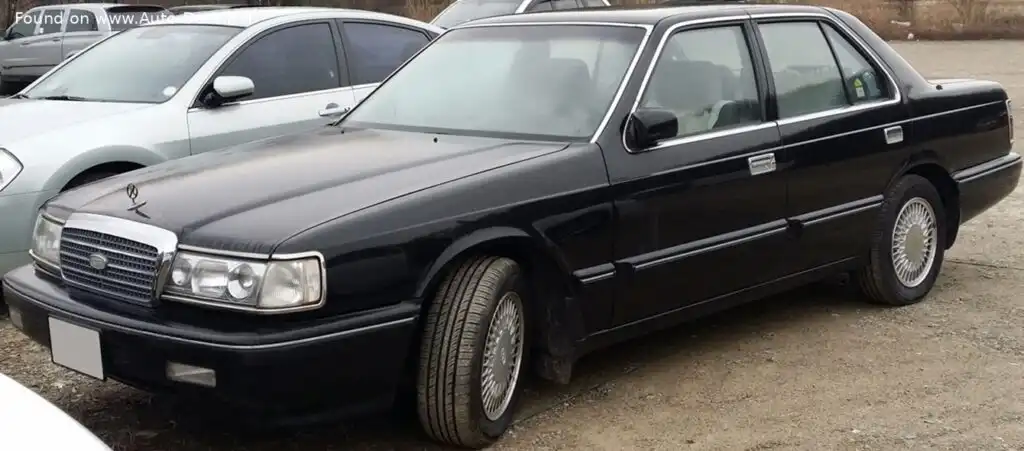
The Kia Potentia 2.2 12V (120 hp) Automatic, produced between 1992 and 1997, represented Kia’s entry into the mid-size sedan market, primarily aimed at offering a comfortable and relatively affordable rear-wheel drive option. Positioned as a step up from more basic Korean offerings of the time, the Potentia sought to establish Kia as a credible automotive manufacturer. This particular variant, with its 2.2-liter engine and four-speed automatic transmission, was intended to appeal to buyers prioritizing ease of driving over outright performance. It was part of the initial Potentia generation, built on a rear-wheel drive platform, and served as a crucial model for Kia as it expanded its global presence.
Technical Specifications
| Brand | Kia |
| Model | Potentia |
| Generation | Potentia |
| Type (Engine) | 2.2 12V (120 Hp) Automatic |
| Start of production | 1992 |
| End of production | 1997 |
| Powertrain Architecture | Internal Combustion engine |
| Body type | Sedan |
| Seats | 5 |
| Doors | 4 |
| Fuel Type | Petrol (Gasoline) |
| Maximum speed | 184 km/h (114.33 mph) |
| Weight-to-power ratio | 12.3 kg/Hp, 81.6 Hp/tonne |
| Weight-to-torque ratio | 7.9 kg/Nm, 126.5 Nm/tonne |
| Power | 120 Hp @ 5500 rpm |
| Power per litre | 54.9 Hp/l |
| Torque | 186 Nm @ 5500 rpm (137.19 lb.-ft. @ 5500 rpm) |
| Engine layout | Front, Longitudinal |
| Engine displacement | 2184 cm3 (133.28 cu. in.) |
| Number of cylinders | 4 |
| Engine configuration | Inline |
| Cylinder Bore | 86 mm (3.39 in.) |
| Piston Stroke | 94 mm (3.7 in.) |
| Compression ratio | 9.8:1 |
| Number of valves per cylinder | 3 |
| Fuel injection system | Multi-port manifold injection |
| Engine aspiration | Naturally aspirated engine |
| Valvetrain | OHC |
| Kerb Weight | 1470 kg (3240.8 lbs.) |
| Trunk (boot) space – minimum | 427 l (15.08 cu. ft.) |
| Fuel tank capacity | 75 l (19.81 US gal | 16.5 UK gal) |
| Length | 4925 mm (193.9 in.) |
| Width | 1725 mm (67.91 in.) |
| Height | 1430 mm (56.3 in.) |
| Wheelbase | 2710 mm (106.69 in.) |
| Front track | 1445 mm (56.89 in.) |
| Rear (Back) track | 1460 mm (57.48 in.) |
| Drivetrain Architecture | The Internal combustion engine (ICE) drives the rear wheels of the vehicle. |
| Drive wheel | Rear wheel drive |
| Number of gears and type of gearbox | 4 gears, automatic transmission |
| Front suspension | Wishbone |
| Rear suspension | Coil spring |
| Front brakes | Ventilated discs |
| Rear brakes | Disc |
| Assisting systems | ABS (Anti-lock braking system) |
| Steering type | Steering rack and pinion |
| Power steering | Hydraulic Steering |
| Tires size | 195/65 R15 |
| Wheel rims size | 15 |
Powertrain & Engine Architecture
The heart of the Potentia 2.2 Automatic was the 4-cylinder, 2.2-liter (2184 cc) gasoline engine. This engine, often identified by its internal codes, featured a single overhead camshaft (OHC) valvetrain with three valves per cylinder. The multi-port fuel injection system delivered fuel to each cylinder individually, contributing to improved efficiency and smoother operation compared to earlier carbureted systems. The engine produced 120 horsepower at 5500 rpm and 186 Nm (137.19 lb-ft) of torque at the same engine speed. The four-speed automatic transmission was a conventional hydraulic unit, chosen for its ease of use and suitability for the target market. While not a particularly advanced transmission, it provided adequate shifting performance for everyday driving. The engine was mounted longitudinally in the front of the vehicle, driving the rear wheels.
Driving Characteristics
The Potentia 2.2 Automatic offered a comfortable, if not particularly sporty, driving experience. The 120 hp engine, coupled with the four-speed automatic, resulted in adequate acceleration for typical commuting and highway cruising. However, it lacked the punch of higher-output engines available in other Potentia trims. The automatic transmission’s gear ratios were geared towards fuel economy and smooth transitions rather than rapid acceleration. Compared to the manual transmission versions, the automatic felt noticeably slower, especially during overtaking maneuvers. The rear-wheel drive configuration provided a balanced feel, but the relatively soft suspension tuning prioritized ride comfort over sharp handling.
Equipment & Trim Levels
The 2.2-liter Automatic Potentia typically came with a reasonable level of standard equipment for its price point. This included power steering, air conditioning, and basic instrumentation. Interior upholstery was typically cloth, with a relatively simple dashboard layout. Optional extras could include power windows, central locking, and an upgraded audio system. The trim level was generally considered mid-range within the Potentia lineup, offering a balance between affordability and features. It sat below the higher-spec models that might have featured larger engines or more luxurious interior appointments.
Chassis & Braking
The Potentia’s chassis featured a conventional suspension setup. The front suspension utilized a wishbone design, while the rear employed a coil spring arrangement. The braking system consisted of ventilated discs at the front and solid discs at the rear, providing adequate stopping power for the vehicle’s weight and performance. An Anti-lock Braking System (ABS) was included as a standard safety feature, enhancing braking performance in slippery conditions. The steering was a rack and pinion system with hydraulic power assistance, offering relatively light and precise steering feel.
Market Reception & Comparison
The Kia Potentia 2.2 Automatic was generally well-received as a practical and affordable mid-size sedan. Critics noted its comfortable ride and reasonable fuel economy. However, the engine’s performance was often cited as a weakness, particularly when compared to competitors offering more powerful engines. Compared to other Potentia trims, such as those with larger displacement engines, the 2.2-liter Automatic offered a more economical option, but at the expense of performance. Its fuel economy was competitive within its class, and its reliability proved to be generally good, although maintenance costs could be higher than some of its Japanese rivals.
Legacy
The Kia Potentia, and specifically the 2.2-liter Automatic variant, played a significant role in establishing Kia’s presence in the global automotive market. While not known for exceptional performance or groundbreaking technology, it offered a reliable and affordable transportation solution. Today, the Potentia 2.2 Automatic is a relatively rare sight on the roads, but those examples that remain are often appreciated by enthusiasts for their classic styling and simple mechanicals. The powertrain, while not particularly sophisticated, proved to be reasonably durable, and parts availability remains adequate for ongoing maintenance and repair. The car represents a pivotal moment in Kia’s history, marking its transition from a primarily domestic manufacturer to a global automotive player.
