
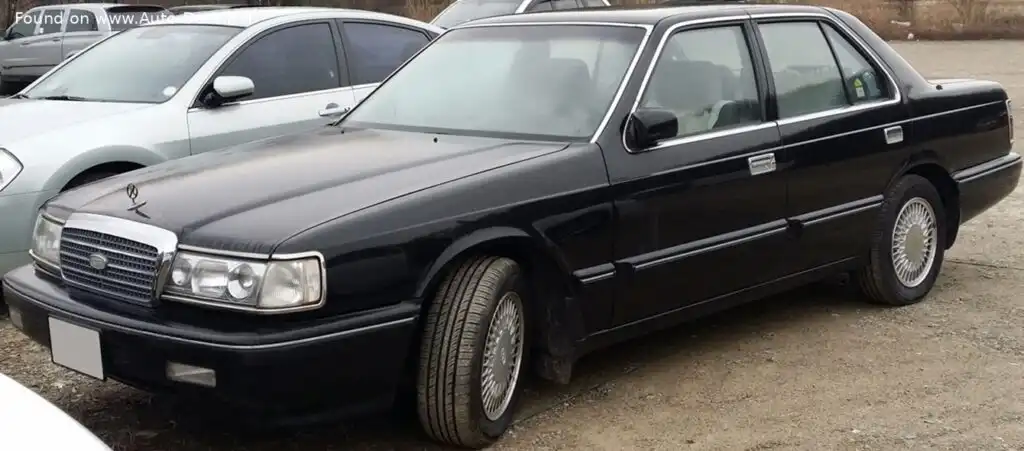
The Kia Potentia, produced between 1992 and 1997, represented Kia’s ambitious entry into the mid-size sedan market. The 3.0 i V6 variant, equipped with a 200 horsepower engine and a four-speed automatic transmission, was positioned as the premium offering within the Potentia lineup. Built upon Kia’s own platform, the Potentia aimed to provide a comfortable and well-equipped vehicle, primarily targeted towards buyers seeking a larger, more refined sedan than Kia had previously offered. This model was significant as it showcased Kia’s growing engineering capabilities and aspirations to compete with established automotive manufacturers.
Technical Specifications
| Brand | Kia |
| Model | Potentia |
| Generation | Potentia |
| Type (Engine) | 3.0 i V6 (200 Hp) |
| Start of production | 1992 |
| End of production | 1997 |
| Powertrain Architecture | Internal Combustion engine |
| Body type | Sedan |
| Seats | 5 |
| Doors | 4 |
| Fuel Type | Petrol (Gasoline) |
| Maximum speed | 185 km/h (114.95 mph) |
| Weight-to-power ratio | 8.1 kg/Hp, 123.8 Hp/tonne |
| Weight-to-torque ratio | 6.2 kg/Nm, 161 Nm/tonne |
| Power | 200 Hp @ 6000 rpm |
| Power per litre | 67.7 Hp/l |
| Torque | 260 Nm @ 4500 rpm (191.77 lb.-ft. @ 4500 rpm) |
| Engine layout | Front, Longitudinal |
| Engine displacement | 2954 cm3 (180.26 cu. in.) |
| Number of cylinders | 6 |
| Engine configuration | V-engine |
| Cylinder Bore | 90 mm (3.54 in.) |
| Piston Stroke | 77.4 mm (3.05 in.) |
| Compression ratio | 8.9:1 |
| Number of valves per cylinder | 4 |
| Fuel injection system | Multi-port manifold injection |
| Engine aspiration | Naturally aspirated engine |
| Valvetrain | DOHC |
| Kerb Weight | 1615 kg (3560.47 lbs.) |
| Trunk (boot) space – minimum | 427 l (15.08 cu. ft.) |
| Fuel tank capacity | 70 l (18.49 US gal | 15.4 UK gal) |
| Length | 4925 mm (193.9 in.) |
| Width | 1725 mm (67.91 in.) |
| Height | 1430 mm (56.3 in.) |
| Wheelbase | 2710 mm (106.69 in.) |
| Front track | 1445 mm (56.89 in.) |
| Rear (Back) track | 1460 mm (57.48 in.) |
| Drivetrain Architecture | The Internal combustion engine (ICE) drives the rear wheels of the vehicle. |
| Drive wheel | Rear wheel drive |
| Number of gears and type of gearbox | 4 gears, automatic transmission |
| Front suspension | Wishbone |
| Rear suspension | Coil spring |
| Front brakes | Ventilated discs |
| Rear brakes | Ventilated discs |
| Assisting systems | ABS (Anti-lock braking system) |
| Steering type | Steering rack and pinion |
| Power steering | Hydraulic Steering |
| Tires size | 205/60 R15 H |
Powertrain & Engine Architecture
The heart of the Potentia 3.0 i V6 was the 2.95-liter (2954 cc) naturally aspirated V6 engine. This engine, internally designated with various codes depending on the specific year and market, featured a double overhead camshaft (DOHC) valvetrain with four valves per cylinder. The multi-port fuel injection system delivered fuel to each cylinder individually, optimizing combustion efficiency. The 8.9:1 compression ratio was a compromise between performance and the fuel quality available in various markets. The engine produced 200 horsepower at 6000 rpm and 260 Nm (191.77 lb-ft) of torque at 4500 rpm. This power was channeled through a four-speed automatic transmission to the rear wheels. The automatic transmission, while providing ease of use, was a conventional hydraulic unit, lacking the electronic controls found in more modern transmissions.
Driving Characteristics
The 3.0 i V6 Potentia offered a comfortable and relatively refined driving experience. The automatic transmission, while not particularly sporty, provided smooth shifts. Acceleration was adequate for the time, with a 0-60 mph time estimated around 9-10 seconds. Compared to the base engine options, the V6 provided significantly more power and torque, making highway merging and overtaking easier. However, it wasn’t as responsive as a manual transmission equipped model would have been. The rear-wheel-drive configuration contributed to balanced handling, although the suspension was tuned more for comfort than outright sportiness. The gear ratios of the four-speed automatic were spaced to prioritize fuel economy and smooth cruising rather than aggressive acceleration.
Equipment & Trim Levels
The 3.0 i V6 Potentia typically came equipped with a higher level of standard features than lower-trim models. These included power windows, power locks, air conditioning, and a basic audio system. Interior upholstery was typically cloth, although leather options were available. Dashboard configuration was relatively straightforward, with analog gauges and a simple center console. Optional extras included a sunroof, upgraded audio system, and alloy wheels. The overall interior design aimed for a sense of spaciousness and comfort, reflecting the Potentia’s positioning as a premium sedan.
Chassis & Braking
The Potentia utilized a conventional chassis design with an independent wishbone suspension at the front and a coil spring suspension at the rear. Ventilated disc brakes were fitted on all four wheels, providing adequate stopping power. An anti-lock braking system (ABS) was standard on the 3.0 i V6 model, enhancing safety. The steering system was a rack and pinion setup with hydraulic power assistance, offering a reasonable level of steering feel. The tires were typically 205/60 R15 size, providing a balance between ride comfort and handling.
Market Reception & Comparison
The Kia Potentia 3.0 i V6 was generally well-received by automotive critics as a competent and well-equipped sedan. However, it faced stiff competition from established Japanese and European brands. Critics noted the Potentia’s comfortable ride and spacious interior, but also pointed out its somewhat bland styling and lack of brand recognition. Compared to other trims in the Potentia lineup, the V6 offered significantly more performance but at a higher price point. Fuel economy was reasonable for a V6 engine of that era, but not class-leading. Reliability was generally good, although some owners reported minor issues with the automatic transmission over time.
Legacy
The Kia Potentia, particularly the 3.0 i V6 variant, played a crucial role in establishing Kia as a credible automotive manufacturer. While not a sales blockbuster, it demonstrated Kia’s ability to produce a well-engineered and reasonably refined sedan. Today, the Potentia 3.0 i V6 is a relatively rare sight on the road. The powertrain, while not particularly high-tech by modern standards, has proven to be reasonably durable. Used examples are often sought after by enthusiasts looking for a classic Korean sedan with a comfortable ride and a distinctive V6 engine note. Parts availability can be a challenge, but the engine’s robust design and relatively simple construction make it a viable candidate for restoration and maintenance.
