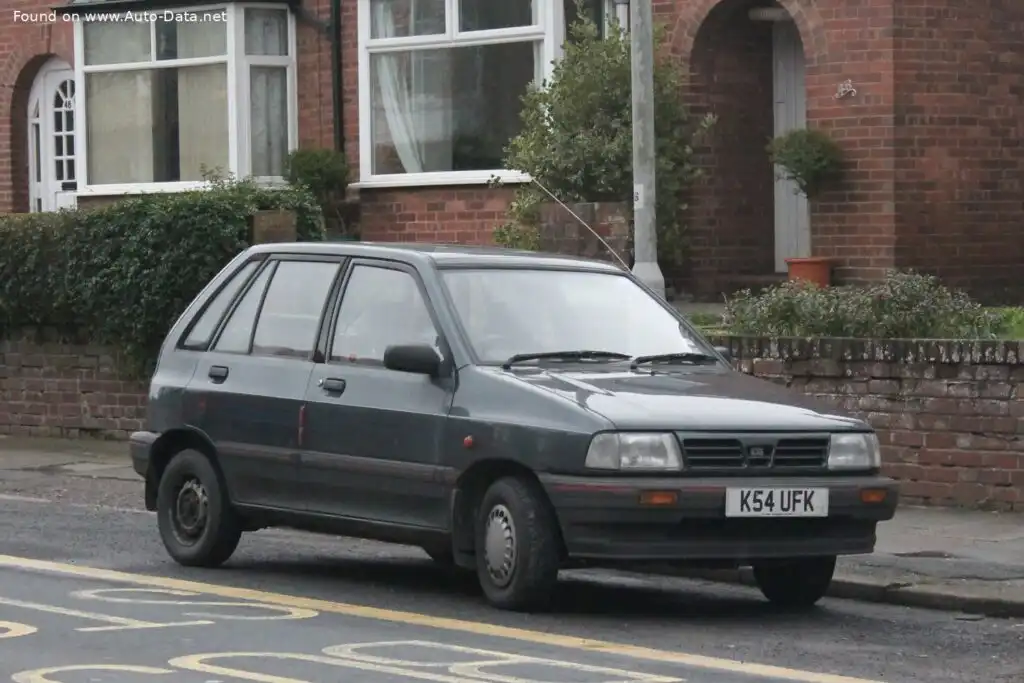
The Kia Pride (DA), produced between 1991 and 1995, represents a significant early effort by Kia to establish a foothold in the global automotive market. Based on the Mazda-derived platform, the Pride was initially intended for export, particularly to developing nations and Europe, offering affordable transportation. The 1.1 i variant, equipped with a 52 horsepower engine and a four-speed manual transmission, served as the entry-level model in the Pride lineup. It was designed to be an economical and practical city car, prioritizing fuel efficiency and low running costs over outright performance. The DA generation Pride was available in both 3-door and 5-door hatchback configurations.
Technical Specifications
| Brand | Kia |
| Model | Pride |
| Generation | Pride (DA) |
| Type (Engine) | 1.1 i (52 Hp) |
| Start of production | 1991 |
| End of production | 1995 |
| Powertrain Architecture | Internal Combustion engine |
| Body type | Hatchback |
| Seats | 5 |
| Doors | 3/5 |
| Fuel consumption (urban) | 7.6 l/100 km (30.9 US mpg, 37.2 UK mpg, 13.2 km/l) |
| Fuel consumption (extra urban) | 5.2 l/100 km (45.2 US mpg, 54.3 UK mpg, 19.2 km/l) |
| Fuel consumption (combined) | 7.3 l/100 km (32.2 US mpg, 38.7 UK mpg, 13.7 km/l) |
| Fuel Type | Petrol (Gasoline) |
| Acceleration 0 – 100 km/h | 13.6 sec |
| Acceleration 0 – 62 mph | 13.6 sec |
| Acceleration 0 – 60 mph | 12.9 sec |
| Maximum speed | 150 km/h (93.21 mph) |
| Weight-to-power ratio | 16.3 kg/Hp |
| Weight-to-torque ratio | 9.9 kg/Nm |
| Power | 52 Hp @ 5500 rpm |
| Power per litre | 45.7 Hp/l |
| Torque | 86 Nm @ 3500 rpm (63.43 lb.-ft. @ 3500 rpm) |
| Engine layout | Front, Transverse |
| Engine Model/Code | B1 |
| Engine displacement | 1138 cm3 (69.45 cu. in.) |
| Number of cylinders | 4 |
| Engine configuration | Inline |
| Cylinder Bore | 68 mm (2.68 in.) |
| Piston Stroke | 78.4 mm (3.09 in.) |
| Compression ratio | 10:1 |
| Number of valves per cylinder | 2 |
| Fuel injection system | Carburettor |
| Engine aspiration | Naturally aspirated |
| Valvetrain | OHC |
| Engine oil capacity | 3.4 l (3.59 US qt | 2.99 UK qt) |
| Kerb Weight | 850 kg (1873.93 lbs.) |
| Trunk (boot) space – minimum | 330 l (11.65 cu. ft.) |
| Trunk (boot) space – maximum | 750 l (26.49 cu. ft.) |
| Fuel tank capacity | 38 l (10.04 US gal | 8.36 UK gal) |
| Length | 3565 mm (140.35 in.) |
| Width | 1605 mm (63.19 in.) |
| Height | 1460 mm (57.48 in.) |
| Wheelbase | 2295 mm (90.35 in.) |
| Front track | 1405 mm (55.31 in.) |
| Rear track | 1385 mm (54.53 in.) |
| Minimum turning circle | 9.4 m (30.84 ft.) |
| Drivetrain Architecture | Front wheel drive |
| Number of gears | 4 |
| Gearbox type | Manual transmission |
| Front suspension | Wishbone |
| Rear suspension | Coil spring |
| Front brakes | Disc |
| Rear brakes | Drum |
| Assisting systems | ABS (Anti-lock braking system) |
| Steering type | Steering rack and pinion |
| Tires size | 165/70 R12 |
Powertrain & Engine Architecture
The heart of the 1.1 i Pride is the B1 engine, a 1.1-liter (1138 cc) inline-four cylinder gasoline engine. This engine utilizes a single overhead camshaft (OHC) valvetrain with two valves per cylinder. Notably, it employs a carburetor for fuel delivery, a technology becoming less common in the early 1990s as fuel injection gained prominence. The carburetor system, while simpler and less expensive, resulted in slightly lower fuel efficiency and increased emissions compared to fuel-injected counterparts. The engine produces 52 horsepower at 5500 rpm and 86 Nm (63.43 lb-ft) of torque at 3500 rpm. The four-speed manual transmission was the standard offering for this variant, providing a relatively simple and durable drivetrain. The engine is transversely mounted, contributing to a more compact engine bay and maximizing interior space.
Driving Characteristics
The 1.1 i Pride, with its modest 52 horsepower, was never intended to be a performance car. Acceleration from 0 to 60 mph took approximately 12.9 seconds, and top speed was limited to around 93 mph. The four-speed manual transmission offered reasonable control, but the engine lacked the torque to provide brisk acceleration in higher gears. The gear ratios were optimized for fuel economy rather than performance, meaning frequent downshifts were necessary when encountering hills or overtaking. Compared to potential upgrades like a 1.5L engine, the 1.1L felt significantly underpowered. However, the light weight of the vehicle (850 kg) helped to mitigate the lack of power, making it reasonably nimble in city driving. The steering was light and easy, further enhancing its suitability for urban environments.
Equipment & Trim Levels
The 1.1 i Pride was positioned as the base model, and as such, it came with a relatively basic level of equipment. Standard features typically included cloth upholstery, a simple dashboard layout, and manual windows and door locks. Power steering was not typically included as standard equipment on this trim level. Optional extras, depending on the market, could include a radio/cassette player, upgraded interior trim, and sometimes even air conditioning. The interior was designed with practicality in mind, offering adequate space for five passengers, although rear legroom was somewhat limited. The 330-750 liter trunk space (depending on rear seat configuration) was a strong point for a car in this class.
Chassis & Braking
The Pride utilized a front-wheel-drive layout with a relatively simple suspension setup. The front suspension consisted of wishbone arms, while the rear suspension employed a coil spring arrangement. This setup provided a comfortable, if not particularly sporty, ride. The braking system featured disc brakes on the front wheels and drum brakes on the rear. ABS (Anti-lock Braking System) was available as an option, enhancing safety, particularly in wet or slippery conditions. The steering system was a rack and pinion type, providing reasonably precise steering feel.
Market Reception & Comparison
The Kia Pride 1.1 i was generally well-received as an affordable and reliable city car. Critics praised its fuel efficiency and low running costs, but noted its lack of performance and basic interior. Compared to other small hatchbacks of the era, such as the Hyundai Excel or the Daewoo Cielo, the Pride offered a competitive price point and a reasonable level of reliability. However, it often lagged behind in terms of refinement and features. Fuel economy was a key selling point, with combined fuel consumption averaging around 32.2 US mpg. Reliability was generally good, although the carburetor system required periodic maintenance.
Legacy
The Kia Pride, particularly the 1.1 i variant, played a crucial role in establishing Kia as a viable automotive manufacturer. While not known for its performance or luxury, it proved to be a durable and economical vehicle, gaining a reputation for reliability in many markets. Today, the Pride is a relatively rare sight on the roads, but it remains a popular choice among enthusiasts seeking a simple, affordable, and easy-to-maintain classic car. The B1 engine, while not particularly sophisticated, proved to be robust and long-lasting, and many examples are still running today. The Pride laid the groundwork for Kia’s subsequent success and its evolution into a major global automotive brand.