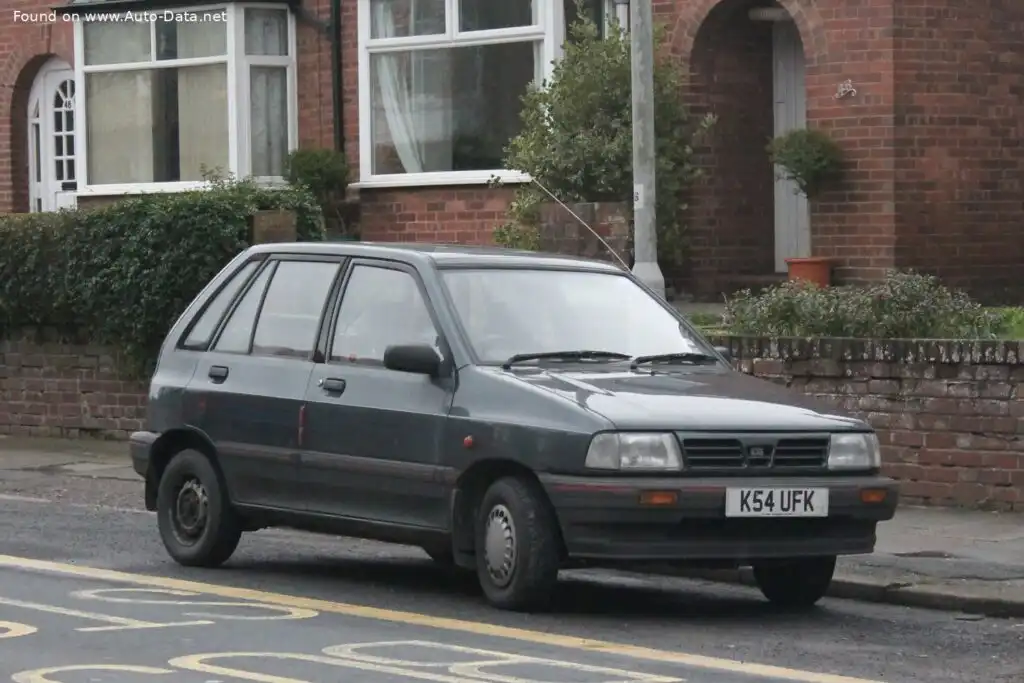
The Kia Pride (DA) 1.3i, producing 64 horsepower, was a subcompact car manufactured by Kia Motors from 1996 to 2000. This variant occupied the entry-level position within the DA Pride range, serving as the most affordable and fuel-efficient option. The DA generation represented a significant step forward for Kia, offering a more modern and refined vehicle compared to its predecessors. It was primarily aimed at budget-conscious buyers seeking reliable transportation, particularly in emerging markets and as a first car for new drivers. The Pride DA was based on the Mazda 121 platform, a result of Kia’s collaboration with Mazda during the early 1990s.
Technical Specifications
| Brand | Kia |
| Model | Pride |
| Generation | Pride (DA) |
| Type (Engine) | 1.3i (64 Hp) |
| Start of production | 1996 |
| End of production | 2000 |
| Powertrain Architecture | Internal Combustion engine |
| Body type | Hatchback |
| Seats | 5 |
| Doors | 3/5 |
| Fuel consumption (urban) | 8.8 l/100 km (26.7 US mpg) |
| Fuel consumption (extra urban) | 5.6 l/100 km (42 US mpg) |
| Fuel Type | Petrol (Gasoline) |
| Acceleration 0 – 100 km/h | 13.7 sec |
| Acceleration 0 – 62 mph | 13.7 sec |
| Acceleration 0 – 60 mph | 13 sec |
| Maximum speed | 159 km/h (98.8 mph) |
| Weight-to-power ratio | 12.9 kg/Hp |
| Weight-to-torque ratio | 8.1 kg/Nm |
| Power | 64 Hp @ 5200 rpm |
| Torque | 102 Nm @ 3000 rpm (75.23 lb.-ft. @ 3000 rpm) |
| Engine layout | Front, Transverse |
| Engine Model/Code | B3A5 |
| Engine displacement | 1324 cm3 (80.8 cu. in.) |
| Number of cylinders | 4 |
| Engine configuration | Inline |
| Cylinder Bore | 71 mm (2.8 in.) |
| Piston Stroke | 83.6 mm (3.29 in.) |
| Compression ratio | 9.7:1 |
| Number of valves per cylinder | 2 |
| Fuel injection system | Multi-port manifold injection |
| Engine aspiration | Naturally aspirated engine |
| Valvetrain | OHC |
| Engine oil capacity | 3.4 l (3.59 US qt | 2.99 UK qt) |
| Coolant capacity | 5 l (5.28 US qt | 4.4 UK qt) |
| Kerb Weight | 825 kg (1818.81 lbs.) |
| Max. weight | 1310 kg (2888.06 lbs.) |
| Max load | 485 kg (1069.24 lbs.) |
| Trunk (boot) space – minimum | 190 l (6.71 cu. ft.) |
| Fuel tank capacity | 38 l (10.04 US gal | 8.36 UK gal) |
| Length | 3565 mm (140.35 in.) |
| Width | 1605 mm (63.19 in.) |
| Height | 1450 mm (57.09 in.) |
| Wheelbase | 2295 mm (90.35 in.) |
| Front track | 1405 mm (55.31 in.) |
| Rear (Back) track | 1385 mm (54.53 in.) |
| Minimum turning circle | 9.4 m (30.84 ft.) |
| Drivetrain Architecture | Front wheel drive |
| Number of gears | 5 gears, manual transmission |
| Front suspension | Wishbone |
| Rear suspension | Coil spring |
| Front brakes | Disc |
| Rear brakes | Drum |
| Assisting systems | ABS (Anti-lock braking system) |
| Steering type | Steering rack and pinion |
| Tires size | 165/70 R12 |
| Wheel rims size | 12 |
INTRODUCTION
The Kia Pride (DA) 1.3i, launched in 1996, represented a crucial model for Kia as it sought to establish itself as a credible automotive manufacturer. Built upon the Mazda 121 platform, the DA Pride offered a more refined and spacious interior than its predecessors. The 1.3i variant, with its 64 horsepower engine, was specifically designed to appeal to buyers prioritizing fuel economy and affordability. Available in both 3-door and 5-door hatchback configurations, it became a common sight on roads in Europe, Asia, and South America. The DA series continued until 2000, paving the way for the next generation of Kia vehicles.
Powertrain & Engine Architecture
The heart of the Pride 1.3i is the B3A5 engine, a 1.3-liter inline-four cylinder gasoline engine. This engine utilizes a single overhead camshaft (OHC) valvetrain with two valves per cylinder. Fuel delivery is managed by a multi-port fuel injection system, contributing to improved fuel efficiency and smoother operation compared to carbureted engines. The engine produces 64 horsepower at 5200 rpm and 102 Nm (75.23 lb-ft) of torque at 3000 rpm. The engine’s relatively simple design prioritized reliability and ease of maintenance. The Pride 1.3i was exclusively offered with a five-speed manual transmission. This transmission was chosen to maximize fuel economy and provide a reasonably engaging driving experience, given the engine’s modest power output. The transmission’s gear ratios were tuned for acceleration in urban environments and efficient cruising on highways.
Driving Characteristics
The Kia Pride 1.3i offered a predictable and undemanding driving experience. Acceleration was modest, taking approximately 13.7 seconds to reach 62 mph (100 km/h). The 1.3-liter engine felt strained when pushed hard, particularly when fully loaded or climbing hills. However, for everyday commuting and city driving, the engine provided sufficient power. The five-speed manual transmission allowed drivers to keep the engine in its optimal power band. Compared to the slightly more powerful 1.5-liter variants, the 1.3i prioritized fuel economy over outright performance. The steering was light and easy, making it maneuverable in tight spaces. The suspension, while basic, provided a comfortable ride on most road surfaces.
Equipment & Trim Levels
The 1.3i trim level was the base model in the Pride DA range. Standard equipment typically included basic steel wheels, cloth upholstery, a simple dashboard layout, and manual windows and door locks. Air conditioning and a radio/cassette player were often optional extras. Safety features were limited, typically consisting of seatbelts and an optional Anti-lock Braking System (ABS). Interior trim was functional and durable, prioritizing practicality over luxury. The 3-door version often appealed to younger buyers, while the 5-door offered greater practicality for families.
Chassis & Braking
The Kia Pride DA utilized a front-wheel-drive layout with a simple yet effective chassis design. The front suspension employed a wishbone configuration, while the rear suspension featured a coil spring setup. Braking duties were handled by disc brakes at the front and drum brakes at the rear. The braking system, while adequate for the vehicle’s weight and performance, lacked the sophistication of more modern systems. The relatively lightweight construction of the Pride 1.3i (approximately 825 kg or 1818.81 lbs) contributed to its fuel efficiency and manageable handling.
Market Reception & Comparison
The Kia Pride 1.3i was generally well-received as an affordable and reliable city car. Critics praised its fuel economy and low purchase price. However, its modest performance and basic interior were often noted. Compared to competitors like the Fiat Punto and Renault Clio, the Pride offered a more budget-friendly option, albeit with fewer features and a less refined driving experience. The 1.5-liter Pride variants offered more power but came at a higher price point and with slightly reduced fuel economy. The 1.3i’s simplicity and robust engine made it a popular choice for first-time car buyers and those seeking economical transportation.
Legacy
The Kia Pride (DA) 1.3i has proven to be a remarkably durable vehicle. Many examples are still on the road today, testament to the engine’s reliability and the overall build quality. In the used car market, the Pride 1.3i remains an affordable option for those seeking basic transportation. Maintenance costs are generally low, and spare parts are readily available. While it may lack the features and refinement of modern vehicles, the Pride 1.3i represents a significant milestone in Kia’s history, demonstrating the company’s ability to produce a competitive and reliable subcompact car.