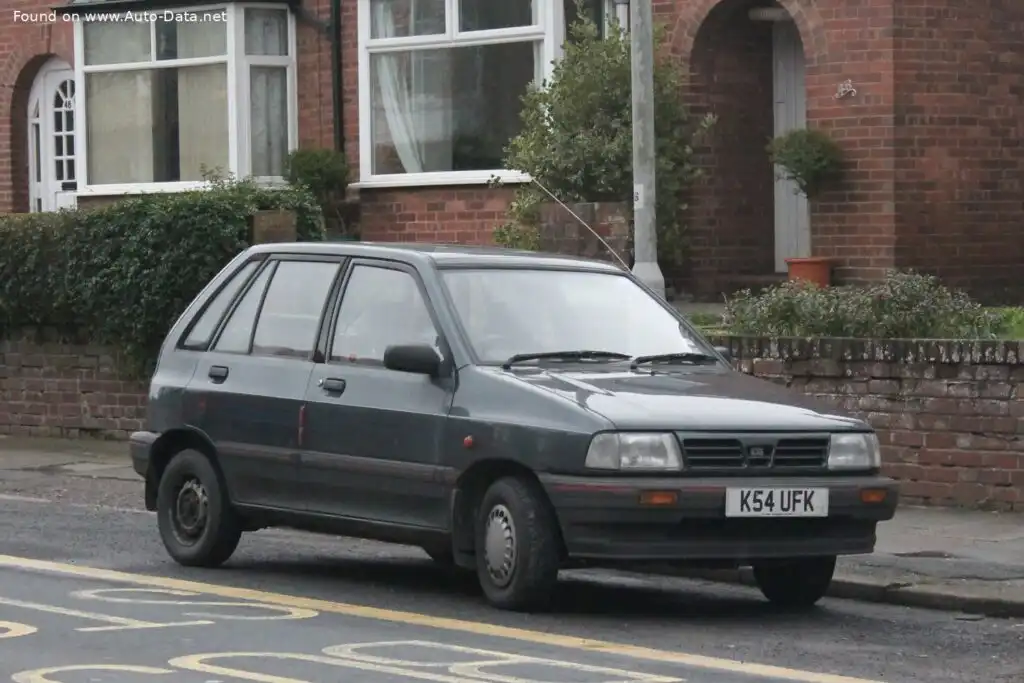
Technical Specifications
| Brand | Kia |
| Model | Pride |
| Generation | Pride (DA) |
| Type (Engine) | 1.3i (64 Hp) Automatic |
| Start of production | 1996 |
| End of production | 2000 |
| Powertrain Architecture | Internal Combustion engine |
| Body type | Hatchback |
| Seats | 5 |
| Doors | 3/5 |
| Fuel consumption (urban) | 9.7 l/100 km (24.2 US mpg) |
| Fuel consumption (extra urban) | 6.8 l/100 km (34.6 US mpg) |
| Fuel Type | Petrol (Gasoline) |
| Acceleration 0 – 100 km/h | 13.7 sec |
| Acceleration 0 – 62 mph | 13.7 sec |
| Acceleration 0 – 60 mph | 13 sec |
| Maximum speed | 159 km/h (98.8 mph) |
| Weight-to-power ratio | 12.9 kg/Hp |
| Weight-to-torque ratio | 8.1 kg/Nm |
| Power | 64 Hp @ 5200 rpm |
| Torque | 102 Nm @ 3000 rpm (75.23 lb.-ft. @ 3000 rpm) |
| Engine layout | Front, Transverse |
| Engine Model/Code | B3A5 |
| Engine displacement | 1324 cm3 (80.8 cu. in.) |
| Number of cylinders | 4 |
| Engine configuration | Inline |
| Cylinder Bore | 71 mm (2.8 in.) |
| Piston Stroke | 83.6 mm (3.29 in.) |
| Compression ratio | 9.7:1 |
| Number of valves per cylinder | 2 |
| Fuel injection system | Multi-port manifold injection |
| Engine aspiration | Naturally aspirated |
| Valvetrain | OHC |
| Engine oil capacity | 3.4 l (3.59 US qt | 2.99 UK qt) |
| Coolant capacity | 5 l (5.28 US qt | 4.4 UK qt) |
| Kerb Weight | 825 kg (1818.81 lbs.) |
| Max. weight | 1310 kg (2888.06 lbs.) |
| Max load | 485 kg (1069.24 lbs.) |
| Trunk (boot) space – minimum | 190 l (6.71 cu. ft.) |
| Fuel tank capacity | 38 l (10.04 US gal | 8.36 UK gal) |
| Length | 3565 mm (140.35 in.) |
| Width | 1605 mm (63.19 in.) |
| Height | 1450 mm (57.09 in.) |
| Wheelbase | 2295 mm (90.35 in.) |
| Front track | 1405 mm (55.31 in.) |
| Rear track | 1385 mm (54.53 in.) |
| Minimum turning circle | 9.4 m (30.84 ft.) |
| Drivetrain | Front wheel drive |
| Number of gears | 3 |
| Gearbox type | Automatic transmission |
| Front suspension | Wishbone |
| Rear suspension | Coil spring |
| Front brakes | Disc |
| Rear brakes | Drum |
| Assisting systems | ABS (Anti-lock braking system) |
| Steering type | Steering rack and pinion |
| Tires size | 165/70 R12 |
| Wheel rims size | 12 |
The Kia Pride (DA) 1.3i Automatic, manufactured from 1996 to 2000, was a key variant within the DA generation of Kia’s popular subcompact. Built upon the 1HX0/A3 platform, the Pride aimed to provide affordable and reliable transportation. The 1.3i Automatic occupied the lower end of the trim spectrum, serving as the entry point for buyers wanting the convenience of an automatic gearbox. It was designed to appeal to those prioritizing ease of use and fuel efficiency over outright performance. The DA generation represented a significant step forward for Kia in terms of design and build quality, moving away from the more basic offerings of previous models.
Powertrain & Engine Architecture
At the heart of the 1.3i Automatic was the B3A5 engine, a 1324cc inline-four cylinder gasoline engine. This engine featured a single overhead camshaft (OHC) valvetrain with two valves per cylinder. Fuel delivery was handled by a multi-port fuel injection system, a relatively modern feature for its time, contributing to improved fuel efficiency and smoother operation compared to carbureted engines. The engine produced 64 horsepower at 5200 rpm and 102 Nm (75.23 lb-ft) of torque at 3000 rpm. The engine’s design prioritized reliability and low-cost maintenance. Paired with the engine was a 3-speed automatic transmission. This transmission, while not known for its sophistication, provided smooth, if somewhat leisurely, gear changes. It was a typical torque converter automatic, prioritizing comfort over sporty responsiveness.
Driving Characteristics
The driving experience in the 1.3i Automatic was characterized by its relaxed and undemanding nature. Acceleration was modest, with a 0-60 mph time of around 13 seconds and a top speed of 98.8 mph. The 3-speed automatic transmission meant that the engine often felt strained during overtaking maneuvers or when climbing hills. Compared to the 1.5L manual versions of the Pride, the 1.3i Automatic offered significantly less performance. The manual transmission provided quicker acceleration and a more engaging driving experience. However, the automatic’s ease of use made it a popular choice for city driving and for drivers less concerned with performance. The gear ratios were optimized for fuel economy rather than spirited driving, resulting in a comfortable but unexciting ride.
Equipment & Trim Levels
The 1.3i Automatic trim level was fairly basic, reflecting its position as the entry-level model. Standard features typically included power steering, cloth upholstery, and a basic audio system. Air conditioning was often an optional extra, as were power windows and central locking. The interior was functional and durable, with a focus on practicality rather than luxury. Dashboard design was simple and straightforward, with easy-to-read gauges. The exterior styling was also understated, with steel wheels and basic trim levels. Higher trim levels of the Pride DA, such as those equipped with the 1.5L engine, offered more luxurious features like alloy wheels, upgraded audio systems, and more refined interior materials.
Chassis & Braking
The Pride (DA) 1.3i Automatic utilized a front-wheel-drive layout with a relatively simple suspension setup. The front suspension consisted of wishbone arms, while the rear suspension employed a coil spring arrangement. This setup provided a comfortable ride, but handling was not particularly sharp. The braking system featured disc brakes on the front wheels and drum brakes on the rear. ABS (Anti-lock Braking System) was often included as standard equipment, enhancing safety. The relatively light weight of the vehicle (825 kg / 1818.81 lbs) helped to compensate for the modest braking performance. Stabilizer bars were typically smaller in diameter on the 1.3i models compared to higher-spec versions.
Market Reception & Comparison
The Kia Pride (DA) 1.3i Automatic was generally well-received as an affordable and reliable city car. Critics praised its fuel efficiency and ease of use, but noted its lack of performance. Compared to other subcompacts available at the time, such as the Daewoo Cielo or the Hyundai Accent, the Pride offered a competitive price point and a decent level of equipment for the money. The automatic transmission, while not particularly advanced, was a significant selling point for buyers who preferred the convenience of not having to shift gears. Fuel economy was a strong point, with figures of around 24.2 US mpg in urban driving and 34.6 US mpg on the highway. Reliability was generally good, although some owners reported minor issues with the automatic transmission over time.
Legacy
The Kia Pride (DA) 1.3i Automatic, while not a performance icon, remains a reasonably popular choice in the used car market, particularly in regions where affordability and reliability are paramount. The B3A5 engine is known for its durability, and parts availability is generally good. However, potential buyers should be aware of the limitations of the 3-speed automatic transmission and the relatively basic level of equipment. The 1.3i Automatic powertrain is considered relatively low-maintenance, making it an attractive option for budget-conscious buyers. Today, it’s often seen as a practical and economical choice for short commutes and city driving, representing a significant step in Kia’s evolution as a global automotive manufacturer.