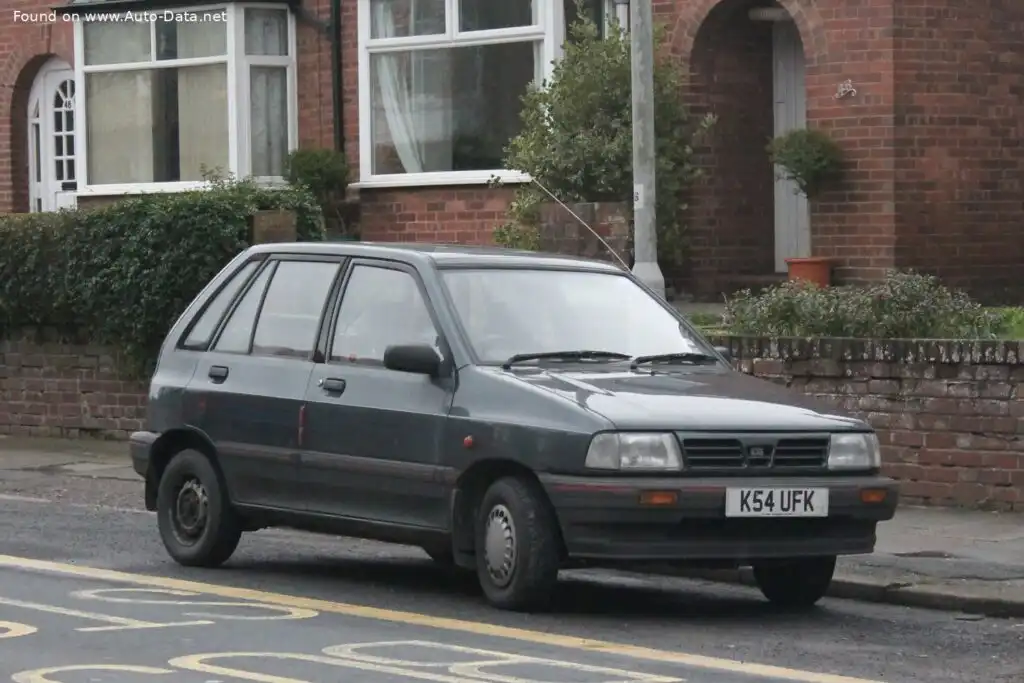
The Kia Pride (DA) 1.3i, producing 73 horsepower, was a subcompact car manufactured by Kia Motors from 1991 to 1995. This variant occupied the entry-level position within the DA Pride range, serving as the most affordable and fuel-efficient option. Based on the Mazda 121/Ford Festiva platform – a result of Kia’s technological collaboration with Mazda and Ford – the Pride represented a significant step forward for the Korean automaker in terms of build quality and international market appeal. The DA generation Pride was primarily aimed at budget-conscious buyers seeking reliable transportation, particularly in emerging markets and as a first car for new drivers. It was available in both 3-door and 5-door hatchback configurations.
Technical Specifications
| Brand | Kia |
| Model | Pride |
| Generation | Pride (DA) |
| Type (Engine) | 1.3i (73 Hp) |
| Start of production | 1991 |
| End of production | 1995 |
| Powertrain Architecture | Internal Combustion engine |
| Body type | Hatchback |
| Seats | 5 |
| Doors | 3/5 |
| Fuel consumption (combined) | 7.5 l/100 km |
| Fuel consumption (US mpg) | 31.4 |
| Fuel consumption (UK mpg) | 37.7 |
| Fuel consumption (km/l) | 13.3 |
| Fuel Type | Petrol (Gasoline) |
| Acceleration 0 – 100 km/h | 13.7 sec |
| Acceleration 0 – 62 mph | 13.7 sec |
| Acceleration 0 – 60 mph | 13 sec |
| Maximum speed | 159 km/h (98.8 mph) |
| Weight-to-power ratio | 10.9 kg/Hp |
| Weight-to-torque ratio | 5.9 kg/Nm |
| Power | 73 Hp @ 5500 rpm |
| Power per litre | 55.1 Hp/l |
| Torque | 135 Nm @ 3000 rpm (99.57 lb.-ft. @ 3000 rpm) |
| Engine layout | Front, Transverse |
| Engine Model/Code | B3A7 |
| Engine displacement | 1324 cm3 (80.8 cu. in.) |
| Number of cylinders | 4 |
| Engine configuration | Inline |
| Cylinder Bore | 71 mm (2.8 in.) |
| Piston Stroke | 83.6 mm (3.29 in.) |
| Compression ratio | 9.7:1 |
| Number of valves per cylinder | 2 |
| Fuel injection system | Multi-port manifold injection |
| Engine aspiration | Naturally aspirated |
| Valvetrain | OHC |
| Engine oil capacity | 3.4 l (3.59 US qt | 2.99 UK qt) |
| Coolant capacity | 5 l (5.28 US qt | 4.4 UK qt) |
| Kerb Weight | 795 kg (1752.67 lbs.) |
| Max. weight | 1270 kg (2799.87 lbs.) |
| Max load | 475 kg (1047.2 lbs.) |
| Trunk (boot) space – minimum | 205 l (7.24 cu. ft.) |
| Trunk (boot) space – maximum | 510 l (18.01 cu. ft.) |
| Fuel tank capacity | 37 l (9.77 US gal | 8.14 UK gal) |
| Length | 3565 mm (140.35 in.) |
| Width | 1605 mm (63.19 in.) |
| Height | 1460 mm (57.48 in.) |
| Wheelbase | 2295 mm (90.35 in.) |
| Front track | 1401 mm (55.16 in.) |
| Rear track | 1385 mm (54.53 in.) |
| Minimum turning circle | 9.4 m (30.84 ft.) |
| Drivetrain | Front wheel drive |
| Number of gears | 5 gears, manual transmission |
| Front suspension | Wishbone |
| Rear suspension | Coil spring |
| Front brakes | Disc |
| Rear brakes | Drum |
| Assisting systems | ABS (Anti-lock braking system) |
| Steering type | Steering rack and pinion |
| Tires size | 165/70 R12 |
| Wheel rims size | 12 |
Powertrain & Engine Architecture
The 1.3i Pride utilized the B3A7 engine, a naturally aspirated, inline-four cylinder gasoline engine. This engine, derived from Mazda designs, featured a single overhead camshaft (OHC) valvetrain with two valves per cylinder. Fuel delivery was managed by a multi-port fuel injection system, a relatively modern feature for its time, contributing to improved fuel efficiency and smoother operation compared to carbureted engines. The engine produced 73 horsepower at 5500 rpm and 99.57 lb-ft of torque at 3000 rpm. The engine’s relatively small displacement and modest output were geared towards maximizing fuel economy rather than outright performance. The transmission was a standard five-speed manual, offering a reasonable balance between usability and efficiency. An automatic transmission was also available, but it was less common and generally resulted in slightly reduced fuel economy and acceleration.
Driving Characteristics
The 1.3i Pride with the manual transmission offered adequate, though not exhilarating, performance. Acceleration to 60 mph took approximately 13 seconds, and the top speed was around 98.8 mph. The engine felt somewhat strained at higher speeds, and passing maneuvers required careful planning. The five-speed manual transmission allowed drivers to keep the engine in its optimal power band, but the gear ratios were relatively tall, prioritizing fuel economy over rapid acceleration. The automatic transmission further diminished performance, making the car feel sluggish, especially when climbing hills or accelerating from a standstill. Handling was predictable and safe, but not particularly sporty. The suspension was tuned for comfort, absorbing bumps reasonably well, but body roll was noticeable in corners.
Equipment & Trim Levels
The 1.3i Pride was typically equipped with basic amenities. Standard features included cloth upholstery, a simple dashboard layout, and manual windows and door locks. Power steering was often optional, as was air conditioning. Higher trim levels, though still relatively spartan, might include features like a basic radio/cassette player, upgraded interior trim, and color-coded bumpers. The focus was on providing essential transportation at an affordable price point, so luxury features were kept to a minimum. The interior space was adequate for a subcompact car, offering comfortable seating for four adults, though rear legroom was limited.
Chassis & Braking
The Pride’s chassis featured a front-engine, front-wheel-drive layout. The front suspension utilized a wishbone design, while the rear suspension employed a coil spring setup. Braking consisted of disc brakes on the front wheels and drum brakes on the rear. Anti-lock braking system (ABS) was available as an option, enhancing safety by preventing wheel lockup during hard braking. The steering system was a rack and pinion type, providing reasonably precise steering feel. The relatively lightweight construction of the vehicle contributed to its maneuverability and fuel efficiency.
Market Reception & Comparison
The Kia Pride 1.3i was generally well-received as an affordable and reliable subcompact car. Critics praised its fuel efficiency and build quality, particularly considering its price point. However, its modest performance and basic interior were often noted as drawbacks. Compared to other subcompacts of the era, such as the Ford Festiva (which it was closely related to) and the Suzuki Swift, the Pride offered a competitive combination of price, fuel economy, and reliability. The automatic transmission version was often criticized for its sluggish performance and reduced fuel economy compared to the manual transmission model. The 1.5i variant, offering more power, was a popular upgrade for those seeking improved performance.
Legacy
The Kia Pride (DA) 1.3i played a crucial role in establishing Kia as a viable automaker in international markets. The B3A7 engine proved to be reasonably durable and reliable, and many examples remain on the road today. While not known for its performance or luxury, the Pride earned a reputation as a dependable and economical car, making it a popular choice for budget-conscious buyers. In the used car market, the 1.3i Pride is often sought after for its simplicity, affordability, and ease of maintenance. Its relatively simple mechanical design makes it a good candidate for DIY repairs, and parts availability remains reasonable. The Pride’s legacy lies in its contribution to Kia’s growth and its reputation as a practical and reliable form of transportation.