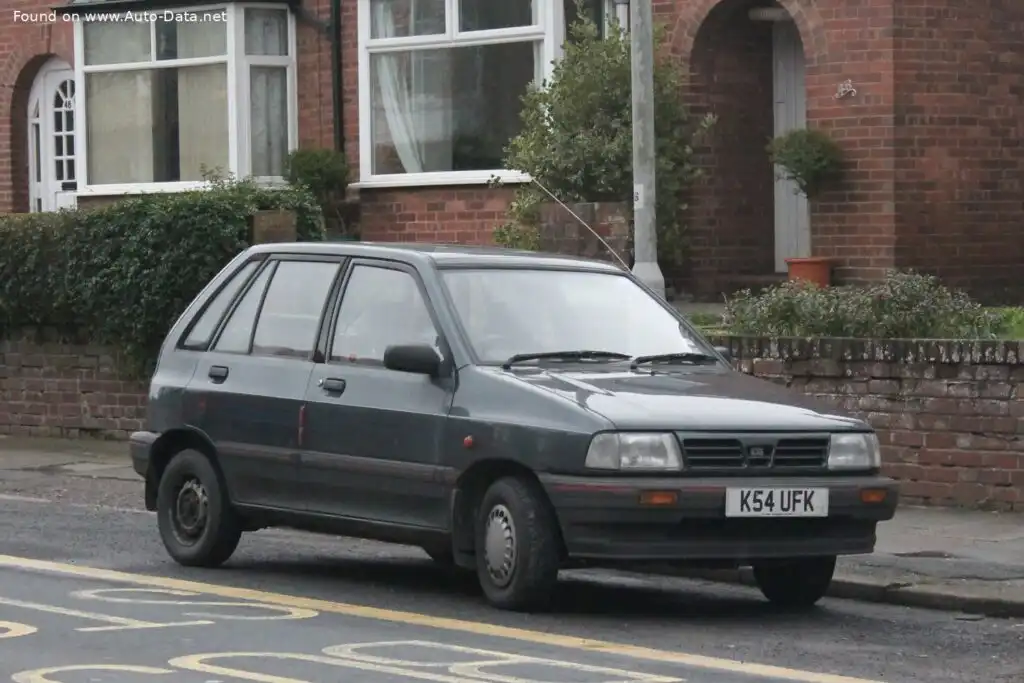
The Kia Pride (DA) 1.3i Automatic, produced between 1991 and 1995, represented an entry-level offering within the first generation of the Pride subcompact. Developed under the direction of Kia Motors, the DA series was heavily based on the Mazda 121/Ford Festiva platform, a result of Kia’s technical collaboration with Mazda and Ford. This particular 1.3i Automatic variant was primarily aimed at buyers seeking affordable, economical transportation with the convenience of an automatic transmission, particularly in markets where manual transmissions were less popular. It served as a foundational model in Kia’s expansion into international markets, offering a budget-friendly alternative to established European and Japanese competitors.
Technical Specifications
| Brand | Kia |
| Model | Pride |
| Generation | Pride (DA) |
| Type (Engine) | 1.3i (73 Hp) Automatic |
| Start of production | 1991 |
| End of production | 1995 |
| Powertrain Architecture | Internal Combustion engine |
| Body type | Hatchback |
| Seats | 5 |
| Doors | 3/5 |
| Fuel consumption (combined) | 7.5 l/100 km |
| Fuel consumption (US mpg) | 31.4 |
| Fuel consumption (UK mpg) | 37.7 |
| Fuel consumption (km/l) | 13.3 |
| Fuel Type | Petrol (Gasoline) |
| Acceleration 0 – 100 km/h | 13.7 sec |
| Acceleration 0 – 62 mph | 13.7 sec |
| Acceleration 0 – 60 mph | 13 sec |
| Maximum speed | 159 km/h (98.8 mph) |
| Weight-to-power ratio | 10.9 kg/Hp |
| Weight-to-torque ratio | 5.9 kg/Nm |
| Power | 73 Hp @ 5500 rpm |
| Power per litre | 55.1 Hp/l |
| Torque | 135 Nm @ 3000 rpm (99.57 lb.-ft. @ 3000 rpm) |
| Engine layout | Front, Transverse |
| Engine Model/Code | B3A7 |
| Engine displacement | 1324 cm3 (80.8 cu. in.) |
| Number of cylinders | 4 |
| Engine configuration | Inline |
| Cylinder Bore | 71 mm (2.8 in.) |
| Piston Stroke | 83.6 mm (3.29 in.) |
| Compression ratio | 9.7:1 |
| Number of valves per cylinder | 2 |
| Fuel injection system | Multi-port manifold injection |
| Engine aspiration | Naturally aspirated |
| Valvetrain | OHC |
| Engine oil capacity | 3.4 l (3.59 US qt | 2.99 UK qt) |
| Coolant capacity | 5 l (5.28 US qt | 4.4 UK qt) |
| Kerb Weight | 795 kg (1752.67 lbs.) |
| Max. weight | 1270 kg (2799.87 lbs.) |
| Max load | 475 kg (1047.2 lbs.) |
| Trunk (boot) space – minimum | 205 l (7.24 cu. ft.) |
| Trunk (boot) space – maximum | 510 l (18.01 cu. ft.) |
| Fuel tank capacity | 37 l (9.77 US gal | 8.14 UK gal) |
| Length | 3565 mm (140.35 in.) |
| Width | 1605 mm (63.19 in.) |
| Height | 1460 mm (57.48 in.) |
| Wheelbase | 2295 mm (90.35 in.) |
| Front track | 1401 mm (55.16 in.) |
| Rear track | 1385 mm (54.53 in.) |
| Minimum turning circle | 9.4 m (30.84 ft.) |
| Drivetrain | Front wheel drive |
| Number of gears | 4 |
| Gearbox type | Automatic transmission |
| Front suspension | Wishbone |
| Rear suspension | Coil spring |
| Front brakes | Disc |
| Rear brakes | Drum |
| Assisting systems | ABS (Anti-lock braking system) |
| Steering type | Steering rack and pinion |
| Tires size | 165/70 R12 |
| Wheel rims size | 12 |
INTRODUCTION
The Kia Pride (DA) 1.3i Automatic, manufactured from 1991 to 1995, was a key model in Kia’s early efforts to establish a foothold in the global automotive market. Built upon the Mazda-derived DA platform (also known as the 1HX0 chassis), it offered a practical and affordable solution for buyers seeking a small, fuel-efficient hatchback. The automatic transmission option, while adding a premium to the base price, broadened the car’s appeal to those prioritizing convenience over outright performance. Positioned as the entry-level automatic variant, it sat below the more powerful (though not offered in the US market) 1.5-liter and 1.6-liter engine options available in other regions.
Powertrain & Engine Architecture
At the heart of the Pride 1.3i Automatic lies the B3A7 engine, a 1.324-liter inline-four cylinder gasoline engine. This engine featured a single overhead camshaft (OHC) valvetrain with two valves per cylinder. Fuel delivery was managed by a multi-port fuel injection system, a relatively modern feature for its time, contributing to improved fuel efficiency and smoother operation compared to carbureted engines. The engine produced 73 horsepower at 5,500 rpm and 99.57 lb-ft of torque at 3,000 rpm. Paired with this engine was a four-speed automatic transmission. This transmission, while providing ease of use, was not known for its particularly quick shifts or sporty feel. It was selected for its reliability and cost-effectiveness, aligning with the overall budget-oriented nature of the vehicle. The engine’s relatively simple design and robust construction contributed to its longevity, though regular maintenance was crucial for optimal performance.
Driving Characteristics
The driving experience in the Pride 1.3i Automatic was characterized by its focus on practicality and ease of use. Acceleration was modest, with a 0-60 mph time of around 13 seconds. The automatic transmission, while convenient, resulted in a noticeable loss of responsiveness compared to the available manual transmission versions. Gear ratios were optimized for fuel economy rather than performance, meaning the engine often felt strained during uphill climbs or when attempting quick overtaking maneuvers. The suspension, tuned for comfort, provided a reasonably smooth ride on typical road surfaces, but body roll was noticeable during cornering. Overall, the driving experience was best described as adequate for everyday commuting and urban driving, but not particularly engaging for enthusiasts.
Equipment & Trim Levels
The 1.3i Automatic trim level typically included basic amenities such as cloth upholstery, a simple dashboard layout, and manual windows and door locks. Power steering was often included, a welcome feature for ease of maneuverability. Air conditioning was frequently offered as an optional extra, and its presence significantly increased the vehicle’s appeal in warmer climates. Other optional extras included a basic audio system and upgraded interior trim. The interior design was functional and utilitarian, prioritizing durability and ease of cleaning over luxury or aesthetic appeal. Safety features were limited by the standards of the time, typically including seatbelts and, in some markets, an Anti-lock Braking System (ABS).
Chassis & Braking
The Pride 1.3i Automatic utilized a front-wheel-drive layout with a relatively simple chassis design. The front suspension employed a wishbone configuration, while the rear suspension featured a coil spring setup. Braking duties were handled by disc brakes at the front and drum brakes at the rear. The braking system, while adequate for normal driving conditions, lacked the stopping power and feel of more advanced systems. The car’s relatively light weight (approximately 1753 lbs) helped to mitigate the limitations of the braking system. Stabilizer bars were typically omitted on the base trim levels, contributing to increased body roll during cornering.
Market Reception & Comparison
The Kia Pride 1.3i Automatic was generally well-received as an affordable and reliable transportation option. Critics praised its fuel efficiency and low purchase price, but noted its lack of performance and refinement. Compared to its siblings, the 1.3i Automatic offered the convenience of an automatic transmission but sacrificed the responsiveness and fuel economy of the manual transmission versions. The higher-output 1.5 and 1.6-liter engines provided significantly more power, but at a higher cost. In terms of reliability, the Pride proved to be a reasonably dependable vehicle, although some owners reported issues with the automatic transmission over the long term. Its main competitors included other subcompact hatchbacks such as the Hyundai Excel, Ford Festiva, and Nissan Sentra.
Legacy
The Kia Pride (DA) 1.3i Automatic played a significant role in establishing Kia as a viable automotive manufacturer in international markets. While not known for its performance or luxury, it earned a reputation for affordability, reliability, and fuel efficiency. Today, the Pride is a relatively rare sight on the roads, but it remains a popular choice among collectors and enthusiasts seeking a classic example of 1990s subcompact motoring. The B3A7 engine, while simple in design, proved to be reasonably durable, and many examples are still running today with proper maintenance. The automatic transmission, however, is often the first component to fail, and finding replacement parts can be challenging. The Pride’s legacy lies in its contribution to Kia’s growth and its demonstration that a budget-friendly car could still offer reliable transportation.