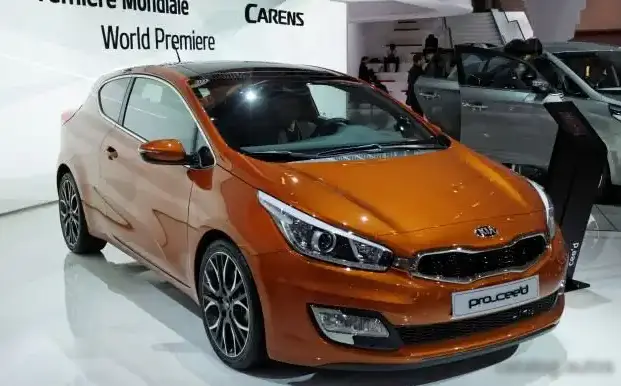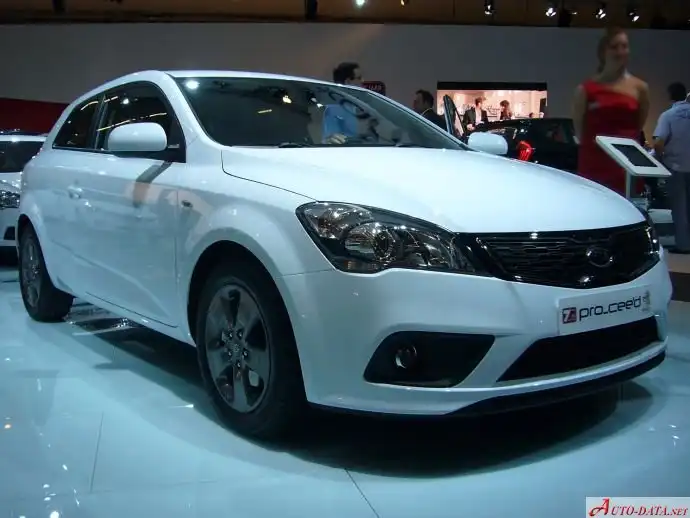
The Kia Pro Cee’d, introduced in 2007, represented Kia’s first foray into the European C-segment hatchback market. The first generation (JD) underwent a significant facelift in 2011, designated as the Pro Cee’d I (facelift). This refresh brought updated styling, improved interior materials, and revised engine options. The 1.6 16V variant, producing 126 horsepower, was a key offering in the lineup from 2011 to 2013, positioned as a balance between affordability and reasonable performance. It aimed to appeal to buyers seeking a stylish and practical hatchback with lower running costs than the more powerful engine options.
Technical Specifications
| Brand | Kia |
| Model | Pro Cee’d |
| Generation | Pro Cee’d I (facelift 2011) |
| Type (Engine) | 1.6 16V (126 Hp) |
| Start of production | 2011 |
| End of production | 2013 |
| Powertrain Architecture | Internal Combustion engine |
| Body type | Hatchback |
| Seats | 5 |
| Doors | 3 |
| Fuel consumption (urban) | 7.8 l/100 km (30.2 US mpg) |
| Fuel consumption (extra urban) | 5.3 l/100 km (44.4 US mpg) |
| Fuel consumption (combined) | 6.1 l/100 km (38.6 US mpg) |
| Fuel Type | Petrol (Gasoline) |
| Acceleration 0 – 100 km/h | 10.8 sec |
| Acceleration 0 – 62 mph | 10.8 sec |
| Acceleration 0 – 60 mph | 10.3 sec |
| Maximum speed | 192 km/h (119.3 mph) |
| Emission standard | Euro 5 |
| Weight-to-power ratio | 10 kg/Hp |
| Weight-to-torque ratio | 8.2 kg/Nm |
| Power | 126 Hp |
| Torque | 154 Nm @ 4200 rpm (113.58 lb.-ft. @ 4200 rpm) |
| Engine layout | Front, Transverse |
| Engine Model/Code | G4FC |
| Engine displacement | 1591 cm3 (97.09 cu. in.) |
| Number of cylinders | 4 |
| Engine configuration | Inline |
| Number of valves per cylinder | 4 |
| Fuel injection system | Multi-port manifold injection |
| Engine aspiration | Naturally aspirated engine |
| Valvetrain | DOHC |
| Engine oil capacity | 3.3 l (3.49 US qt | 2.9 UK qt) |
| Coolant capacity | 5.5 l (5.81 US qt | 4.84 UK qt) |
| Kerb Weight | 1257 kg (2771.21 lbs.) |
| Max. weight | 1750 kg (3858.09 lbs.) |
| Max load | 493 kg (1086.88 lbs.) |
| Trunk (boot) space – minimum | 340 l (12.01 cu. ft.) |
| Trunk (boot) space – maximum | 1210 l (42.73 cu. ft.) |
| Fuel tank capacity | 53 l (14 US gal | 11.66 UK gal) |
| Length | 4250 mm (167.32 in.) |
| Width | 1790 mm (70.47 in.) |
| Height | 1450 mm (57.09 in.) |
| Wheelbase | 2650 mm (104.33 in.) |
| Minimum turning circle | 10.34 m (33.92 ft.) |
| Drivetrain Architecture | ICE, Front Wheel Drive |
| Drive wheel | Front wheel drive |
| Number of gears | 6 gears, manual transmission |
| Front brakes | Ventilated discs |
| Rear brakes | Disc |
| Assisting systems | ABS (Anti-lock braking system) |
| Steering type | Steering rack and pinion |
| Tires size | 185/65 R15; 195/65 R15; 205/55 R16 |
| Wheel rims size | 15; 16 |
Powertrain & Engine Architecture
The 1.6 16V engine, internally designated as the G4FC, is a naturally aspirated, four-cylinder gasoline engine. It features a double overhead camshaft (DOHC) valvetrain operating 16 valves (four per cylinder). The engine utilizes a multi-point fuel injection system, delivering fuel directly into the intake ports. This design, common for its time, prioritized simplicity and cost-effectiveness. The engine’s 1591cc displacement and relatively high compression ratio (typically around 10.5:1) contributed to its modest power output. The 126 hp peak power was achieved at around 6,300 rpm, while the 154 Nm (113.58 lb-ft) of torque peaked at 4,200 rpm. The engine was paired with a six-speed manual transmission, which was the standard offering for this variant. While an automatic transmission was available on other Pro Cee’d trims, it wasn’t offered with the 1.6 16V engine.
Driving Characteristics
The 1.6 16V Pro Cee’d offered a fairly typical driving experience for a C-segment hatchback of its era. Acceleration from 0-60 mph took around 10.3 seconds, making it adequate for everyday driving but not particularly sporty. The six-speed manual transmission helped to keep the engine in its optimal power band, but the engine lacked the low-end grunt of larger displacement or turbocharged alternatives. Gear ratios were fairly well-spaced, providing reasonable flexibility for both urban and highway driving. Compared to the more powerful 1.6 GDI (Gasoline Direct Injection) or diesel variants, the 1.6 16V felt noticeably less responsive. However, its lighter weight compared to some of the higher-spec models partially offset this difference.
Equipment & Trim Levels
The 1.6 16V Pro Cee’d typically came with a reasonable level of standard equipment. This included air conditioning, electric front windows, a radio/CD player with USB connectivity, and central locking. Safety features such as ABS, Electronic Stability Control (ESC), and multiple airbags were also standard. Higher trim levels, such as the ‘2’ or ‘3’ trims, added features like alloy wheels, rear electric windows, a multi-function steering wheel, and upgraded interior trim. Optional extras included a sunroof, parking sensors, and a more advanced audio system.
Chassis & Braking
The Pro Cee’d utilized a MacPherson strut front suspension and a coupled torsion beam rear suspension. This setup was a common choice for front-wheel-drive hatchbacks, offering a good balance between ride comfort and handling. The front brakes were ventilated discs, providing adequate stopping power, while the rear brakes were solid discs. The steering was a rack and pinion system, offering reasonable precision and feedback. The suspension was tuned for comfort, resulting in a relatively soft ride, but it could feel a little underdamped when pushed hard through corners.
Market Reception & Comparison
The 1.6 16V Pro Cee’d was generally well-received by automotive critics as a sensible and affordable option within the C-segment. It was praised for its stylish design, spacious interior, and good value for money. However, it was often criticized for its lack of outright performance compared to some of its rivals. Fuel economy was a strong point, with combined figures around 38.6 US mpg. Compared to the diesel variants, the 1.6 16V offered lower purchase price but higher running costs due to fuel consumption. Against competitors like the Ford Focus, Volkswagen Golf, and Vauxhall Astra, the Pro Cee’d offered a compelling alternative, particularly for buyers prioritizing style and value.
Legacy
The G4FC engine, while not known for being particularly groundbreaking, proved to be a relatively reliable unit. Common issues are typically related to age and maintenance, such as oil leaks and worn suspension components. The 1.6 16V Pro Cee’d remains a relatively affordable used car option today. Its simplicity and relatively low maintenance costs make it an attractive choice for budget-conscious buyers. While it may not offer the performance or refinement of more modern hatchbacks, it still provides a practical and stylish mode of transportation.