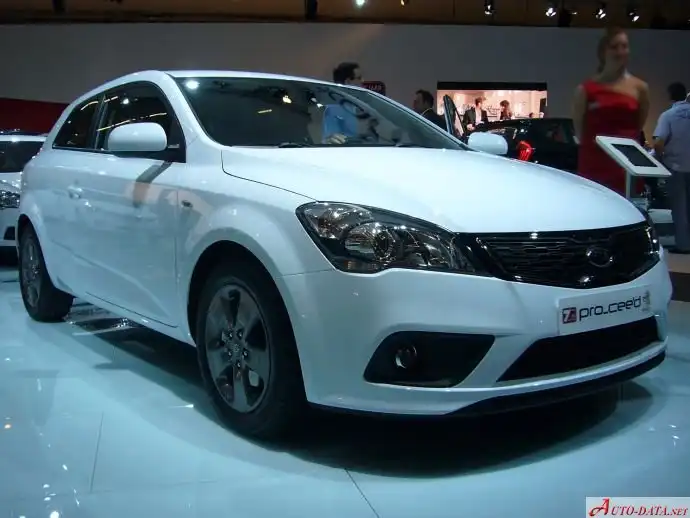
The Kia Pro Cee’d, introduced in 2007, represented Kia’s significant push into the European C-segment hatchback market. The first generation (JD) was a departure from previous Kia offerings, focusing on European design sensibilities and driving dynamics. The facelifted version, launched in 2011 (often referred to as the Pro Cee’d I facelift), brought revised styling, improved interior materials, and updated engine options. The 1.6 CRDi 16V with 115 horsepower and a four-speed automatic transmission, produced from 2011 to 2013, was positioned as a fuel-efficient and accessible entry point into the Pro Cee’d range, appealing to buyers prioritizing economy and ease of use over outright performance.
Technical Specifications
| Brand | Kia |
| Model | Pro Cee’d |
| Generation | Pro Cee’d I (facelift 2011) |
| Type (Engine) | 1.6 CRDi 16V (115 Hp) Automatic |
| Start of production | 2011 |
| End of production | 2013 |
| Powertrain Architecture | Internal Combustion engine |
| Body type | Hatchback |
| Seats | 5 |
| Doors | 3 |
| Fuel consumption (urban) | 6.9 l/100 km (34.1 US mpg, 40.9 UK mpg, 14.5 km/l) |
| Fuel consumption (extra urban) | 4.9 l/100 km (48 US mpg, 57.6 UK mpg, 20.4 km/l) |
| Fuel consumption (combined) | 5.6 l/100 km (42 US mpg, 50.4 UK mpg, 17.9 km/l) |
| Fuel Type | Diesel |
| Acceleration 0 – 100 km/h | 12.8 sec |
| Acceleration 0 – 62 mph | 12.8 sec |
| Acceleration 0 – 60 mph | 12.2 sec |
| Maximum speed | 180 km/h (111.85 mph) |
| Emission standard | Euro 5 |
| Weight-to-power ratio | 11.9 kg/Hp, 84.2 Hp/tonne |
| Weight-to-torque ratio | 5.4 kg/Nm, 186.8 Nm/tonne |
| Power | 115 Hp |
| Power per litre | 72.7 Hp/l |
| Torque | 255 Nm @ 1900 rpm (188.08 lb.-ft. @ 1900 rpm) |
| Engine layout | Front, Transverse |
| Engine Model/Code | D4FB |
| Engine displacement | 1582 cm3 (96.54 cu. in.) |
| Number of cylinders | 4 |
| Engine configuration | Inline |
| Number of valves per cylinder | 4 |
| Fuel injection system | Diesel Commonrail |
| Engine aspiration | Turbocharger, Intercooler |
| Valvetrain | DOHC |
| Engine oil capacity | 5.3 l (5.6 US qt | 4.66 UK qt) |
| Coolant capacity | 6.3 l (6.66 US qt | 5.54 UK qt) |
| Kerb Weight | 1365 kg (3009.31 lbs.) |
| Max. weight | 1880 kg (4144.69 lbs.) |
| Max load | 515 kg (1135.38 lbs.) |
| Trunk (boot) space – minimum | 340 l (12.01 cu. ft.) |
| Trunk (boot) space – maximum | 1210 l (42.73 cu. ft.) |
| Fuel tank capacity | 53 l (14 US gal | 11.66 UK gal) |
| Length | 4250 mm (167.32 in.) |
| Width | 1790 mm (70.47 in.) |
| Height | 1450 mm (57.09 in.) |
| Wheelbase | 2650 mm (104.33 in.) |
| Minimum turning circle | 10.34 m (33.92 ft.) |
| Drivetrain Architecture | Front wheel drive |
| Number of gears | 4 |
| Gearbox type | Automatic transmission |
| Front brakes | Ventilated discs |
| Rear brakes | Disc |
| Tire size | 185/65 R15; 195/65 R15; 205/55 R16 |
| Wheel rims size | 15; 16 |
INTRODUCTION
The 1.6 CRDi automatic variant of the facelifted Kia Pro Cee’d was a key offering for the brand in Europe. Kia aimed to establish itself as a credible alternative to established European manufacturers, and the Pro Cee’d was central to this strategy. The facelift, introduced in 2011, refined the original design and addressed some early criticisms regarding interior quality. This particular engine and transmission combination was designed to appeal to a broad audience seeking a practical, economical, and comfortable hatchback. It sat in the lower to mid-range of the Pro Cee’d lineup, below the more powerful petrol and diesel options, and above the base-level trims.
Powertrain & Engine Architecture
The heart of this Pro Cee’d variant is the D4FB 1.6-liter four-cylinder diesel engine. This engine is a common rail direct injection (CRDi) unit, utilizing a Bosch-supplied system for precise fuel delivery. The 16-valve DOHC (Double Overhead Camshaft) configuration, coupled with a turbocharger and intercooler, helps to maximize power and efficiency. The engine produces 115 horsepower and a respectable 255 Nm (188 lb-ft) of torque at 1900 rpm. The four-speed automatic transmission, while providing convenience, is a relatively conventional unit. It lacks the efficiency and responsiveness of more modern transmissions with a greater number of gears. The transmission is electronically controlled, offering a ‘manual’ shift mode, though it’s primarily geared towards smooth, comfortable operation.
Driving Characteristics
The 1.6 CRDi automatic Pro Cee’d prioritizes fuel economy and ease of driving over sporty performance. Acceleration from 0-60 mph takes around 12.2 seconds, and top speed is limited to 111.85 mph. The four-speed automatic transmission, while smooth, can feel somewhat sluggish, particularly during quick overtaking maneuvers. The relatively wide gear ratios mean the engine often operates at higher RPMs during highway cruising, potentially impacting refinement. Compared to the six-speed manual version of the same engine, the automatic suffers a slight performance penalty and reduced fuel economy. The higher-output 1.6 CRDi variants, and the petrol engines, offered significantly more spirited driving experiences, but at the cost of increased fuel consumption.
Equipment & Trim Levels
The 1.6 CRDi automatic typically came equipped with a reasonable level of standard equipment. This included air conditioning, electric front windows, a radio/CD player with USB connectivity, and central locking. Safety features such as ABS (Anti-lock Braking System) and front airbags were also standard. Higher trim levels, such as ‘2’ or ‘3’, added features like alloy wheels, rear parking sensors, climate control, and upgraded interior trim. Interior upholstery was typically cloth, with a dark color scheme. Optional extras included a panoramic sunroof, leather upholstery, and a more advanced audio system.
Chassis & Braking
The Pro Cee’d utilizes a MacPherson strut front suspension and a coupled torsion beam rear suspension. This setup provides a good balance between ride comfort and handling. The front brakes are ventilated discs, offering adequate stopping power, while the rear brakes are solid discs. The steering is a rack and pinion system, providing reasonable precision. The suspension tuning is geared towards comfort, resulting in a relatively soft ride. Stabilizer bars are fitted front and rear to reduce body roll during cornering. Tire sizes varied depending on the trim level, ranging from 185/65 R15 to 205/55 R16.
Market Reception & Comparison
The Kia Pro Cee’d, and specifically the 1.6 CRDi automatic, was generally well-received by automotive critics. It was praised for its value for money, comfortable ride, and fuel efficiency. However, the four-speed automatic transmission was often criticized for its lack of responsiveness and refinement compared to competitors’ offerings. Compared to rivals like the Volkswagen Golf, Ford Focus, and Vauxhall Astra, the Pro Cee’d offered a more affordable price point, but lacked the brand prestige and driving dynamics of those established players. The 1.6 CRDi automatic offered better fuel economy than the petrol engines, but the higher-powered diesel variants provided superior performance.
Legacy
The D4FB engine, in its various iterations, proved to be a relatively reliable unit. While not without its issues (such as potential turbocharger wear and occasional DPF problems), it generally offered good longevity with regular maintenance. The four-speed automatic transmission is also generally reliable, but can be prone to wear and tear with high mileage. Today, the 1.6 CRDi automatic Pro Cee’d represents an affordable and practical used car option. Its fuel efficiency and relatively low running costs make it an attractive choice for budget-conscious buyers. However, potential buyers should be aware of the limitations of the four-speed automatic transmission and the importance of regular maintenance to ensure long-term reliability.