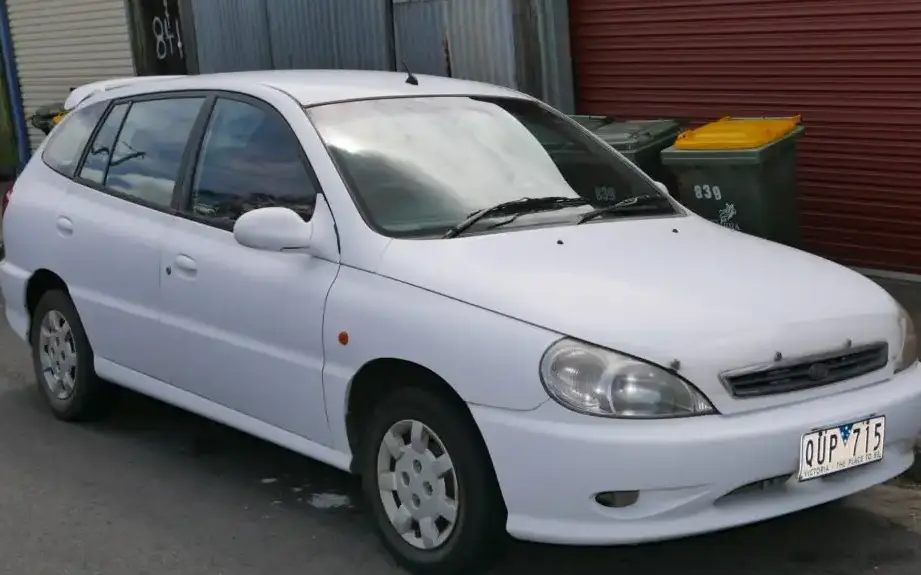
The Kia Rio I Hatchback (DC, facelift 2002) 1.3 i, producing 82 horsepower, represented an entry-level offering within the first generation Rio lineup, produced from 2002 to 2005. Positioned as a budget-friendly and economical option, this variant aimed to provide basic transportation with reasonable fuel efficiency. The facelifted DC model, introduced in 2002, featured minor cosmetic updates and refinements over the original Rio launched in 2000. It was primarily marketed towards first-time car buyers, commuters, and those seeking a small, practical hatchback. This model played a key role in establishing Kia’s presence in the European and other international markets as a value-oriented brand.
Technical Specifications
| Brand | Kia |
| Model | Rio |
| Generation | Rio I Hatchback (DC, facelift 2002) |
| Type (Engine) | 1.3 i (82 Hp) |
| Start of production | 2002 |
| End of production | 2005 |
| Powertrain Architecture | Internal Combustion engine |
| Body type | Hatchback |
| Seats | 5 |
| Doors | 5 |
| Fuel consumption (urban) | 8.8 l/100 km (26.7 US mpg) |
| Fuel consumption (extra urban) | 5.4 l/100 km (43.6 US mpg) |
| Fuel Type | Petrol (Gasoline) |
| Acceleration 0 – 100 km/h | 14.3 sec |
| Acceleration 0 – 62 mph | 14.3 sec |
| Acceleration 0 – 60 mph | 13.6 sec |
| Maximum speed | 165 km/h (102.53 mph) |
| Weight-to-power ratio | 12.2 kg/Hp |
| Weight-to-torque ratio | 8.6 kg/Nm |
| Power | 82 Hp @ 5500 rpm |
| Torque | 116 Nm @ 3000 rpm (85.56 lb.-ft. @ 3000 rpm) |
| Engine layout | Front, Transverse |
| Engine Model/Code | A3E |
| Engine displacement | 1343 cm3 (81.95 cu. in.) |
| Number of cylinders | 4 |
| Engine configuration | Inline |
| Cylinder Bore | 75.5 mm (2.97 in.) |
| Piston Stroke | 75 mm (2.95 in.) |
| Compression ratio | 9.4:1 |
| Number of valves per cylinder | 2 |
| Fuel injection system | Multi-port manifold injection |
| Engine aspiration | Naturally aspirated engine |
| Valvetrain | OHC |
| Engine oil capacity | 3.4 l (3.59 US qt | 2.99 UK qt) |
| Coolant capacity | 6 l (6.34 US qt | 5.28 UK qt) |
| Kerb Weight | 1000 kg (2204.62 lbs.) |
| Max. weight | 1508 kg (3324.57 lbs.) |
| Max load | 508 kg (1119.95 lbs.) |
| Trunk (boot) space – minimum | 449 l (15.86 cu. ft.) |
| Trunk (boot) space – maximum | 1277 l (45.1 cu. ft.) |
| Fuel tank capacity | 45 l (11.89 US gal | 9.9 UK gal) |
| Length | 4240 mm (166.93 in.) |
| Width | 1680 mm (66.14 in.) |
| Height | 1440 mm (56.69 in.) |
| Wheelbase | 2410 mm (94.88 in.) |
| Front track | 1430 mm (56.3 in.) |
| Rear track | 1435 mm (56.5 in.) |
| Minimum turning circle | 9.5 m (31.17 ft.) |
| Drivetrain Architecture | Front wheel drive |
| Number of gears | 5 gears, manual transmission |
| Front suspension | Spring Strut |
| Rear suspension | Coil spring |
| Front brakes | Ventilated discs |
| Rear brakes | Drum |
| Assisting systems | ABS (Anti-lock braking system) |
| Steering type | Steering rack and pinion |
| Power steering | Hydraulic Steering |
| Tires size | 175/65 R14 |
Powertrain & Engine Architecture
The 1.3-liter inline-four engine, designated A3E, was a relatively simple and robust design. It featured a single overhead camshaft (OHC) operating two valves per cylinder. Fuel delivery was handled by a multi-point fuel injection system, providing adequate, though not exceptional, combustion control. The engine’s 9.4:1 compression ratio was a compromise between efficiency and performance. This engine was not known for its power, but for its durability and relatively low maintenance requirements. The five-speed manual transmission was the standard pairing for this engine, offering a reasonable spread of gears for everyday driving. The transmission was designed for economy and smooth operation rather than sporty performance.
Driving Characteristics
The 1.3L Rio was not a performance-oriented vehicle. With 82 horsepower and 116 Nm of torque, acceleration was modest, taking around 14.3 seconds to reach 60 mph. The engine felt strained when pushed hard, particularly when fully loaded or climbing hills. The five-speed manual transmission helped to keep the engine in its optimal power band, but overall, the driving experience was geared towards practicality and fuel economy. Compared to higher-trim Rio models equipped with larger engines (like the 1.5L or 1.6L), the 1.3L felt significantly underpowered. However, the lighter weight of the 1.3L variant did contribute to slightly better fuel economy and handling in city driving.
Equipment & Trim Levels
The 1.3 i Rio typically came with a basic level of equipment. Standard features generally included power steering, central locking, and an AM/FM radio. Air conditioning was often an optional extra, as were power windows and alloy wheels. Interior upholstery was typically cloth, with a simple, functional dashboard layout. The focus was on providing essential features at a low price point. Higher trim levels added features like upgraded audio systems, body-colored bumpers, and more comfortable seating.
Chassis & Braking
The Rio I utilized a relatively conventional chassis design, with a MacPherson strut front suspension and a coil spring rear suspension. The front brakes were ventilated discs, providing adequate stopping power for the vehicle’s weight and performance. However, the rear brakes were drums, which were less effective than discs, particularly under heavy braking. The suspension was tuned for comfort rather than sporty handling, resulting in a relatively soft ride. Stabilizer bars were typically smaller in diameter on the base 1.3L model compared to higher-spec versions.
Market Reception & Comparison
The 1.3L Rio was generally well-received as an affordable and reliable city car. Critics praised its fuel efficiency and low running costs, but noted its lack of power and refinement. Compared to competitors like the Ford Fiesta or Volkswagen Polo, the Rio offered a lower price point but lacked the same level of build quality and driving dynamics. The 1.5L and 1.6L Rio models offered significantly better performance, but at a higher cost. The 1.3L version appealed to buyers prioritizing economy and practicality over driving enjoyment.
Legacy
The A3E 1.3L engine proved to be a durable and reliable unit, with many examples still on the road today. While not known for its performance, it was relatively easy and inexpensive to maintain. In the used car market, the 1.3L Rio remains an affordable option for those seeking a basic, economical hatchback. However, potential buyers should be aware of the engine’s limited power and the age-related wear and tear that may be present in older examples. The Rio I, particularly the 1.3L variant, helped establish Kia as a viable alternative to established European and Japanese automakers, paving the way for the brand’s subsequent growth and success.