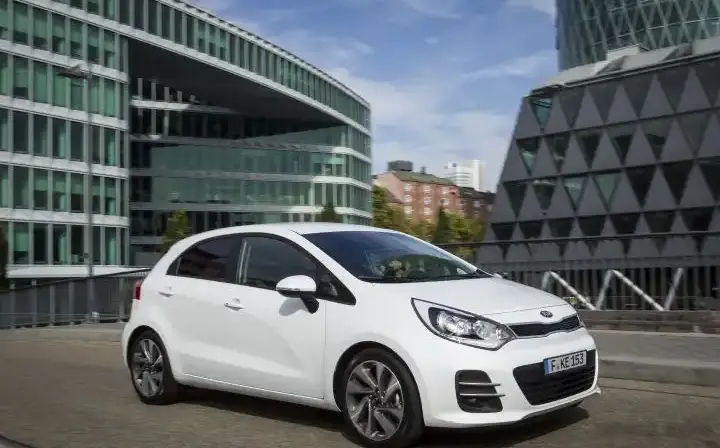
The Kia Rio III Hatchback, specifically the UB facelift model produced from 2015 to 2017, offered a range of engine and transmission options to cater to diverse consumer needs. Among these, the 1.1 CRDI (75 hp) variant equipped with the Intelligent Stop & Go (ISG) system represented an entry-level offering focused on fuel efficiency and affordability. This model played a significant role in Kia’s expansion within the European market, where demand for economical diesel hatchbacks was high. The Rio III, built on the UB platform, aimed to provide a more sophisticated and refined package compared to its predecessors, competing with established players like the Ford Fiesta and Volkswagen Polo.
Technical Specifications
| Brand | Kia |
| Model | Rio |
| Generation | Rio III Hatchback (UB, facelift 2015) |
| Type (Engine) | 1.1 CRDI (75 Hp) ISG |
| Start of production | 2015 |
| End of production | 2017 |
| Powertrain Architecture | Internal Combustion engine |
| Body type | Hatchback |
| Seats | 5 |
| Doors | 5 |
| Fuel consumption (urban) | 4.1 l/100 km (57.4 US mpg, 68.9 UK mpg, 24.4 km/l) |
| Fuel consumption (extra urban) | 3.3 l/100 km (71.3 US mpg, 85.6 UK mpg, 30.3 km/l) |
| Fuel consumption (combined) | 3.6 l/100 km (65.3 US mpg, 78.5 UK mpg, 27.8 km/l) |
| CO2 emissions | 94 g/km |
| Fuel Type | Diesel |
| Acceleration 0 – 100 km/h | 16.5 sec |
| Acceleration 0 – 62 mph | 16.5 sec |
| Acceleration 0 – 60 mph | 15.7 sec |
| Maximum speed | 160 km/h (99.42 mph) |
| Emission standard | Euro 6 |
| Weight-to-power ratio | 15 kg/Hp, 66.7 Hp/tonne |
| Weight-to-torque ratio | 6.6 kg/Nm, 151.1 Nm/tonne |
| Power | 75 Hp @ 4000 rpm |
| Power per litre | 67 Hp/l |
| Torque | 170 Nm @ 1500-2750 rpm (125.39 lb.-ft. @ 1500-2750 rpm) |
| Engine layout | Front, Transverse |
| Engine Model/Code | D3FA |
| Engine displacement | 1120 cm3 (68.35 cu. in.) |
| Number of cylinders | 3 |
| Engine configuration | Inline |
| Cylinder Bore | 75 mm (2.95 in.) |
| Piston Stroke | 84.5 mm (3.33 in.) |
| Compression ratio | 17.8:1 |
| Number of valves per cylinder | 4 |
| Fuel injection system | Diesel Commonrail |
| Engine aspiration | Turbocharger, Intercooler |
| Engine oil capacity | 4.8 l (5.07 US qt | 4.22 UK qt) |
| Coolant | 6.4 l (6.76 US qt | 5.63 UK qt) |
| Kerb Weight | 1125-1205 kg (2480.2 – 2656.57 lbs.) |
| Max. weight | 1640 kg (3615.58 lbs.) |
| Max load | 435-515 kg (959.01 – 1135.38 lbs.) |
| Trunk (boot) space – minimum | 288 l (10.17 cu. ft.) |
| Trunk (boot) space – maximum | 923 l (32.6 cu. ft.) |
| Fuel tank capacity | 43 l (11.36 US gal | 9.46 UK gal) |
| Max. roof load | 70 kg (154.32 lbs.) |
| Permitted trailer load with brakes (12%) | 800 kg (1763.7 lbs.) |
| Permitted trailer load without brakes | 450 kg (992.08 lbs.) |
| Permitted towbar download | 50 kg (110.23 lbs.) |
| Length | 4050 mm (159.45 in.) |
| Width | 1720 mm (67.72 in.) |
| Width including mirrors | 1985 mm (78.15 in.) |
| Height | 1455 mm (57.28 in.) |
| Wheelbase | 2570 mm (101.18 in.) |
| Front track | 1507-1520 mm (59.33 – 59.84 in.) |
| Rear (Back) track | 1511-1525 mm (59.49 – 60.04 in.) |
| Front overhang | 810 mm (31.89 in.) |
| Rear overhang | 670 mm (26.38 in.) |
| Minimum turning circle | 10.5 m (34.45 ft.) |
| Drivetrain | Front wheel drive |
| Number of gears | 6 gears, manual transmission |
| Front suspension | Independent, type McPherson with coil spring and anti-roll bar |
| Rear suspension | Semi-independent, coil spring |
| Front brakes | Ventilated discs |
| Rear brakes | Disc |
| Assisting systems | ABS (Anti-lock braking system) |
| Steering type | Steering rack and pinion |
| Power steering | Electric Steering |
| Tires size | 185/65 R15; 195/55 R16; 205/45 R17 |
| Wheel rims size | 5.5J x 15; 6.0J x 16; 6.5J x 17 |
INTRODUCTION
The Kia Rio III Hatchback (UB) facelift, launched in 2015, represented a mid-cycle refresh of the popular subcompact car. The 1.1 CRDI ISG variant was positioned as the most fuel-efficient option in the Rio lineup, targeting budget-conscious buyers and those prioritizing low running costs. The “ISG” designation indicates the inclusion of Kia’s Intelligent Stop & Go system, which automatically shuts off the engine when the vehicle is stationary (e.g., at traffic lights) to further reduce fuel consumption. This trim level was primarily sold in Europe, where diesel engines and small displacement options were highly favored due to taxation and fuel prices.
Powertrain & Engine Architecture
The heart of this Rio variant is the D3FA 1.1-liter three-cylinder diesel engine. This engine utilizes a common-rail direct injection system, delivering fuel directly into the combustion chamber at extremely high pressure for improved efficiency and reduced emissions. A turbocharger with an intercooler is employed to boost power output despite the small displacement. The engine produces 75 horsepower at 4000 rpm and 170 Nm (125 lb-ft) of torque between 1500 and 2750 rpm. The engine features four valves per cylinder and a compression ratio of 17.8:1. The engine is transversely mounted at the front of the vehicle. The 1.1 CRDI was typically paired with a six-speed manual transmission, optimized for fuel economy rather than outright performance.
Driving Characteristics
The 1.1 CRDI automatic Rio is not known for its blistering acceleration. With a 0-62 mph (0-100 km/h) time of around 16.5 seconds, it prioritizes fuel efficiency over speed. The engine’s torque delivery is relatively flat, providing adequate pulling power for everyday driving situations, but it requires downshifts for overtaking maneuvers. The six-speed manual transmission helps to keep the engine within its optimal operating range, maximizing fuel economy. The ISG system, while effective in stop-and-go traffic, can sometimes feel slightly jerky during engine restarts. Overall, the driving experience is best described as comfortable and economical, rather than sporty or engaging.
Equipment & Trim Levels
The 1.1 CRDI ISG trim typically came with a reasonable level of standard equipment. This included air conditioning, power steering, electric front windows, a basic audio system with USB connectivity, and ABS brakes. Safety features such as airbags were also standard. Higher trim levels offered additional features like alloy wheels, a more advanced audio system, rear electric windows, and a trip computer. Interior upholstery was typically cloth, with a functional and durable design. Optional extras included metallic paint, parking sensors, and a navigation system.
Chassis & Braking
The Rio III Hatchback utilizes a McPherson strut front suspension and a semi-independent coil spring rear suspension. This setup provides a comfortable ride quality, although it’s not particularly sporty. The front brakes are ventilated discs, while the rear brakes are discs. ABS (Anti-lock Braking System) is standard. The steering is electrically assisted, providing light and easy steering feel. The relatively lightweight construction of the vehicle helps to compensate for the modest engine power.
Market Reception & Comparison
The 1.1 CRDI ISG Rio was generally well-received by critics for its fuel efficiency and affordability. However, some reviewers noted its lack of power and somewhat basic interior. Compared to other trims in the Rio lineup, such as the 1.25-liter gasoline engine, the 1.1 CRDI offered significantly better fuel economy but less performance. Against competitors like the Ford Fiesta and Volkswagen Polo, the Rio offered a compelling value proposition, often undercutting them in price while providing a similar level of equipment. Reliability reports suggest that the 1.1 CRDI engine is generally robust, although regular maintenance is essential.
Legacy
The Kia Rio III 1.1 CRDI ISG remains a popular choice in the used car market, particularly for buyers seeking an economical and reliable city car. The engine’s relatively simple design and robust construction contribute to its long-term durability. While not a performance car, it provides a practical and affordable transportation solution. The ISG system, while potentially requiring occasional maintenance, helps to further reduce fuel consumption and emissions. The Rio III helped to establish Kia as a credible competitor in the European small car segment, paving the way for future models.