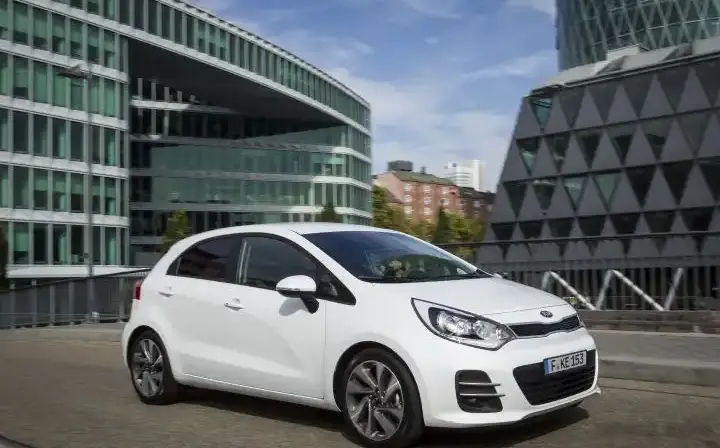
The Kia Rio III Hatchback, specifically the 1.2-liter (84 horsepower) variant produced from 2015 to 2017, represented an entry-level offering within the UB facelift generation of the Rio. Positioned as a budget-friendly option, this model aimed to provide affordable transportation with reasonable fuel efficiency. It served as a key model for Kia in several international markets, including Europe, where the Rio competed in the highly contested subcompact hatchback segment. This version of the Rio was designed to appeal to first-time car buyers, city dwellers, and those seeking a practical and economical vehicle.
Technical Specifications
| Brand | Kia |
| Model | Rio |
| Generation | Rio III Hatchback (UB, facelift 2015) |
| Type (Engine) | 1.2 (84 Hp) |
| Start of production | 2015 |
| End of production | 2017 |
| Powertrain Architecture | Internal Combustion engine |
| Body type | Hatchback |
| Seats | 5 |
| Doors | 5 |
| Fuel consumption (urban) | 6.3 l/100 km (37.3 US mpg, 44.8 UK mpg, 15.9 km/l) |
| Fuel consumption (extra urban) | 4.2 l/100 km (56 US mpg, 67.3 UK mpg, 23.8 km/l) |
| Fuel consumption (combined) | 5 l/100 km (47 US mpg, 56.5 UK mpg, 20 km/l) |
| CO2 emissions | 115 g/km |
| Fuel Type | Petrol (Gasoline) |
| Acceleration 0 – 100 km/h | 13.4 sec |
| Acceleration 0 – 62 mph | 13.4 sec |
| Acceleration 0 – 60 mph | 12.7 sec |
| Maximum speed | 168 km/h (104.39 mph) |
| Emission standard | Euro 6 |
| Weight-to-power ratio | 12.5 kg/Hp, 79.8 Hp/tonne |
| Weight-to-torque ratio | 8.7 kg/Nm, 115 Nm/tonne |
| Power | 84 Hp @ 6000 rpm |
| Power per litre | 67.3 Hp/l |
| Torque | 121 Nm @ 4000 rpm (89.25 lb.-ft. @ 4000 rpm) |
| Engine layout | Front, Transverse |
| Engine Model/Code | G4LA |
| Engine displacement | 1248 cm3 (76.16 cu. in.) |
| Number of cylinders | 4 |
| Engine configuration | Inline |
| Cylinder Bore | 71 mm (2.8 in.) |
| Piston Stroke | 78.8 mm (3.1 in.) |
| Compression ratio | 10.5:1 |
| Number of valves per cylinder | 4 |
| Fuel injection system | Multi-port manifold injection |
| Engine aspiration | Naturally aspirated engine |
| Engine oil capacity | 3.5 l (3.7 US qt | 3.08 UK qt) |
| Coolant | 4.7 l (4.97 US qt | 4.14 UK qt) |
| Kerb Weight | 1052-1132 kg (2319.26 – 2495.63 lbs.) |
| Max. weight | 1560 kg (3439.21 lbs.) |
| Max load | 428-508 kg (943.58 – 1119.95 lbs.) |
| Trunk (boot) space – minimum | 288 l (10.17 cu. ft.) |
| Trunk (boot) space – maximum | 923 l (32.6 cu. ft.) |
| Fuel tank capacity | 43 l (11.36 US gal | 9.46 UK gal) |
| Max. roof load | 70 kg (154.32 lbs.) |
| Permitted trailer load with brakes (12%) | 900 kg (1984.16 lbs.) |
| Permitted trailer load without brakes | 450 kg (992.08 lbs.) |
| Permitted towbar download | 50 kg (110.23 lbs.) |
| Length | 4050 mm (159.45 in.) |
| Width | 1720 mm (67.72 in.) |
| Width including mirrors | 1985 mm (78.15 in.) |
| Height | 1455 mm (57.28 in.) |
| Wheelbase | 2570 mm (101.18 in.) |
| Front track | 1507-1520 mm (59.33 – 59.84 in.) |
| Rear (Back) track | 1511-1525 mm (59.49 – 60.04 in.) |
| Front overhang | 810 mm (31.89 in.) |
| Rear overhang | 670 mm (26.38 in.) |
| Minimum turning circle (turning diameter) | 10.5 m (34.45 ft.) |
| Drivetrain Architecture | The Internal combustion engine (ICE) drives the front wheels of the vehicle. |
| Drive wheel | Front wheel drive |
| Number of gears and type of gearbox | 5 gears, manual transmission |
| Front suspension | Independent, type McPherson with coil spring and anti-roll bar |
| Rear suspension | Semi-independent, coil spring |
| Front brakes | Ventilated discs |
| Rear brakes | Disc |
| Assisting systems | ABS (Anti-lock braking system) |
| Steering type | Steering rack and pinion |
| Power steering | Electric Steering |
| Tires size | 185/65 R15; 195/55 R16; 205/45 R17 |
| Wheel rims size | 5.5J x 15; 6.0J x 16; 6.5J x 17 |
INTRODUCTION
The Kia Rio III Hatchback (UB) facelift, launched in 2015, represented a significant refresh of the popular subcompact. The 1.2-liter engine option, producing 84 horsepower, was a cornerstone of the range, particularly in European markets where smaller displacement engines were favored due to tax regulations and fuel costs. This variant was designed to offer a balance between affordability, fuel economy, and practicality. It slotted into the Rio lineup as the entry-level engine choice, below the more powerful 1.4-liter variants. The UB generation Rio aimed to elevate Kia’s reputation for build quality and design, offering a more mature and refined package compared to its predecessors.
Powertrain & Engine Architecture
The heart of this Rio variant is the Kia G4LA 1.2-liter inline-four cylinder gasoline engine. This engine utilizes a multi-point fuel injection system, delivering fuel directly into the intake ports. The G4LA engine features a dual overhead camshaft (DOHC) valvetrain with four valves per cylinder, contributing to improved breathing and efficiency. The engine’s design prioritizes fuel economy and reduced emissions. The 1.2L engine was paired with a five-speed manual transmission as standard. This transmission was chosen for its simplicity and efficiency, contributing to the vehicle’s overall affordability. The gear ratios were optimized for urban driving and fuel economy, rather than outright performance.
Driving Characteristics
The 1.2-liter, 84 horsepower Rio is not a performance-oriented vehicle. Acceleration is modest, taking approximately 13.4 seconds to reach 62 mph (100 km/h). In real-world driving, the engine feels adequate for city commuting and shorter trips, but struggles when fully loaded or attempting to overtake on highways. The five-speed manual transmission requires frequent shifting to maintain momentum, especially on inclines. Compared to the 1.4-liter versions, the 1.2L feels noticeably less responsive. However, the lighter engine weight contributes to slightly improved handling and agility. The steering is light and easy to use, making it well-suited for navigating tight urban spaces.
Equipment & Trim Levels
The 1.2-liter Rio typically came with a base level of equipment, focusing on essential features. Standard amenities generally included air conditioning, power steering, central locking, and an audio system with USB connectivity. Safety features such as ABS (Anti-lock Braking System) and front airbags were also standard. Higher trim levels, available as optional upgrades, added features like alloy wheels, electric windows, a trip computer, and upgraded interior trim. Interior upholstery was typically cloth, with a simple and functional dashboard layout.
Chassis & Braking
The Rio III Hatchback utilizes a McPherson strut front suspension and a semi-independent coil spring rear suspension. This setup provides a comfortable ride quality, absorbing bumps and imperfections in the road surface effectively. The front brakes are ventilated discs, offering adequate stopping power, while the rear brakes are discs. The steering is a rack and pinion system with electric power assistance, providing light and precise steering feel. The suspension tuning is geared towards comfort and stability, rather than sporty handling.
Market Reception & Comparison
The 1.2-liter Rio received generally positive reviews for its fuel efficiency and affordability. Critics praised its practicality and ease of driving, making it a suitable choice for first-time car buyers and city commuters. However, the engine’s lack of power was a common criticism. Compared to the 1.4-liter variants, the 1.2L offered significantly lower performance but also better fuel economy. The 1.2L Rio was often seen as a more sensible and economical choice than its more powerful siblings, appealing to a different segment of the market.
Legacy
The Kia Rio III 1.2-liter variant has proven to be a relatively reliable powertrain. The G4LA engine is known for its durability and low maintenance costs. In the used car market, these Rios are often sought after for their affordability and fuel efficiency. While not a particularly exciting vehicle to drive, it provides dependable transportation at a low cost. Common issues are generally limited to routine maintenance items, such as spark plugs, air filters, and oil changes. The Rio III helped solidify Kia’s position as a mainstream automotive brand, offering a compelling alternative to established European and Japanese competitors.