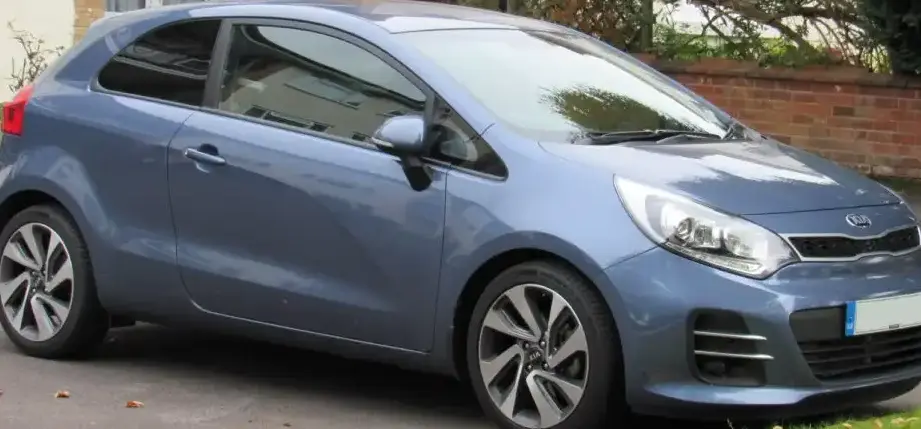
The Kia Rio III Hatchback, specifically the 3-door 1.4-liter (109 horsepower) variant produced from 2015 to 2017, represents a significant iteration of Kia’s subcompact offering. This facelifted version of the UB generation Rio aimed to enhance the model’s appeal in the highly competitive European and global small car segments. Positioned as a mid-range trim, it offered a balance between affordability, fuel efficiency, and practicality, targeting young drivers and urban commuters. The 3-door body style, while less common in the US market, was popular in Europe for its sporty aesthetic and ease of parking.
Technical Specifications
| Brand | Kia |
| Model | Rio |
| Generation | Rio III Hatchback (UB, facelift 2015) 3 door |
| Type (Engine) | 1.4 (109 Hp) |
| Start of production | 2015 |
| End of production | 2017 |
| Powertrain Architecture | Internal Combustion engine |
| Body type | Hatchback |
| Seats | 5 |
| Doors | 3 |
| Fuel consumption (urban) | 7.2 l/100 km (32.7 US mpg) |
| Fuel consumption (extra urban) | 4.5 l/100 km (52.3 US mpg) |
| Fuel consumption (combined) | 5.5 l/100 km (42.8 US mpg) |
| CO2 emissions | 127 g/km |
| Fuel Type | Petrol (Gasoline) |
| Acceleration 0 – 100 km/h | 11.4 sec |
| Acceleration 0 – 62 mph | 11.4 sec |
| Acceleration 0 – 60 mph | 10.8 sec |
| Maximum speed | 185 km/h (114.95 mph) |
| Emission standard | Euro 6 |
| Weight-to-power ratio | 9.8 kg/Hp |
| Weight-to-torque ratio | 7.8 kg/Nm |
| Power | 109 Hp @ 6300 rpm |
| Torque | 137 Nm @ 4200 rpm (101.05 lb.-ft. @ 4200 rpm) |
| Engine layout | Front, Transverse |
| Engine Model/Code | G4FA |
| Engine displacement | 1396 cm3 (85.19 cu. in.) |
| Number of cylinders | 4 |
| Engine configuration | Inline |
| Cylinder Bore | 77 mm (3.03 in.) |
| Piston Stroke | 74.9 mm (2.95 in.) |
| Compression ratio | 10.5:1 |
| Number of valves per cylinder | 4 |
| Fuel injection system | Multi-port manifold injection |
| Engine aspiration | Naturally aspirated engine |
| Engine oil capacity | 3.3 l (3.49 US qt | 2.9 UK qt) |
| Coolant | 5.3 l (5.6 US qt | 4.66 UK qt) |
| Kerb Weight | 1072-1152 kg (2363.36 – 2539.73 lbs.) |
| Max. weight | 1590 kg (3505.35 lbs.) |
| Max load | 438-518 kg (965.62 – 1141.99 lbs.) |
| Trunk (boot) space – minimum | 288 l (10.17 cu. ft.) |
| Trunk (boot) space – maximum | 923 l (32.6 cu. ft.) |
| Fuel tank capacity | 43 l (11.36 US gal | 9.46 UK gal) |
| Max. roof load | 70 kg (154.32 lbs.) |
| Permitted trailer load with brakes (12%) | 1050 kg (2314.85 lbs.) |
| Permitted trailer load without brakes | 450 kg (992.08 lbs.) |
| Permitted towbar download | 50 kg (110.23 lbs.) |
| Length | 4050 mm (159.45 in.) |
| Width | 1720 mm (67.72 in.) |
| Width including mirrors | 1985 mm (78.15 in.) |
| Height | 1455 mm (57.28 in.) |
| Wheelbase | 2570 mm (101.18 in.) |
| Front track | 1507-1520 mm (59.33 – 59.84 in.) |
| Rear (Back) track | 1511-1525 mm (59.49 – 60.04 in.) |
| Front overhang | 810 mm (31.89 in.) |
| Rear overhang | 670 mm (26.38 in.) |
| Minimum turning circle | 10.5 m (34.45 ft.) |
| Drivetrain | Front wheel drive |
| Number of gears and type of gearbox | 6 gears, manual transmission |
| Front suspension | Independent, type McPherson with coil spring and anti-roll bar |
| Rear suspension | Semi-independent, coil spring |
| Front brakes | Ventilated discs |
| Rear brakes | Disc |
| Assisting systems | ABS (Anti-lock braking system) |
| Steering type | Steering rack and pinion |
| Power steering | Electric Steering |
| Tires size | 185/65 R15; 195/55 R16; 205/45 R17 |
| Wheel rims size | 5.5J x 15; 6.0J x 16; 6.5J x 17 |
INTRODUCTION
The 2015-2017 Kia Rio III facelift, in its 3-door 1.4-liter guise, was a key model for Kia in markets where smaller, more agile vehicles were preferred. Built on the UB platform (shared with the Hyundai i20), this version received styling updates and minor mechanical refinements compared to the pre-facelift model. The 1.4-liter engine and manual transmission combination was designed to offer a balance of affordability and acceptable performance, making it a popular choice for first-time car buyers and those seeking a practical city car. The 3-door configuration, while offering a sportier look, sacrificed some rear passenger access compared to the 5-door version.
Powertrain & Engine Architecture
The heart of this Rio variant is the Kia G4FA 1.4-liter inline-four cylinder gasoline engine. This engine, a mainstay in several Hyundai-Kia models, utilizes a multi-point fuel injection system and a single overhead camshaft (SOHC) valvetrain with four valves per cylinder. The engine produces 109 horsepower at 6,300 rpm and 137 Nm (101 lb-ft) of torque at 4,200 rpm. The engine’s design prioritizes fuel efficiency and reliability over outright performance. The 6-speed manual transmission was the standard offering for this trim, providing a relatively direct connection between the engine and the front wheels. The transmission’s gear ratios were tuned for everyday drivability, with a focus on maximizing fuel economy rather than providing rapid acceleration.
Driving Characteristics
The 1.4-liter Rio 3-door delivers a driving experience best described as adequate for urban and suburban environments. Acceleration from 0-60 mph takes around 10.8 seconds, and top speed is rated at 114.95 mph. While not particularly quick, the engine provides sufficient power for merging onto highways and navigating city traffic. The manual transmission allows for a degree of driver engagement, but the relatively long throws and light clutch feel don’t offer a particularly sporty experience. The suspension, tuned for comfort, absorbs bumps reasonably well, but body roll is noticeable during cornering. The steering is light and precise, making it easy to maneuver in tight spaces.
Equipment & Trim Levels
The 1.4-liter Rio 3-door typically came equipped with a reasonable level of standard features. These included air conditioning, power windows, central locking, and a basic audio system with USB connectivity. Safety features such as ABS, airbags, and stability control were also standard. Higher trim levels offered options like alloy wheels, a more advanced audio system, and a sunroof. Interior upholstery was typically cloth, with a simple and functional dashboard layout. The 3-door configuration meant rear seat access was less convenient than in the 5-door model, and rear passenger space was somewhat limited.
Chassis & Braking
The Rio III utilized a front-wheel-drive chassis with an independent McPherson strut suspension in the front and a semi-independent coil spring suspension in the rear. The front brakes were ventilated discs, providing adequate stopping power, while the rear brakes were solid discs. The suspension setup prioritized ride comfort over sporty handling. The steering system employed an electric power steering (EPS) system, which provided light and easy steering feel, particularly useful for maneuvering in urban environments. Tire sizes varied depending on the trim level, ranging from 185/65 R15 to 205/45 R17.
Market Reception & Comparison
The Kia Rio III 1.4-liter 3-door received generally positive reviews for its affordability, fuel efficiency, and practicality. Critics noted that it offered a good value proposition compared to its competitors, such as the Ford Fiesta and Volkswagen Polo. However, some reviewers criticized its lack of refinement and relatively uninspiring driving dynamics. Compared to higher-output Rio variants, such as those with larger engines, the 1.4-liter model offered significantly less performance. However, it also delivered better fuel economy and lower running costs. The 1.4L was often seen as a good entry point into the Rio range, appealing to budget-conscious buyers.
Legacy
The Kia Rio III 1.4-liter 3-door has proven to be a relatively reliable vehicle, with few major mechanical issues reported. The G4FA engine is known for its durability, and the manual transmission is generally robust. In the used car market, these Rios are often available at attractive prices, making them a popular choice for first-time car buyers or those seeking an affordable and economical city car. While not a performance icon, the 1.4-liter Rio 3-door represents a solid and practical option in the subcompact hatchback segment, offering a blend of affordability, fuel efficiency, and reliability.