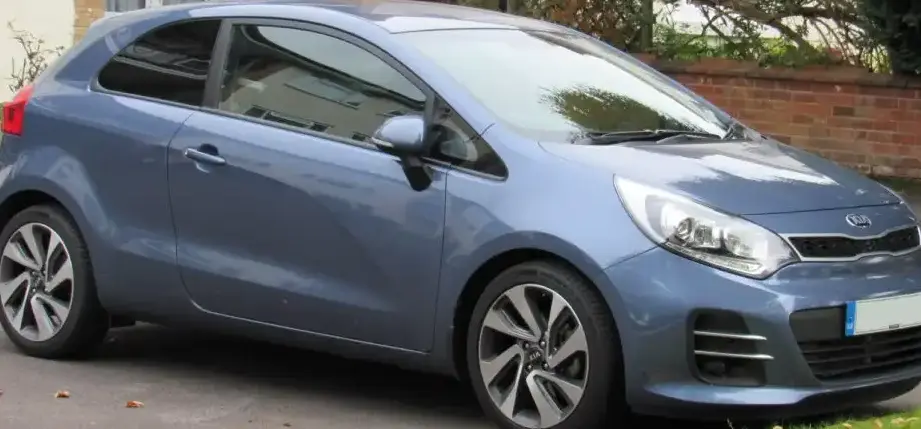
The Kia Rio III Hatchback, specifically the 3-door variant equipped with the 1.4 CRDI (90 hp) engine and ISG (Idle Stop & Go) system, was a key offering in Kia’s European and Asian markets from 2015 to 2017. This model represented a facelift of the UB generation Rio, aiming to enhance fuel efficiency and appeal to budget-conscious buyers. Positioned as an entry-level option within the Rio lineup, it provided a diesel-powered alternative to the gasoline engines, focusing on economy rather than outright performance. The 3-door body style was particularly popular in European markets where smaller, more nimble cars were favored.
Technical Specifications
| Brand | Kia |
| Model | Rio |
| Generation | Rio III Hatchback (UB, facelift 2015) 3 door |
| Type (Engine) | 1.4 CRDI (90 Hp) ISG |
| Start of production | 2015 |
| End of production | 2017 |
| Powertrain Architecture | Internal Combustion engine |
| Body type | Hatchback |
| Seats | 5 |
| Doors | 3 |
| Fuel consumption (urban) | 4.4 l/100 km (53.5 US mpg, 64.2 UK mpg, 22.7 km/l) |
| Fuel consumption (extra urban) | 3.4 l/100 km (69.2 US mpg, 83.1 UK mpg, 29.4 km/l) |
| Fuel consumption (combined) | 3.8 l/100 km (61.9 US mpg, 74.3 UK mpg, 26.3 km/l) |
| CO2 emissions | 98 g/km |
| Fuel Type | Diesel |
| Acceleration 0 – 100 km/h | 13.9 sec |
| Acceleration 0 – 62 mph | 13.9 sec |
| Acceleration 0 – 60 mph | 13.2 sec |
| Maximum speed | 169 km/h (105.01 mph) |
| Emission standard | Euro 6 |
| Weight-to-power ratio | 13 kg/Hp, 76.7 Hp/tonne |
| Weight-to-torque ratio | 5.3 kg/Nm, 187.4 Nm/tonne |
| Power | 90 Hp @ 4000 rpm |
| Power per litre | 64.5 Hp/l |
| Torque | 220 Nm @ 1750-2750 rpm (162.26 lb.-ft. @ 1750-2750 rpm) |
| Engine layout | Front, Transverse |
| Engine Model/Code | D4FC |
| Engine displacement | 1396 cm3 (85.19 cu. in.) |
| Number of cylinders | 4 |
| Engine configuration | Inline |
| Cylinder Bore | 75 mm (2.95 in.) |
| Piston Stroke | 79 mm (3.11 in.) |
| Compression ratio | 17:1 |
| Number of valves per cylinder | 4 |
| Fuel injection system | Diesel Commonrail |
| Engine aspiration | Turbocharger, Intercooler |
| Engine oil capacity | 5.3 l (5.6 US qt | 4.66 UK qt) |
| Coolant capacity | 6.6 l (6.97 US qt | 5.81 UK qt) |
| Kerb Weight | 1174-1253 kg (2588.23 – 2762.39 lbs.) |
| Max. weight | 1680 kg (3703.77 lbs.) |
| Max load | 427-506 kg (941.37 – 1115.54 lbs.) |
| Trunk (boot) space – minimum | 288 l (10.17 cu. ft.) |
| Trunk (boot) space – maximum | 923 l (32.6 cu. ft.) |
| Fuel tank capacity | 43 l (11.36 US gal | 9.46 UK gal) |
| Max. roof load | 70 kg (154.32 lbs.) |
| Permitted trailer load with brakes (12%) | 1100 kg (2425.08 lbs.) |
| Permitted trailer load without brakes | 450 kg (992.08 lbs.) |
| Permitted towbar download | 50 kg (110.23 lbs.) |
| Length | 4050 mm (159.45 in.) |
| Width | 1720 mm (67.72 in.) |
| Width including mirrors | 1985 mm (78.15 in.) |
| Height | 1455 mm (57.28 in.) |
| Wheelbase | 2570 mm (101.18 in.) |
| Front track | 1507-1520 mm (59.33 – 59.84 in.) |
| Rear (Back) track | 1511-1525 mm (59.49 – 60.04 in.) |
| Front overhang | 810 mm (31.89 in.) |
| Rear overhang | 670 mm (26.38 in.) |
| Minimum turning circle | 10.5 m (34.45 ft.) |
| Drivetrain | Front wheel drive |
| Number of gears and type of gearbox | 6 gears, manual transmission |
| Front suspension | Independent, type McPherson with coil spring and anti-roll bar |
| Rear suspension | Semi-independent, coil spring |
| Front brakes | Ventilated discs |
| Rear brakes | Disc |
| Assisting systems | ABS (Anti-lock braking system) |
| Steering type | Steering rack and pinion |
| Power steering | Electric Steering |
| Tires size | 185/65 R15; 195/55 R16; 205/45 R17 |
| Wheel rims size | 5.5J x 15; 6.0J x 16; 6.5J x 17 |
INTRODUCTION
The 2015-2017 Kia Rio III Hatchback 3-door 1.4 CRDI ISG represents a significant step in Kia’s efforts to offer fuel-efficient and practical vehicles to the European and Asian markets. Built on the UB platform, this model benefited from the facelift introduced in 2015, which included styling updates and improvements to the interior. The 1.4 CRDI engine, coupled with the Idle Stop & Go (ISG) system, was designed to maximize fuel economy, making it an attractive option for urban commuters. The 3-door configuration catered to buyers seeking a more sporty and compact hatchback.
Powertrain & Engine Architecture
The heart of this Rio variant is the D4FC 1.4-liter common-rail diesel engine. This engine utilizes a second-generation common-rail direct injection system, delivering fuel at extremely high pressure for optimized combustion. The engine features a turbocharger with an intercooler, enhancing power output and efficiency. The 4-cylinder, inline configuration provides a relatively smooth power delivery. The engine produces 90 horsepower at 4000 rpm and 220 Nm of torque between 1750 and 2750 rpm. The ISG system automatically shuts off the engine when the vehicle is stationary (at a red light, for example) and restarts it instantly when the clutch is depressed, further reducing fuel consumption and emissions. The engine’s relatively high compression ratio of 17:1 contributes to its efficiency, but also requires high-quality diesel fuel.
Driving Characteristics
The 1.4 CRDI engine, while not particularly powerful, provides adequate performance for everyday driving. Acceleration from 0 to 100 km/h takes approximately 13.9 seconds, and the top speed is 169 km/h. The engine’s torque is readily available at low to mid-range revs, making it suitable for navigating city streets and overtaking on highways. Compared to the gasoline versions of the Rio, the 1.4 CRDI offers significantly better fuel economy, but lacks the responsiveness of the higher-output engines. The 6-speed manual transmission is well-matched to the engine’s characteristics, providing smooth gear changes. The overall driving experience is comfortable and predictable, prioritizing fuel efficiency over sporty handling.
Equipment & Trim Levels
The 1.4 CRDI ISG trim typically included standard features such as air conditioning, power steering, electric front windows, and a basic audio system with USB connectivity. Safety features included ABS, airbags, and stability control. Higher trim levels offered additional features like alloy wheels, a more advanced audio system, and climate control. Interior upholstery was typically cloth, with a functional and durable design. Optional extras included a sunroof, parking sensors, and a navigation system.
Chassis & Braking
The Rio III Hatchback utilizes a McPherson strut front suspension and a semi-independent coil spring rear suspension. This setup provides a comfortable ride quality, although it’s not particularly sporty. The front brakes are ventilated discs, while the rear brakes are discs, providing adequate stopping power for the vehicle’s weight and performance. The electric power steering offers light and precise steering feel. The chassis is designed to balance comfort and handling, prioritizing stability and ease of driving.
Market Reception & Comparison
The Kia Rio III 1.4 CRDI ISG was generally well-received by critics for its fuel efficiency and affordability. It was often compared to other small diesel hatchbacks, such as the Volkswagen Polo and the Ford Fiesta. While the Rio didn’t offer the same level of refinement or driving dynamics as some of its competitors, it provided excellent value for money. Fuel economy was a key selling point, with the Rio consistently achieving impressive figures in real-world testing. Reliability was also a positive aspect, with Kia’s improving reputation for build quality.
Legacy
The 1.4 CRDI engine, while not without its maintenance considerations (like any diesel engine, DPF maintenance is crucial), has proven to be relatively reliable over the long term. The Rio III 1.4 CRDI ISG remains a popular choice in the used car market, particularly for buyers seeking an economical and practical hatchback. Its fuel efficiency and low running costs continue to appeal to budget-conscious drivers. However, potential buyers should be aware of the importance of regular maintenance, especially regarding the diesel particulate filter (DPF) and timing belt replacement.