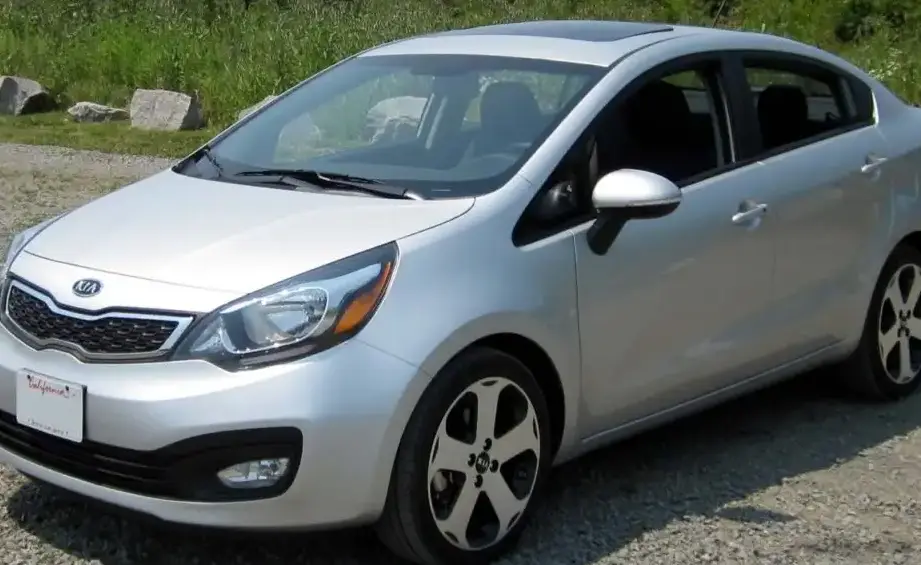
Technical Specifications
| Brand | Kia |
| Model | Rio |
| Generation | Rio III Sedan (UB) |
| Type (Engine) | 1.2 16V (85 Hp) |
| Start of production | June, 2011 |
| End of production | 2015 |
| Powertrain Architecture | Internal Combustion engine |
| Body type | Sedan |
| Seats | 5 |
| Doors | 4 |
| Fuel consumption (urban) | 6.3 l/100 km (37.3 US mpg, 44.8 UK mpg, 15.9 km/l) |
| Fuel consumption (extra urban) | 4.4 l/100 km (53.5 US mpg, 64.2 UK mpg, 22.7 km/l) |
| Fuel consumption (combined) | 5.1 l/100 km (46.1 US mpg, 55.4 UK mpg, 19.6 km/l) |
| Fuel Type | Petrol (Gasoline) |
| Acceleration 0 – 100 km/h | 13.1 sec |
| Acceleration 0 – 62 mph | 13.1 sec |
| Acceleration 0 – 60 mph | 12.4 sec |
| Maximum speed | 168 km/h (104.39 mph) |
| Emission standard | Euro 5 |
| Weight-to-power ratio | 12.1 kg/Hp, 82.6 Hp/tonne |
| Weight-to-torque ratio | 8.5 kg/Nm, 117.6 Nm/tonne |
| Power | 85 Hp @ 6300 rpm |
| Power per litre | 68.1 Hp/l |
| Torque | 121 Nm @ 4000 rpm (89.25 lb.-ft. @ 4000 rpm) |
| Engine layout | Front, Transverse |
| Engine Model/Code | G4LA |
| Engine displacement | 1248 cm3 (76.16 cu. in.) |
| Number of cylinders | 4 |
| Engine configuration | Inline |
| Number of valves per cylinder | 4 |
| Fuel injection system | Multi-port manifold injection |
| Engine aspiration | Naturally aspirated engine |
| Valvetrain | DOHC |
| Engine oil capacity | 3.5 l (3.7 US qt | 3.08 UK qt) |
| Coolant capacity | 4.7 l (4.97 US qt | 4.14 UK qt) |
| Kerb Weight | 1029 kg (2268.56 lbs) |
| Max. weight | 1560 kg (3439.21 lbs) |
| Max load | 531 kg (1170.65 lbs) |
| Trunk (boot) space – minimum | 500 l (17.66 cu. ft) |
| Fuel tank capacity | 43 l (11.36 US gal | 9.46 UK gal) |
| Length | 4370 mm (172.05 in) |
| Width | 1700 mm (66.93 in) |
| Height | 1470 mm (57.87 in) |
| Wheelbase | 2570 mm (101.18 in) |
| Front track | 1495 mm (58.86 in) |
| Rear (Back) track | 1502 mm (59.13 in) |
| Minimum turning circle | 10.5 m (34.45 ft) |
| Drivetrain Architecture | Front wheel drive |
| Number of gears and type of gearbox | 5 gears, manual transmission |
| Front brakes | Ventilated discs |
| Rear brakes | Disc |
| Assisting systems | ABS (Anti-lock braking system) |
| Steering type | Steering rack and pinion |
| Tires size | 185/65 R15; 195/55 R16; 205/45 R17 |
| Wheel rims size | 15; 16; 17 |
The Kia Rio III Sedan (UB), produced from 2011 to 2015, marked a notable improvement for Kia in the subcompact sedan market. The 1.2 16V variant, delivering 85 horsepower, was a crucial offering, particularly in European and Asian markets where smaller engine displacements were favored due to tax incentives and fuel economy considerations. This model occupied the entry-level position within the Rio Sedan lineup, providing an affordable and economical transportation solution. Built on the UB platform – an evolution of the previous generation’s architecture – it prioritized enhanced refinement and fuel efficiency.
Powertrain & Engine Architecture
At the core of the Rio 1.2 16V is the Kia G4LA engine, a 1.2-liter inline-four cylinder gasoline engine. This engine features a dual overhead camshaft (DOHC) valvetrain with four valves per cylinder, contributing to its relatively efficient operation. Fuel delivery is handled by a multi-point fuel injection system, a common configuration for engines of this period. The G4LA is naturally aspirated, meaning it doesn’t utilize forced induction like turbocharging or supercharging. This simplicity enhances its reliability, but also limits its overall power output. The engine was engineered to minimize internal friction and weight, maximizing fuel economy. The 1.2L engine was available with either a five-speed manual transmission or a four-speed automatic transmission. The automatic transmission, while offering convenience, was known for its less-than-dynamic shift quality and slightly reduced fuel efficiency compared to the manual counterpart.
Driving Characteristics
The 1.2-liter engine, producing 85 horsepower, offered adequate, though not particularly exciting, performance. Acceleration from 0 to 60 mph took approximately 12.4 seconds, making it well-suited for city driving and commuting, but less ideal for quick highway maneuvers. The four-speed automatic transmission, while generally smooth, had relatively broad gear ratios, which could sometimes cause the engine to feel strained during acceleration. Compared to the more powerful 1.4L or 1.6L Rio variants, the 1.2L automatic felt noticeably slower. However, its strengths lay in its fuel efficiency and ease of use in urban environments. The suspension was tuned for comfort, providing a reasonably smooth ride, although it didn’t offer particularly sporty handling characteristics.
Equipment & Trim Levels
The 1.2 16V Rio Sedan typically came equipped with a base level of features, focusing on essential amenities. Standard equipment included air conditioning, power steering, central locking, and an audio system with MP3 playback capability. Safety features included dual front airbags and ABS brakes. Higher trim levels, such as the ‘LX’ or ‘EX’ (depending on the specific market), added features like alloy wheels, electric windows, a trip computer, and upgraded interior trim. Interior upholstery was typically cloth, with a relatively straightforward dashboard layout. Optional extras included a sunroof, upgraded audio systems, and parking sensors.
Chassis & Braking
The Rio III Sedan employed a front-wheel-drive layout with a MacPherson strut front suspension and a torsion beam rear suspension. The torsion beam rear suspension was a cost-effective solution, but it didn’t provide the same level of sophistication as independent rear suspension systems. Braking consisted of ventilated discs on the front wheels and solid discs on the rear wheels. ABS (Anti-lock Braking System) was standard, improving braking performance and safety. The chassis was designed to strike a balance between affordability and acceptable levels of rigidity and crash safety.
Market Reception & Comparison
The Kia Rio 1.2 16V Automatic was generally well-received as an affordable and economical option within its segment. Reviewers praised its fuel efficiency and comfortable ride, but noted its limited performance. Compared to competitors like the Hyundai Accent, Ford Fiesta, and Volkswagen Polo, the Rio offered a competitive price point and a generous warranty. The 1.4L and 1.6L Rio variants offered significantly improved performance, but at a higher cost. The 1.2L automatic was primarily aimed at buyers who prioritized fuel economy and ease of driving over sporty performance.
Legacy
The G4LA 1.2L engine, while not a performance leader, proved to be a relatively reliable unit. Common issues were generally minor, such as occasional oil leaks or sensor failures. The four-speed automatic transmission, however, sometimes faced criticism regarding its long-term durability, with some units experiencing issues with slipping or harsh shifting as they aged. Today, the Rio III Sedan 1.2 16V remains available as an affordable used car option. Its low running costs and simple mechanical design make it an appealing choice for budget-conscious buyers. However, prospective buyers should be aware of the potential for transmission issues and ensure the vehicle has been regularly maintained.