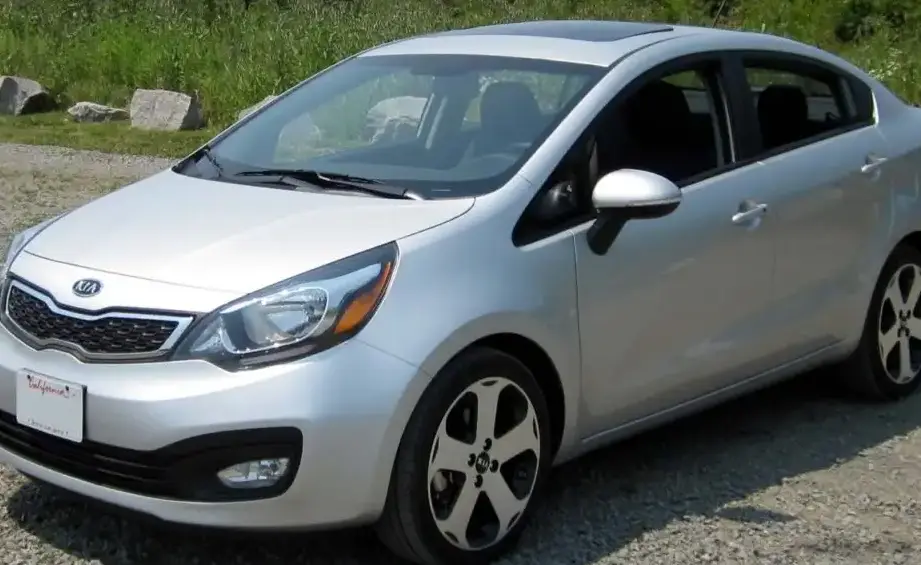
The Kia Rio III Sedan (UB) 1.4 16V automatic, produced from June 2011 to 2015, represented a significant step forward for Kia in the competitive compact sedan segment. Positioned as a mid-range offering within the UB Rio lineup, this variant aimed to provide a balance of affordability, fuel efficiency, and convenience with its four-speed automatic transmission. The UB generation Rio was Kia’s attempt to shed its reputation for basic transportation and offer a vehicle with more refined styling and features, appealing to a broader customer base, particularly in markets outside of North America where compact sedans remained highly popular. This model was primarily sold in Europe, Asia, and South America.
Technical Specifications
| Brand | Kia |
| Model | Rio |
| Generation | Rio III Sedan (UB) |
| Type (Engine) | 1.4 16V (109 Hp) automatic |
| Start of production | June, 2011 |
| End of production | 2015 |
| Powertrain Architecture | Internal Combustion engine |
| Body type | Sedan |
| Seats | 5 |
| Doors | 4 |
| Fuel consumption (urban) | 8.4 l/100 km (28 US mpg, 33.6 UK mpg, 11.9 km/l) |
| Fuel consumption (extra urban) | 5.3 l/100 km (44.4 US mpg, 53.3 UK mpg, 18.9 km/l) |
| Fuel consumption (combined) | 6.4 l/100 km (36.8 US mpg, 44.1 UK mpg, 15.6 km/l) |
| Fuel Type | Petrol (Gasoline) |
| Acceleration 0 – 100 km/h | 13.2 sec |
| Acceleration 0 – 62 mph | 13.2 sec |
| Acceleration 0 – 60 mph | 12.5 sec |
| Maximum speed | 170 km/h (105.63 mph) |
| Emission standard | Euro 5 |
| Weight-to-power ratio | 10 kg/Hp, 99.7 Hp/tonne |
| Weight-to-torque ratio | 8 kg/Nm, 125.3 Nm/tonne |
| Power | 109 Hp |
| Power per litre | 78.1 Hp/l |
| Torque | 137 Nm @ 4200 rpm (101.05 lb.-ft. @ 4200 rpm) |
| Engine layout | Front, Transverse |
| Engine Model/Code | G4FA |
| Engine displacement | 1396 cm3 (85.19 cu. in.) |
| Number of cylinders | 4 |
| Engine configuration | Inline |
| Number of valves per cylinder | 4 |
| Fuel injection system | Multi-port manifold injection |
| Engine aspiration | Naturally aspirated engine |
| Valvetrain | DOHC |
| Engine oil capacity | 3.3 l (3.49 US qt | 2.9 UK qt) |
| Coolant capacity | 5.5 l (5.81 US qt | 4.84 UK qt) |
| Kerb Weight | 1093 kg (2409.65 lbs.) |
| Max. weight | 1630 kg (3593.53 lbs.) |
| Max load | 537 kg (1183.88 lbs.) |
| Trunk (boot) space – minimum | 224 l (7.91 cu. ft.) |
| Fuel tank capacity | 43 l (11.36 US gal | 9.46 UK gal) |
| Length | 4370 mm (172.05 in.) |
| Width | 1700 mm (66.93 in.) |
| Height | 1470 mm (57.87 in.) |
| Wheelbase | 2570 mm (101.18 in.) |
| Front track | 1521 mm (59.88 in.) |
| Rear (Back) track | 1525 mm (60.04 in.) |
| Minimum turning circle | 10.5 m (34.45 ft.) |
| Drivetrain Architecture | The Internal combustion engine (ICE) drives the front wheels of the vehicle. |
| Drive wheel | Front wheel drive |
| Number of gears and type of gearbox | 4 gears, automatic transmission |
| Front suspension | Independent, type McPherson with coil spring and anti-roll bar |
| Rear suspension | Semi-independent, coil spring |
| Front brakes | Ventilated discs |
| Rear brakes | Disc |
| Assisting systems | ABS (Anti-lock braking system) |
| Steering type | Steering rack and pinion |
| Tires size | 185/65 R15; 195/55 R16; 205/45 R17 |
| Wheel rims size | 15; 16; 17 |
Powertrain & Engine Architecture
The heart of the Rio 1.4 automatic is the Kia-developed G4FA engine, a 1.4-liter inline-four cylinder gasoline engine. This engine utilizes a multi-point fuel injection system and a double overhead camshaft (DOHC) valvetrain with four valves per cylinder. The G4FA is a relatively simple engine design, prioritizing reliability and fuel economy over outright performance. It’s a naturally aspirated engine, meaning it doesn’t employ turbocharging or supercharging. The engine produces 109 horsepower and 137 Nm (101 lb-ft) of torque at 4200 rpm. Paired with this engine is a four-speed automatic transmission. While not the most modern transmission available at the time, it provided a level of convenience that appealed to many buyers. The four-speed automatic was chosen for its cost-effectiveness and relative simplicity, contributing to the overall affordability of the vehicle.
Driving Characteristics
The 1.4L automatic Rio offered a comfortable, but not particularly sporty, driving experience. Acceleration from 0-60 mph took around 12.5 seconds, and top speed was limited to 170 km/h (105 mph). The four-speed automatic transmission, while smooth, lacked the responsiveness and efficiency of more modern transmissions with more gears. Gear ratios were tuned for fuel economy rather than performance, resulting in a noticeable delay during acceleration. Compared to the manual transmission version of the same engine, the automatic suffered a slight performance penalty. Higher-trim Rio models equipped with larger engines, such as the 1.6L, offered significantly more power and a more engaging driving experience, but at a higher price point.
Equipment & Trim Levels
The 1.4 automatic trim typically included standard features such as air conditioning, power windows, power door locks, and a basic audio system with CD player and auxiliary input. Safety features included dual front airbags, ABS brakes, and electronic stability control (ESC) in some markets. Higher trim levels offered options like alloy wheels, a more advanced audio system with Bluetooth connectivity, and a sunroof. Interior upholstery was typically cloth, with a relatively simple dashboard design. The focus was on functionality and durability rather than luxury.
Chassis & Braking
The Rio UB utilized a front-wheel-drive layout with an independent McPherson strut suspension in the front and a semi-independent coil spring suspension in the rear. Front brakes were ventilated discs, while rear brakes were solid discs. The suspension was tuned for comfort, providing a relatively smooth ride over uneven surfaces. Steering was via a rack and pinion system, offering adequate precision for everyday driving. The chassis was designed to be lightweight to maximize fuel efficiency and handling, but it didn’t offer the same level of rigidity as more expensive vehicles.
Market Reception & Comparison
The Kia Rio 1.4 automatic was generally well-received by critics as a practical and affordable compact sedan. It was praised for its fuel efficiency, comfortable ride, and generous standard features. However, it was also criticized for its lack of power and the dated four-speed automatic transmission. Compared to competitors like the Hyundai Accent, Ford Fiesta, and Volkswagen Polo, the Rio offered a compelling value proposition, particularly in terms of warranty coverage. Fuel economy was comparable to other vehicles in its class, and reliability was generally good.
Legacy
The Kia Rio UB 1.4 automatic has proven to be a relatively reliable vehicle in the used car market. The G4FA engine is known for its durability, and the four-speed automatic transmission, while not sophisticated, is generally dependable. Common issues include minor oil leaks and wear and tear on suspension components. Today, these Rios represent an affordable and practical option for budget-conscious buyers seeking a dependable compact sedan. The UB generation Rio played a crucial role in Kia’s brand transformation, helping to establish the company as a serious competitor in the global automotive market.