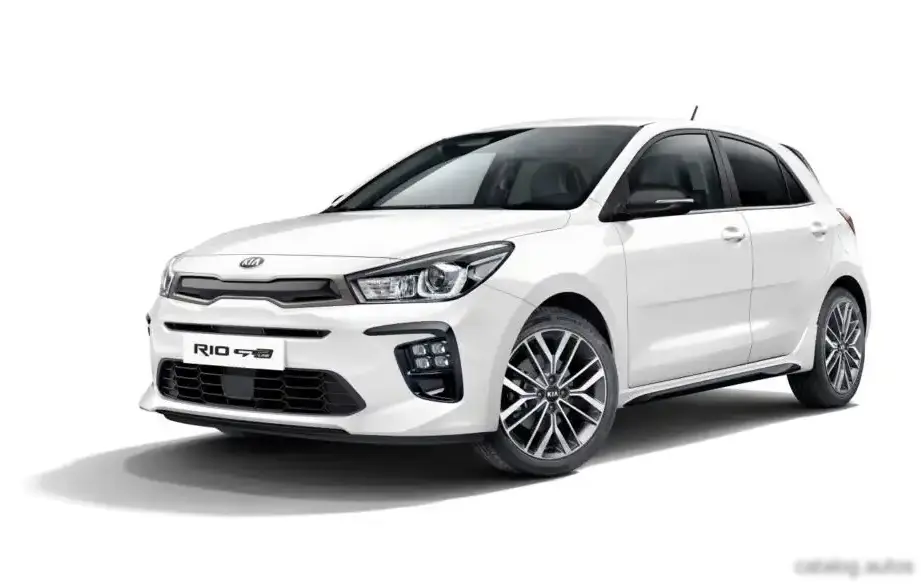
The Kia Rio IV Hatchback (YB) 1.0 T-GDI (120 Hp) DCT, produced from June 2018 to August 2020, represents a significant offering in the subcompact hatchback segment. Positioned as a mid-range trim within the fourth generation Rio (YB) lineup, this variant aimed to balance fuel efficiency with a reasonable level of performance. It was primarily marketed towards buyers seeking a modern, well-equipped, and economical vehicle for urban commuting and everyday use, particularly in European and Asian markets where smaller cars are highly favored. The YB Rio represented a substantial step forward in terms of design, technology, and refinement compared to its predecessors, and the 1.0 T-GDI DCT model was a key component of that evolution.
Technical Specifications
| Brand | Kia |
| Model | Rio |
| Generation | Rio IV Hatchback (YB) |
| Type (Engine) | 1.0 T-GDI (120 Hp) DCT |
| Start of production | June, 2018 |
| End of production | August, 2020 |
| Powertrain Architecture | Internal Combustion engine |
| Body type | Hatchback |
| Seats | 5 |
| Doors | 5 |
| CO2 emissions (WLTP) | 139-147 g/km |
| Fuel consumption (urban) | 5.7-6 l/100 km (41.3 – 39.2 US mpg, 49.6 – 47.1 UK mpg, 17.5 – 16.7 km/l) |
| Fuel consumption (extra urban) | 4.7-5 l/100 km (50 – 47 US mpg, 60.1 – 56.5 UK mpg, 21.3 – 20 km/l) |
| Fuel consumption (combined) | 5.1-5.4 l/100 km (46.1 – 43.6 US mpg, 55.4 – 52.3 UK mpg, 19.6 – 18.5 km/l) |
| CO2 emissions (NEDC) | 117-124 g/km |
| Fuel Type | Petrol (Gasoline) |
| Acceleration 0 – 100 km/h | 10.5 sec |
| Acceleration 0 – 62 mph | 10.5 sec |
| Acceleration 0 – 60 mph | 10 sec |
| Maximum speed | 190 km/h (118.06 mph) |
| Emission standard | Euro 6d-TEMP |
| Weight-to-power ratio | 9.3 kg/Hp, 107.1 Hp/tonne |
| Weight-to-torque ratio | 6.5 kg/Nm, 153.6 Nm/tonne |
| Power | 120 Hp @ 6000 rpm |
| Power per litre | 120.2 Hp/l |
| Torque | 172 Nm @ 1500-4000 rpm (126.86 lb.-ft. @ 1500-4000 rpm) |
| Engine layout | Front, Transverse |
| Engine Model/Code | Kappa II / G3LC |
| Engine displacement | 998 cm3 (60.9 cu. in.) |
| Number of cylinders | 3 |
| Engine configuration | Inline |
| Cylinder Bore | 71 mm (2.8 in.) |
| Piston Stroke | 84 mm (3.31 in.) |
| Compression ratio | 10:1 |
| Number of valves per cylinder | 4 |
| Fuel injection system | Direct injection |
| Engine aspiration | Turbocharger, Intercooler |
| Engine oil capacity | 3.6 l (3.8 US qt | 3.17 UK qt) |
| Coolant capacity | 5.5 l (5.81 US qt | 4.84 UK qt) |
| Kerb Weight | 1120-1220 kg (2469.18 – 2689.64 lbs.) |
| Max. weight | 1650 kg (3637.63 lbs.) |
| Max load | 430-530 kg (947.99 – 1168.45 lbs.) |
| Trunk (boot) space – minimum | 325 l (11.48 cu. ft.) |
| Trunk (boot) space – maximum | 1103 l (38.95 cu. ft.) |
| Fuel tank capacity | 45 l (11.89 US gal | 9.9 UK gal) |
| Max. roof load | 70 kg (154.32 lbs.) |
| Permitted trailer load (braked) | 1110 kg (2447.13 lbs.) |
| Permitted trailer load (unbraked) | 450 kg (992.08 lbs.) |
| Permitted towbar download | 75 kg (165.35 lbs.) |
| Length | 4065 mm (160.04 in.) |
| Width | 1725 mm (67.91 in.) |
| Width including mirrors | 1990 mm (78.35 in.) |
| Height | 1450 mm (57.09 in.) |
| Wheelbase | 2580 mm (101.57 in.) |
| Front track | 1512-1518 mm (59.53 – 59.76 in.) |
| Rear track | 1518-1524 mm (59.76 – 60 in.) |
| Front overhang | 830 mm (32.68 in.) |
| Rear overhang | 655 mm (25.79 in.) |
| Turning circle | 10.2 m (33.46 ft.) |
| Drivetrain | Front wheel drive |
| Gearbox | 7 gears, automatic transmission DCT |
| Front suspension | Independent, McPherson with coil spring and anti-roll bar |
| Rear suspension | Coil spring, Torsion |
| Front brakes | Ventilated discs, 280 mm |
| Rear brakes | Disc, 203-262 mm |
| Tires size | 185/65 R15 88H; 195/55 R16 87H; 205/45 R17 88V |
| Wheel rims size | 6.0J x 15; 6.0J x 16; 6.5J x 17 |
Powertrain & Engine Architecture
The heart of this Rio variant is the Kappa II 1.0 T-GDI engine, designated G3LC. This is a three-cylinder, inline gasoline engine featuring direct fuel injection and a single turbocharger with an intercooler. The engine produces 120 horsepower at 6000 rpm and 172 Nm (126.86 lb.-ft.) of torque between 1500 and 4000 rpm. The direct injection system allows for precise fuel delivery, contributing to both efficiency and performance. The turbocharger helps to overcome the inherent limitations of a small-displacement engine, providing a noticeable boost in power. Paired with the engine is a 7-speed Dual Clutch Transmission (DCT). This DCT offers quicker and smoother gear changes compared to a traditional automatic transmission, enhancing the driving experience and contributing to improved fuel economy. The DCT’s programming prioritizes efficiency, with taller gear ratios designed for highway cruising.
Driving Characteristics
The 1.0 T-GDI with the DCT delivers a surprisingly refined driving experience for a subcompact. While not overtly sporty, the engine provides adequate acceleration for everyday driving situations. The DCT transmission is responsive, and the turbocharger minimizes turbo lag. Acceleration from 0 to 100 km/h (0-62 mph) takes approximately 10.5 seconds. Compared to the base 1.25L naturally aspirated engine, the 1.0 T-GDI offers a significant performance upgrade. However, it doesn’t match the responsiveness of higher-powered engines available in other Rio trims. The DCT’s gear ratios are tuned for fuel efficiency, meaning it may require more frequent downshifts when overtaking or climbing hills. The overall feel is one of comfortable and economical transportation.
Equipment & Trim Levels
The 1.0 T-GDI DCT trim typically included a good level of standard equipment. This often included air conditioning, a touchscreen infotainment system with Apple CarPlay and Android Auto compatibility, Bluetooth connectivity, power windows and locks, and alloy wheels. Safety features such as ABS, Electronic Stability Control (ESC), and multiple airbags were also standard. Optional extras could include a rear-view camera, parking sensors, a larger touchscreen display, and a premium sound system. Interior upholstery was typically cloth, with a focus on durability and practicality. The dashboard layout was modern and functional, with a clear instrument cluster and intuitive controls.
Chassis & Braking
The Rio IV utilizes a front-wheel-drive platform with an independent McPherson strut suspension in the front and a torsion beam suspension in the rear. This setup provides a good balance between ride comfort and handling. The front brakes are ventilated discs, while the rear brakes are discs, providing adequate stopping power for the vehicle’s weight and performance. The electric power steering offers light and precise steering feel, making it easy to maneuver in urban environments. Stabilizer bars are included both front and rear to reduce body roll during cornering.
Market Reception & Comparison
The 1.0 T-GDI DCT Rio was generally well-received by automotive critics. It was praised for its fuel efficiency, refined engine, and well-equipped interior. However, some reviewers noted that the engine could feel strained at higher speeds or when fully loaded. Compared to the base 1.25L engine, the 1.0 T-GDI offered a significant improvement in performance and driving enjoyment. Compared to diesel variants, the 1.0 T-GDI offered a more refined driving experience, albeit with slightly higher running costs. Fuel economy figures of 5.1-5.4 l/100 km (46.1 – 43.6 US mpg) were competitive within the subcompact segment.
Legacy
The Kappa II 1.0 T-GDI engine has proven to be a relatively reliable powertrain, although some owners have reported issues with the turbocharger and direct injection system. Regular maintenance, including oil changes and fuel system cleaning, is crucial for ensuring long-term reliability. On the used car market, the 1.0 T-GDI DCT Rio represents a good value proposition, offering a modern and well-equipped vehicle at an affordable price. Its fuel efficiency and relatively low running costs make it an attractive option for budget-conscious buyers. The YB Rio, in general, marked a turning point for Kia, solidifying its reputation for producing high-quality and reliable vehicles.